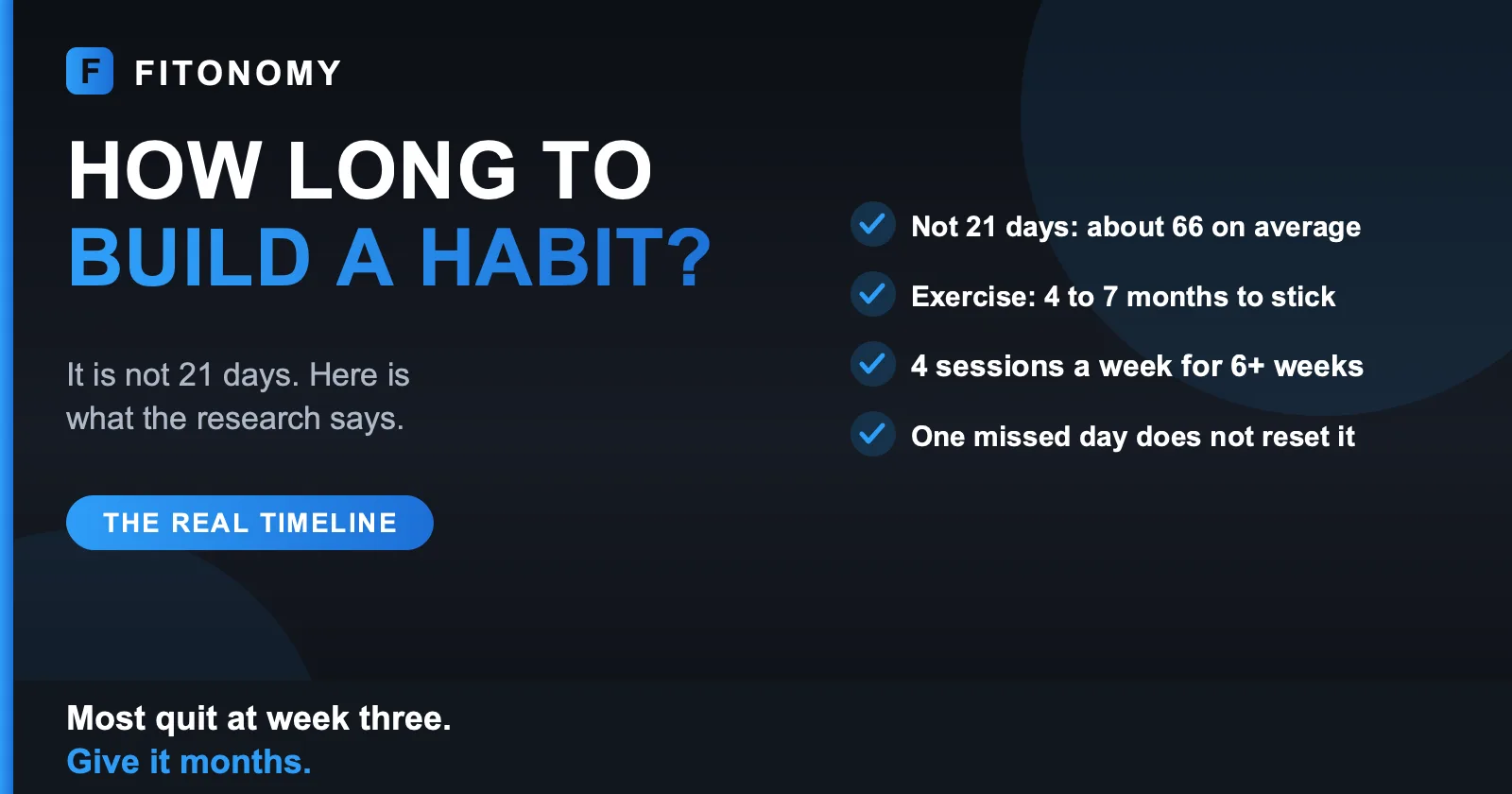
There is no magic deadline
A habit is a behaviour that becomes more automatic through repetition in a consistent context. The familiar claim that every habit forms in twenty one days is not supported by habit formation research. A calendar can help you remember, but it cannot promise the day a behaviour will feel automatic.
What the sixty six day result means
A study of ninety six adults modelled daily automaticity over twelve weeks. Among participants whose data fitted the model, the estimated time to reach ninety five percent of their personal automaticity limit ranged from eighteen to two hundred fifty four days. Sixty six days was the median estimate, not an average guarantee for everyone.
What the newer review adds
A systematic review published in 2024 found that only four included studies reported a specific time to habit formation. Reported medians ranged from fifty nine to sixty six days and means from one hundred six to one hundred fifty four days, with substantial personal variation. The studies used different behaviours and methods, and many had a high risk of bias. The result supports patience, not a personal countdown.
Make the behaviour easier to repeat
Choose one clear action and attach it to a context you regularly encounter. Prepare what you need, keep the first version manageable and record whether you did it. Self chosen actions and stable cues may help, but no time of day works best for every person.
Exercise does not have one required formula
An exercise habit may involve more planning, effort and changing conditions than a small daily action. Research on particular gym groups cannot establish that everyone needs the same weekly frequency or number of weeks. Choose a schedule that fits your health, experience and recovery, then make it repeatable.
A missed opportunity is information
In the original study, missing one opportunity did not materially affect the habit formation process. That does not prove that every pattern of missed sessions is harmless. Resume at the next sensible opportunity and look for a practical obstacle you can change.
Use Fitonomy as a record and cue
A weekly plan, workout reminders and honest logging can make the next action clearer and show what you completed. These tools support organisation. They do not guarantee automaticity or replace individual medical advice.
Give the process room
Measure whether the behaviour is becoming easier to start and repeat. Keep the context clear, adapt the action when life changes and judge progress over a meaningful period. A longer timeline is normal variation, not proof of failure.
Related Fitonomy guide: How to Follow a Weekly Workout Plan in Fitonomy.
Sources reviewed: Lally and colleagues and Singh and colleagues.