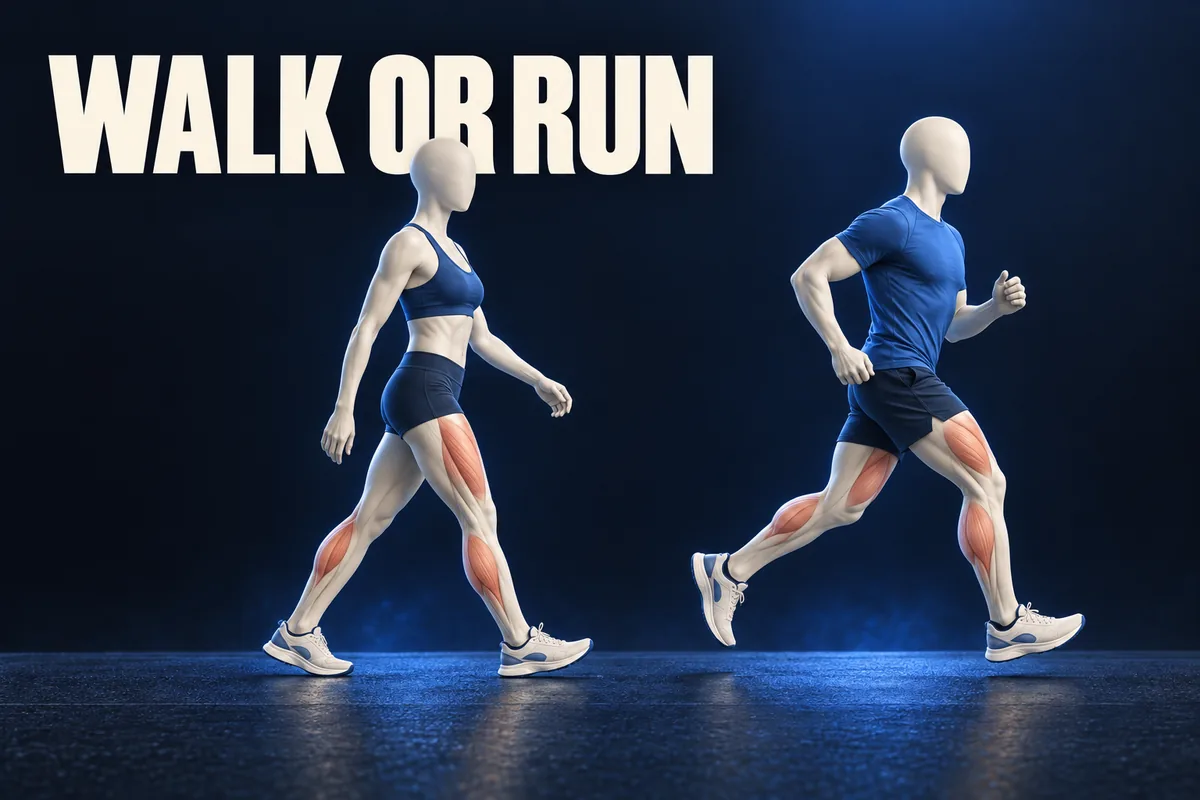
Walking and running can both belong in an activity plan after 30. Running often uses more energy per minute at familiar exercise paces, while walking may fit your schedule, preferences and current ability better. Neither guarantees fat loss, and turning 30 does not create a single best choice.
Choose by the time you can repeat, the effort you can manage and how your body responds. The evidence helps explain the tradeoffs, but it cannot predict your personal weight change or decide how to manage a painful knee.
Compare energy use fairly
Ask whether a comparison holds time, distance or speed constant. Those are different questions. In Hall and colleagues' laboratory study, 24 participants used more energy running than walking the same 1600 metre distance at the tested paces. The run also took less time. That result does not supply a fixed calorie figure for every reader or prove that a thirty minute run always exceeds a sixty minute walk.
An experiment by Wilkin and colleagues measured walking, running and the recovery period in 30 mostly young adults. Energy expenditure returned to resting values about ten minutes after walking and fifteen minutes after running. The finding concerns a particular short laboratory session, not a promise of hours of extra calorie burning or a predicted amount of fat loss.
For your own comparison, keep the duration and pace explicit. Treat a wearable calorie estimate as an estimate, rather than a meal allowance or a guaranteed outcome.
What the longer weight study can tell us
Williams' prospective study followed 15,237 walkers and 32,216 runners for about six years. Changes in reported activity were associated with changes in body mass index. The association was stronger for running in men and in heavier women.
Participants chose their activities; they were not randomly assigned. The groups differed at the start, and detailed diet, sleep and sedentary behaviour were not collected. The study also could not establish whether activity change preceded weight change. It cannot promise that adding a daily run will make you lose a particular number of pounds, or establish a universal running advantage for everyone over 30.
For practical planning, choose activity alongside an appropriate eating pattern and your other needs. Our calorie deficit guide explains why a fixed calorie rule cannot predict everyone's outcome.
Age matters without a birthday cutoff
The review by Volpi and colleagues describes muscle changes with ageing and the roles of physical activity, nutrition and other factors. Population estimates of muscle loss across decades are not a diagnosis or a forecast for an individual at 30. They do not establish that your recovery suddenly slows, your hormones require a particular cardio choice, or ordinary aerobic exercise inevitably causes muscle loss.
Keep strengthening activity in your plan as well as aerobic activity. The CDC adult activity guidance recommends working the major muscle groups on at least two days a week. This is general health guidance, not a guarantee that two sessions reverse every age related change.
Fast walking research is not an incline prescription
In Makino and colleagues' 2022 experiment, 34 university students walked and ran at increasing treadmill speeds. Walking used more energy at speeds close to each participant's maximum walking speed. The comparison was at equivalent speeds, not between ordinary walking and a faster run.
Greiwe and Kohrt's earlier experiment involved 15 healthy, physically active young women. Walking at very high tested speeds could equal or exceed jogging's energy cost at the same speed, and it felt more demanding.
These acute experiments do not establish that fast walking or a steep treadmill incline provides the same long term fat loss as running. They do not test a fixed incline routine as advice for painful knees. You do not need to chase a maximum walking speed to make walking worthwhile.
If you choose a treadmill, use settings you can manage safely and change gradually. Do not respond to knee pain by increasing speed or gradient. Start with a comfortable option and seek individual guidance for an injury, persistent symptoms or an existing joint condition.
The knee question needs context
The 2017 review by Alentorn Geli and colleagues found lower pooled osteoarthritis prevalence among recreational runners than among competitive runners or nonrunning controls. The authors could not determine whether those associations were causal or affected by factors such as previous injury. Prevalence is not an individual's future risk, and the result does not prove running protects everyone's knees.
The review by Timmins and colleagues found mixed evidence. Although some included studies associated running with lower odds of knee surgery, the authors concluded that the available evidence could not determine running's role in knee osteoarthritis. That is different from saying the question is settled.
The cartilage review by Coburn and colleagues found small, apparently transient knee cartilage changes after running, with very low certainty evidence. It studied changes around a running bout, not lifelong safety for every knee or a treatment for an injured joint.
None of these findings establishes a safe weekly mileage boundary or a body mass index cutoff at which everyone should switch from running to walking. Your symptoms, prior injury, current conditioning and clinical advice matter.
The CDC arthritis guidance recommends starting slowly, paying attention to symptoms and choosing accessible activities that cause little or no pain. Stop the session if pain becomes sharp, worsens or changes how you walk. Seek medical advice for severe or persistent symptoms, swelling or an existing restriction. Walking can also need adaptation; it is not automatically suitable at any speed or slope.
Weekly activity is not a universal fat loss threshold
An older review by Ohkawara and colleagues suggested a weekly exercise dose for visceral fat reduction in people with obesity without metabolic disorders. Its dose relationship was not significant across all the included groups. That does not establish a threshold below which nobody benefits, or show that walking and running produce identical outcomes once a number is reached.
A 2024 analysis of 116 randomized trials found that more supervised aerobic exercise was generally associated with greater reductions in weight, waist circumference and body fat measures in adults with overweight or obesity. Trials lasted at least eight weeks. Differences between studies and limited dietary information restrict individual predictions. These results support regular activity, not a guaranteed personal result or a specific walking versus running winner.
For general health, the CDC recommends at least 150 minutes of moderate aerobic activity or 75 minutes of vigorous activity each week, or an equivalent combination, alongside strengthening. Some activity is better than none. If you are starting from little activity, build from what you can manage rather than forcing the whole target immediately.
Choose a plan you can repeat
If walking fits your day, begin with a familiar route and a manageable duration. Use our walking pace guide to understand the rough talk test cue for effort. It does not require matching someone else's speed.
If running interests you and is appropriate for you, use a manageable effort and a gradual start rather than selecting it for a promised fastest result. Alternating walking with brief running periods can be a way to organize a session, with the balance adapted to your ability. Choose walking throughout if that is more comfortable.
Neither activity has a universal adherence advantage. Consider travel time, changing clothes, daylight, access and enjoyment. Reserve a realistic time, then record what you did and how it felt. Review whether you can repeat it before adding more.
An adaptable sample week
This is a planning example, not a minimum dose, rehabilitation programme or promised fat loss routine. Shorten, replace or omit sessions according to your starting point and any individual advice.
- Monday: a comfortable walk on a familiar route.
- Tuesday: strengthening appropriate to your experience.
- Wednesday: another walk, or a manageable mix of walking and running if suitable.
- Thursday: rest or light activity according to how you feel.
- Friday: a second strengthening session if appropriate.
- Saturday: repeat an activity you enjoyed, with a duration you can manage.
- Sunday: review your week and choose the next realistic sessions.
Include aerobic activity and strengthening in ways you can sustain. Adjust the example over time toward applicable health guidance. You do not need a steep incline, a maximum pace or a rigid calendar to begin.
Frequently asked questions
Is walking enough to lose weight after 30?
Walking can contribute to an activity plan, but weight change is not guaranteed by a walking schedule. There is no single weekly threshold that guarantees fat loss for every person. Consider activity together with eating patterns and individual circumstances.
Is running bad for your knees after 30?
The research does not support a simple answer for every knee. Recreational running has been associated with lower osteoarthritis prevalence in some studies, but that does not prove protection. Existing pain or injury requires individual consideration rather than relying on your age alone.
Walking one hour versus running thirty minutes: which uses more energy?
There is no fixed winner without specifying pace, body size and other conditions. A comparison of thirty minutes of each activity cannot answer this unequal duration question. Energy used during a session also does not directly predict fat loss over months.
Can fast walking match running's energy cost?
It did at some very high matched speeds in small laboratory experiments. That is not a target everyone should chase, an incline prescription or proof of equal long term weight change. Choose a pace you can manage comfortably.
How many days should I do cardio?
Spread a manageable amount through your week. General adult guidance is framed around weekly moderate or vigorous activity and strengthening, not a mandatory number of cardio days for fat loss. Begin gradually and adapt to your needs.