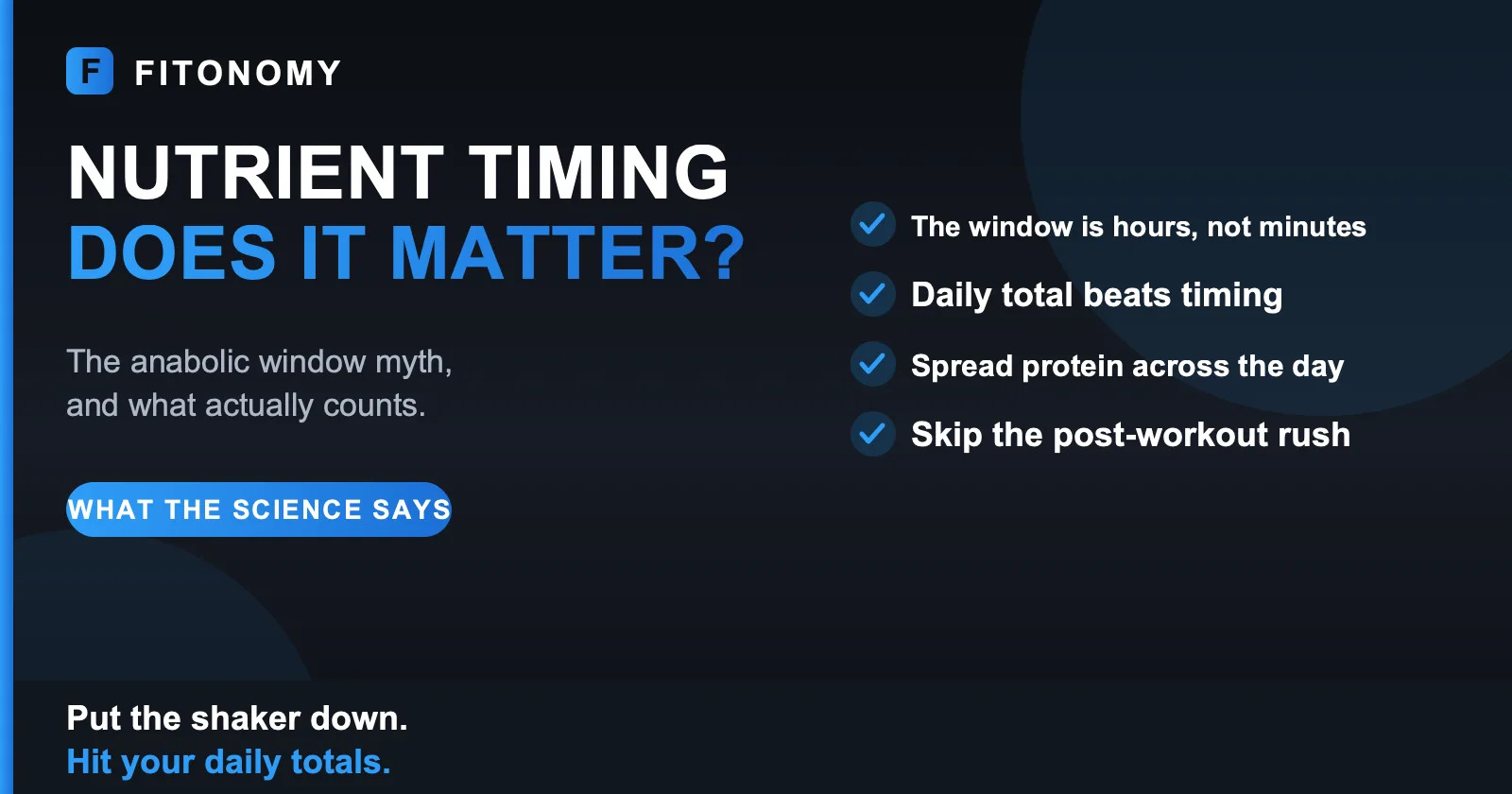
You rack the last weight, and a small voice says the clock is now running. Get protein in within 30 minutes or you have wasted the whole session. This idea, the anabolic window, has sent millions of people sprinting to their shaker before they have even cooled down.
Here is the good news: you can put the shaker down and breathe. The research on nutrient timing is clear and reassuring. When you eat matters far less than how much you eat across the day. There is one timing rule worth following, but it is not the one you have been sold. Here is what actually matters.
The anabolic window is wider than you were told
The "window" was supposed to be a narrow 30 to 60 minutes after training, after which the muscle-building benefit of food supposedly evaporated. A 2013 review by Aragon and Schoenfeld looked hard at this and concluded that the evidence for such a narrow window is far from definitive, and that when you are eating adequate protein, the effect of precise timing is minimal at best.
The ISSN's position stand on nutrient timing (Kerksick and colleagues, 2017) goes further: muscle stays sensitized to protein for at least 24 hours after a resistance session. The 30-minute deadline has no real support for someone training once a day. The window is less a window and more a garage door, open for hours.
Takeaway: The 30-minute anabolic window is largely a myth. Muscle stays primed to use protein for around 24 hours after training, so there is no need to race the clock.
Total daily intake beats timing
If timing is not the lever, what is? The total amount you eat. A 2013 meta-analysis by Schoenfeld, Aragon, and Krieger found a small apparent benefit to post-workout protein, but it vanished once total daily protein intake was accounted for. In other words, the people who seemed to gain from timing were really just eating more protein overall.
This lines up with the bigger picture: total daily protein is the single biggest dietary driver of muscle, more than timing or even source. Hit your daily target (roughly 1.6 grams per kilogram, covered in our guide to how much protein to build muscle) and the exact clock time of each serving barely registers.
Takeaway: Total daily protein is what builds muscle, not the timing of any single meal. Hit your daily target and the post-workout clock stops mattering.
The timing rule that does matter: spread it out
There is one form of timing worth caring about, and it is not about the workout. It is about spacing protein across the day. A 2013 study by Areta and colleagues fed the same total protein in three patterns and measured muscle protein synthesis over 12 hours. Four moderate doses of 20 grams every 3 hours beat both a couple of large doses spaced far apart and many tiny doses too close together, even though the daily total was identical.
The practical version, echoed by the ISSN, is to eat 20 to 40 grams of protein every 3 to 4 hours across the day, roughly 3 to 5 meals. That keeps muscle building switched on repeatedly rather than once. So timing matters as distribution across your whole day, not as a frantic post-workout dose.
Takeaway: The timing that helps is spreading protein into 3 to 5 meals of 20 to 40 grams across the day, not cramming it around your workout.
Eat before or after? Either is fine
Because the window is wide, a meal on either side of training covers you. A 2013 review pointed out that a pre-workout meal still has protein and amino acids circulating during and after your session, which effectively extends the so-called window and makes the post-workout rush even less important. If you ate a normal meal two or three hours before lifting, you are already covered, and there is no urgency to eat the moment you finish.
Training fasted, say first thing in the morning? You have not ruined anything. Just have a protein-containing meal within a few hours afterward and carry on. The day's total is what counts.
Takeaway: A meal before or after training both work. If you ate beforehand, there is no post-workout rush. If you trained fasted, just eat within a few hours after.
What about carbs after a workout?
The other half of the window myth is rushing carbs to refill glycogen. For once-a-day trainees, this barely matters. The ISSN position stand notes a typical lifting session depletes only around 39 percent of muscle glycogen, leaving most of the tank full, and your total daily carbs refill it over the day regardless of timing.
Carb timing only becomes important when you have to recover fast for a second session, under roughly 4 to 8 hours away, like an athlete doing two-a-days. That is a narrow case. For normal training, just eat enough carbs across the day and ignore the stopwatch.
Takeaway: Post-workout carb timing only matters if you train again within a few hours. For once-daily training, total daily carbs are all that count.
Myth versus reality
- Protein within 30 min or it is wasted. What the research shows: Muscle stays protein-sensitive ~24 h after training.
- Timing makes or breaks muscle growth. What the research shows: Timing effect vanishes once total daily protein is equal.
- One big protein dose is enough. What the research shows: Spreading into 3 to 5 moderate doses works better.
- Must slam carbs immediately after. What the research shows: Only matters if training again within ~4 to 8 h.
- Fasted training ruins gains. What the research shows: Fine, just eat within a few hours afterward.
Takeaway: Nearly every urgent timing rule is a myth. The calm version, hit your daily totals and spread your protein, is what the evidence supports.
What to actually do
Keep it simple. Hit your total daily protein (about 1.6 grams per kilogram, more if dieting). Split it across 3 to 5 meals of 20 to 40 grams each. Have protein within a few hours on either side of your workout, whichever fits your schedule. Eat enough total carbs for your energy needs without obsessing over timing. That is the entire evidence-based approach, and it removes a lot of needless stress. Supplements like creatine are similarly daily-total games, not timing games.
Takeaway: Hit your daily protein, spread it across the day, eat around training whenever is convenient, and stop watching the clock.
How Fitonomy helps
The thing that actually moves the needle, your daily protein and meal structure, is exactly what a meal planner is for. Fitonomy's Meal Planner builds your day around a protein and calorie target spread across sensible meals, which is the real version of nutrient timing. Pair that with a solid program and a calorie deficit or surplus to match your goal, and the post-workout stopwatch becomes irrelevant.
The bottom line
Nutrient timing is one of the most overhyped ideas in fitness. The anabolic window is hours wide, not minutes, and the post-workout rush makes almost no difference once your daily protein is handled. The only timing that helps is spreading protein into several moderate meals across the day. So eat enough, spread it out, eat around your workout whenever suits you, and put the shaker down. Your gains were never on a 30-minute timer.
Sources
- Aragon, A.A., Schoenfeld, B.J. (2013). Nutrient timing revisited: is there a post-exercise anabolic window? Journal of the International Society of Sports Nutrition. https://link.springer.com/article/10.1186/1550-2783-10-5
- Schoenfeld, B.J., Aragon, A.A., Krieger, J.W. (2013). The effect of protein timing on muscle strength and hypertrophy: a meta-analysis. Journal of the International Society of Sports Nutrition. https://pmc.ncbi.nlm.nih.gov/articles/PMC3879660/
- Areta, J.L., et al. (2013). Timing and distribution of protein ingestion during prolonged recovery from resistance exercise alters myofibrillar protein synthesis. The Journal of Physiology. https://physoc.onlinelibrary.wiley.com/doi/abs/10.1113/jphysiol.2012.244897
- Kerksick, C.M., et al. (2017). International Society of Sports Nutrition position stand: nutrient timing. Journal of the International Society of Sports Nutrition. https://pmc.ncbi.nlm.nih.gov/articles/PMC5596471/
- Morton, R.W., et al. (2018). A systematic review, meta-analysis and meta-regression of the effect of protein supplementation on resistance training-induced gains in muscle mass and strength in healthy adults. British Journal of Sports Medicine. https://pmc.ncbi.nlm.nih.gov/articles/PMC5867436/
Frequently asked questions
Is the anabolic window real? Not as a narrow 30-minute deadline. Research shows muscle stays sensitized to protein for around 24 hours after resistance training, so the idea that you must eat within half an hour or waste the session is not supported for once-daily lifters. The anabolic window is hours wide, not minutes, so there is no need to rush.
Do I need protein right after a workout? No urgent rush is needed. A 2013 meta-analysis found that the apparent benefit of post-workout protein disappeared once total daily protein intake was accounted for. Having protein within a few hours of training is sensible, but the exact minute does not matter. What matters is hitting your total protein for the day, around 1.6 grams per kilogram of bodyweight.
Does protein timing matter for building muscle? Timing around the workout barely matters once total daily protein is adequate. The timing that does help is distribution: spreading protein into roughly 3 to 5 meals of 20 to 40 grams across the day keeps muscle protein synthesis elevated more than one or two large doses. So think about your whole day, not the post-workout window.
Should I eat before or after working out? Either works. Because the window is wide, a meal on either side of training covers you, and a pre-workout meal keeps amino acids circulating during and after the session, which reduces any post-workout urgency. Pick whichever fits your schedule. If you trained fasted, just eat a protein-containing meal within a few hours afterward.
Do I need carbs immediately after a workout? For most people, no. A typical lifting session depletes only about 39 percent of muscle glycogen, and your total daily carbohydrate intake refills it regardless of timing. Rapid post-workout carbs only matter if you have to train again within roughly 4 to 8 hours, such as an athlete doing two sessions a day. For once-daily training, ignore the stopwatch.
Does training fasted hurt muscle gains? Not if you handle your total daily intake. Training fasted is fine as long as you eat enough protein and calories across the day and have a protein-containing meal within a few hours after your session. The wide anabolic window means a fasted morning workout does not waste your effort, provided the rest of your day is on point.
Use water as the ordinary starting point, then adjust for session length, heat and your own sweat without forcing a universal amount. Workout Hydration Before During and After Exercise
Decide whether a snack is useful, then choose a small familiar food that fits the time before training and your own comfort. Choose a Pre Workout Snack From Ordinary Foods