Caffeine is the most widely used performance booster in all of sport, and the entire pre-workout industry is built on it. But cut through the flashy tubs of powder and one question remains: does caffeine actually make your training better, or does it just make you feel wired?
The answer, unusually for a supplement, is a confident yes. Caffeine is one of only a couple of supplements with truly strong evidence behind it, the other being creatine. Here is exactly what it does for strength and endurance, how much to take and when, and the one catch that can quietly cost you more than the caffeine gives.
Does caffeine actually work?
Yes, and the evidence is deep. A 2020 umbrella review by Grgic and colleagues pulled together 21 separate meta-analyses and concluded that caffeine reliably improves muscle endurance, muscle strength, anaerobic power, and aerobic endurance. A 2024 meta-analysis of meta-analyses reached the same conclusion for strength and endurance. When this many reviews agree, the effect is real.
The benefits are best described as small to moderate, not magic. Caffeine will not add 20 kg to your bench, but it can help you grind out an extra rep, push a little harder, and feel less like quitting, and those small edges add up over months of training.
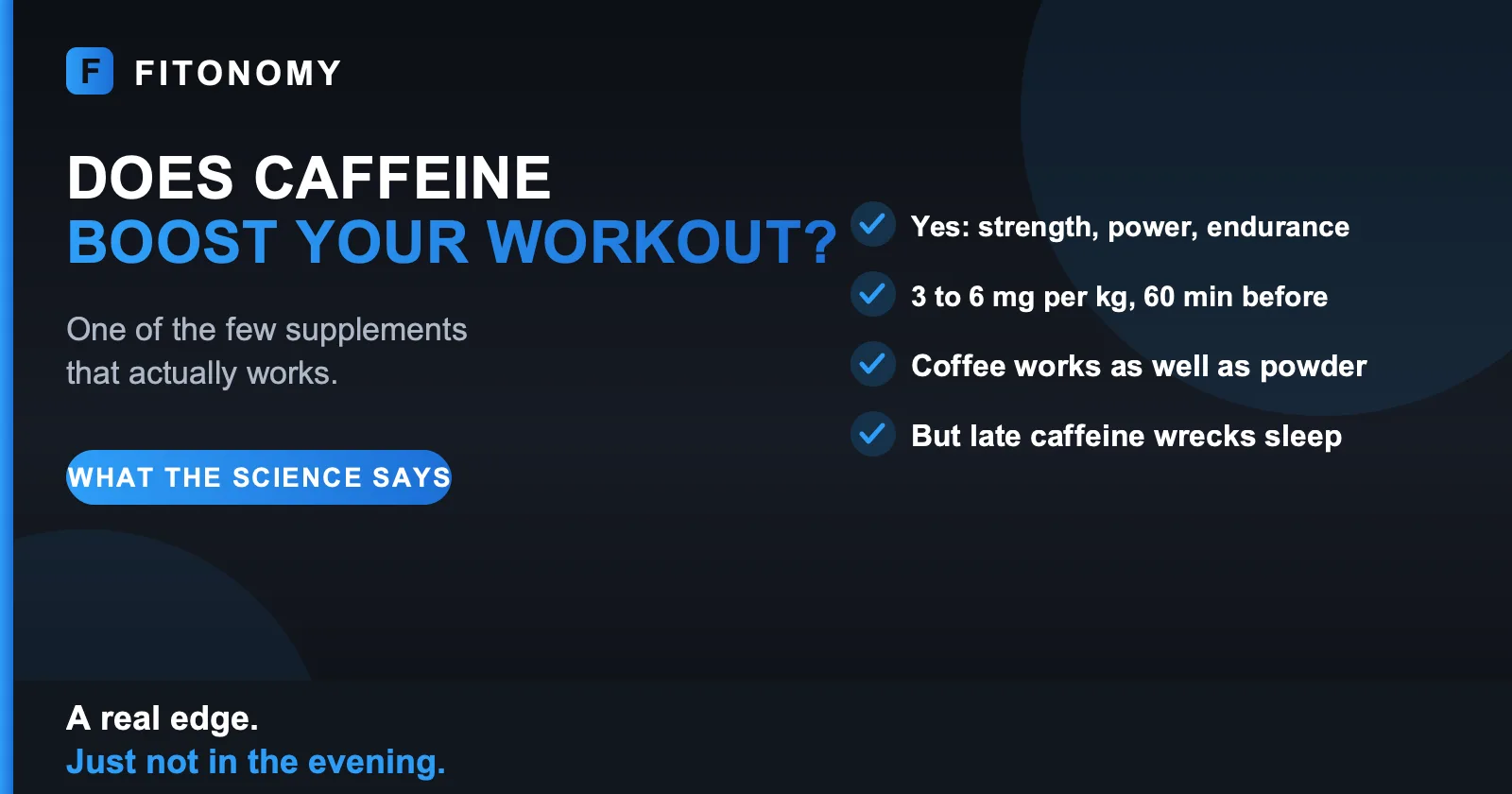
Takeaway: Caffeine genuinely improves strength, power, and endurance. The effect is small to moderate, an edge rather than a transformation, but it is one of the most reliable in all of supplementation.
How much should you take?
The research points to a clear, moderate range. The International Society of Sports Nutrition's position stand (Guest and colleagues, 2021) states that caffeine improves performance at doses of 3 to 6 milligrams per kilogram of bodyweight. For an 80 kg person that is roughly 240 to 480 mg, or about two to three cups of coffee.
More is not better. The ISSN notes that very high doses, around 9 mg/kg, bring a high rate of side effects (jitters, racing heart, anxiety) without adding performance. Start at the low end, around 3 mg/kg, and only nudge up if you tolerate it well.
Takeaway: Take 3 to 6 mg per kg of bodyweight, roughly 200 to 400 mg for most people. Higher doses add side effects, not performance, so start low.
When should you take it?
Timing is simple: about 60 minutes before training is the most studied and effective window, because that is when blood caffeine levels peak. Caffeine in pill or powder form (anhydrous caffeine) absorbs slightly faster and more predictably than coffee, but coffee works fine too. The dose is what matters, not the delivery.
Takeaway: Take caffeine about 60 minutes before your workout. Pills, powder, or coffee all work; consistency of dose matters more than the source.
Strength or endurance: it helps both
For lifting, caffeine offers a small boost to strength and power and, more noticeably, to muscular endurance, meaning more reps before failure. For cardio, the effect is well quantified: a 2018 meta-analysis by Southward and colleagues, covering 46 studies, found caffeine improved endurance time-trial performance by about 2 to 3 percent (reducing completion time by 2.2 percent). A couple of percent sounds tiny, but in endurance events that is a meaningful margin. If you are weighing your conditioning options, our HIIT vs steady-state guide covers the cardio side.
Takeaway: Caffeine helps both lifting (more reps, a bit more force) and endurance (about a 2 to 3 percent boost). It is genuinely versatile across training types.
The catch: caffeine and your sleep
Here is the trade-off almost nobody accounts for. Caffeine has a long half-life, and an evening dose can quietly destroy the sleep that drives your recovery. A 2013 study by Drake and colleagues found that 400 mg of caffeine taken even 6 hours before bed reduced objectively measured sleep by more than an hour. Since sleep is where most of your recovery and muscle building happen (see our guide to sleep and muscle), a late caffeinated workout can cost you more in lost recovery than it gains in performance.
The fix is simple: keep caffeine to morning and early-afternoon training. If you train in the evening, use a much smaller dose or skip the caffeine entirely. The pre-workout that helps your 6 pm session is not worth the sleep it steals at 11 pm.
Takeaway: Caffeine even 6 hours before bed cuts sleep by over an hour. Use it for morning and midday workouts, and go light or caffeine-free for evening sessions to protect recovery.
Individual differences are real
Caffeine does not hit everyone the same. The ISSN notes that genetic variation (in genes like CYP1A2 and ADORA2A) affects how fast you metabolize caffeine and how much you benefit, as well as how likely you are to feel anxious or have your sleep disrupted. Some people are fast metabolizers who barely notice it; others get the shakes from half a cup. Habitual coffee drinkers still get a performance benefit, but the subjective buzz fades with regular use. The practical move is to find the dose that gives you a clean lift in focus and effort without the jitters.
Takeaway: Genetics and habit change how caffeine affects you. Find your personal sweet spot, the dose that sharpens effort without anxiety or sleep problems.
Where to get it
- Coffee. Typical dose: 80 to 120 mg per cup. Notes: Cheap, effective, dose varies by brew.
- Caffeine pills / anhydrous. Typical dose: 100 to 200 mg each. Notes: Precise dosing, fast absorption, cheapest per mg.
- Pre-workout powder. Typical dose: 150 to 300 mg per scoop. Notes: Convenient, but you pay for extra unproven ingredients.
- Energy drinks. Typical dose: 80 to 300 mg per can. Notes: Effective but often loaded with sugar and a high price.
The honest read: a cup of coffee or a cheap caffeine pill delivers the same ergogenic caffeine as a flashy pre-workout, minus the proprietary blend of ingredients with little evidence. Pay for caffeine, not marketing.
Takeaway: Coffee and plain caffeine pills are the cheapest, most evidence-based options. Pre-workout powders work but mostly because of their caffeine, not their extras.
How Fitonomy fits
Caffeine is a small edge on top of a good program, never a substitute for one, the same way creatine is (see our guide to whether creatine works). The foundation is consistent, progressive training, which is what Fitonomy's AI Workout Planner builds and adapts for you. Get the training and recovery right first, then a sensible pre-workout coffee makes a good session a little sharper.
The bottom line
Caffeine is one of the few supplements that genuinely works. Take 3 to 6 mg per kilogram of bodyweight about an hour before training for a small but real boost to strength, power, and endurance. Keep the dose moderate, since more just brings side effects, and respect the one big catch: caffeine late in the day wrecks the sleep your gains depend on, so save it for morning and midday sessions. Used smartly, a simple cup of coffee is one of the cheapest performance upgrades in fitness.
Sources
- Grgic, J., et al. (2020). Wake up and smell the coffee: caffeine supplementation and exercise performance, an umbrella review of 21 published meta-analyses. British Journal of Sports Medicine. https://pubmed.ncbi.nlm.nih.gov/30926628/
- Guest, N.S., et al. (2021). International society of sports nutrition position stand: caffeine and exercise performance. Journal of the International Society of Sports Nutrition. https://pmc.ncbi.nlm.nih.gov/articles/PMC7777221/
- Southward, K., et al. (2018). The Effect of Acute Caffeine Ingestion on Endurance Performance: A Systematic Review and Meta-Analysis. Sports Medicine. https://pubmed.ncbi.nlm.nih.gov/29876876/
- Wu, S., et al. (2024). The effect of caffeine supplementation on muscular strength and endurance: A meta-analysis of meta-analyses. Heliyon. https://pmc.ncbi.nlm.nih.gov/articles/PMC11336343/
- Drake, C., et al. (2013). Caffeine Effects on Sleep Taken 0, 3, or 6 Hours before Going to Bed. Journal of Clinical Sleep Medicine. https://pmc.ncbi.nlm.nih.gov/articles/PMC3805807/
Frequently asked questions
Does caffeine actually improve workout performance? Yes. An umbrella review of 21 meta-analyses concluded that caffeine reliably improves muscle endurance, strength, anaerobic power, and aerobic endurance. The effect is small to moderate, an edge rather than a transformation, but it is one of the most reliable in supplementation. It helps you push a little harder and grind out extra reps, which adds up over time.
How much caffeine should I take before a workout? The research-backed range is 3 to 6 milligrams per kilogram of bodyweight, which is roughly 200 to 400 mg for most people, or about two to three cups of coffee. Higher doses around 9 mg/kg bring more side effects without more performance, so start at the low end and only increase if you tolerate it well.
When should I take caffeine before exercising? About 60 minutes before training, since that is when blood caffeine levels peak. Caffeine pills or powder (anhydrous caffeine) absorb slightly faster and more predictably than coffee, but coffee works well too. The dose matters more than the source, so use whichever form you find convenient and consistent.
Is pre-workout caffeine bad for you? For healthy adults, moderate caffeine use (up to about 400 mg per day) is generally considered safe. The main downsides are side effects at high doses, such as jitters, racing heart, and anxiety, and sleep disruption if taken too late. People who are pregnant or have certain heart or anxiety conditions should be cautious and check with a doctor.
Does coffee work as well as pre-workout powder? Yes. The performance benefit comes from the caffeine, and coffee delivers the same caffeine as a pre-workout powder. Pre-workout products add other ingredients that mostly lack strong evidence, so you are often paying extra for marketing. A cup of coffee or a cheap caffeine pill is just as effective and far cheaper.
Should I avoid caffeine before evening workouts? Largely, yes. Research found that 400 mg of caffeine taken even 6 hours before bed cut measured sleep by over an hour, and sleep is where most recovery happens. For evening training, use a much smaller dose or skip caffeine entirely. The performance boost is not worth the recovery you lose to disrupted sleep.