It is one of the longest-running arguments in fitness. One camp swears by short, brutal interval sessions that leave you on the floor. The other logs long, steady miles at a conversational pace. Both insist theirs is the superior way to burn fat. So which is actually better?
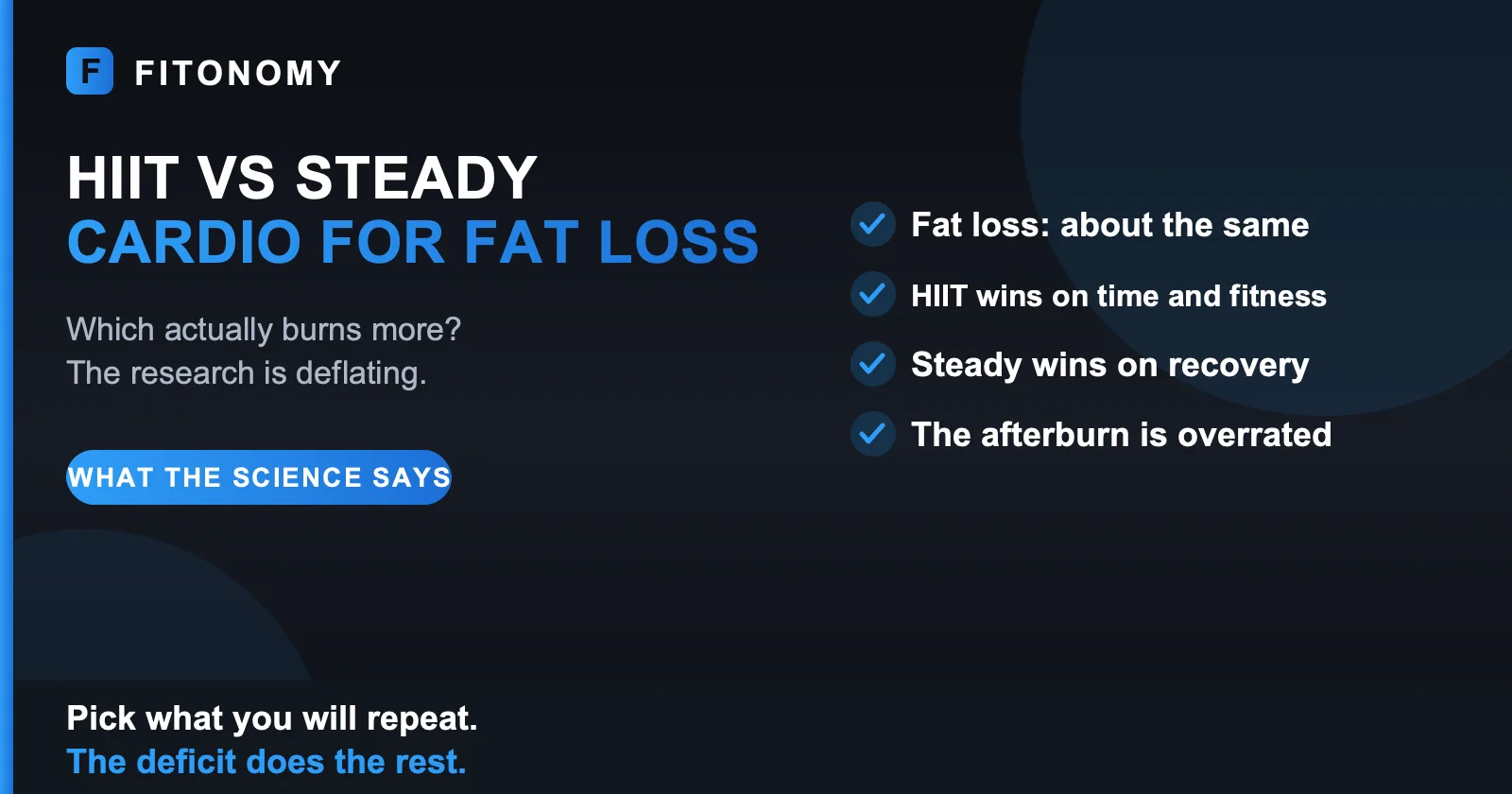
The research has a slightly deflating answer: for fat loss, they are about the same. The bigger differences are in time, fitness, and how hard each is to recover from. Here is what HIIT and steady-state cardio each do best, what the famous afterburn really amounts to, and how to choose.
What each one actually is
High-intensity interval training (HIIT) alternates short bursts of hard effort (think 20 to 60 seconds near all-out) with recovery periods, repeated for 15 to 25 minutes. Steady-state cardio, sometimes called moderate-intensity continuous training, is a sustained effort you can hold for a longer stretch: a 30 to 60 minute jog, brisk walk, bike, or row at a moderate, talk-but-not-sing pace.
One is short and savage. The other is long and steady. The interesting part is how similar their fat-loss results turn out to be.
Takeaway: HIIT is short hard intervals with rest. Steady-state is a sustained moderate effort. Very different to do, surprisingly similar in fat-loss outcome.
For fat loss, they are roughly equal
This is the headline most people do not expect. A 2017 meta-analysis by Wewege and colleagues compared HIIT against steady-state training and found similar reductions in body fat and waist circumference between the two. A separate 2017 review by Keating and colleagues, covering 31 studies, found both produced only modest fat loss and neither clearly beat the other: interval training cut body fat by about 1.26 percent and steady-state by about 1.48 percent, a difference too small to matter.
Notice those numbers are small. That is the honest part nobody markets: cardio of either type, on its own, produces fairly modest fat loss. What actually drives fat loss is the calorie deficit, which is mostly won in the kitchen (see our guide to setting a calorie deficit). Cardio supports the deficit and improves your health; it is not a magic fat incinerator in either form.
Takeaway: HIIT and steady-state produce similar, and fairly modest, fat loss. The deficit drives fat loss; the cardio style you pick barely moves that needle.
The afterburn is overrated
HIIT's biggest selling point is the "afterburn," the idea that you keep torching calories for hours afterward. This is excess post-exercise oxygen consumption, or EPOC, and it is real, but small. A review by LaForgia and colleagues (2006) concluded that optimism about EPOC playing an important role in weight loss is generally unfounded, because the absolute number of extra calories burned simply is not large. Higher intensity does raise EPOC as a percentage, but the total still amounts to a modest bonus, not a metabolic cheat code.
Takeaway: The afterburn is real but minor. Do not pick HIIT expecting hours of bonus fat burning, because the extra calories are small.
Where HIIT genuinely wins: time and fitness
HIIT has two clear, research-backed advantages. The first is time. Wewege found HIIT achieved its similar fat-loss results in about 40 percent less training time than steady-state. If your schedule is tight, that is a real edge. A 2018 meta-analysis by Maillard and colleagues agreed, calling HIIT a time-efficient way to reduce total, abdominal, and even visceral fat.
The second is cardiovascular fitness. Milanovic and colleagues (2015) found HIIT improved VO2max (a key marker of cardio fitness and longevity) by 4.9 mL/kg/min versus 1.9 for steady-state, more than double the gain. For raising your fitness ceiling in less time, HIIT is the stronger tool.
Takeaway: HIIT wins on efficiency (similar fat loss in about 40 percent less time) and on cardio fitness (bigger VO2max gains). If time or fitness is the priority, lean HIIT.
Where steady-state wins: sustainability and recovery
Steady-state is gentler. It is lower impact, far less taxing to recover from, and easy to do often, even daily, without wrecking your legs or your next strength session. HIIT is demanding: it generates more fatigue and soreness, competes with your lifting for recovery, and most people can only handle two or three quality sessions a week (the same recovery logic as in our muscle soreness guide). Steady-state is also simply more pleasant for many people, which matters because the best cardio is the one you keep doing. If you are weighing specific steady-state options, our walking vs running guide breaks those down.
Takeaway: Steady-state is lower impact, easier to recover from, and more sustainable day to day. It also spares your strength training, which HIIT can interfere with.
HIIT vs steady-state at a glance
- Fat loss. HIIT: Modest (similar to steady). Steady-state: Modest (similar to HIIT).
- Time needed. HIIT: Less (about 40 percent less). Steady-state: More.
- VO2max / fitness. HIIT: Bigger gains. Steady-state: Smaller gains.
- Joint impact. HIIT: Higher. Steady-state: Lower.
- Recovery cost. HIIT: High (competes with lifting). Steady-state: Low.
- Best for. HIIT: Time-crunched, fitness gains. Steady-state: Daily volume, sustainability, joint-friendly.
Takeaway: Neither wins outright. HIIT is the efficient, fitness-boosting option; steady-state is the sustainable, recovery-friendly one. Match the tool to your goal and schedule.
So which should you do?
The best cardio for fat loss is the one you will actually do consistently while in a calorie deficit. For most people the smartest answer is both: a couple of short HIIT sessions a week for efficiency and fitness, plus easy steady-state (like brisk walking) on other days for extra movement that does not hurt your recovery. If you only have 20 minutes, do HIIT. If you want something you can do daily without burning out, do steady-state. If you lift, prioritize protecting your strength sessions and use steady-state as the bulk of your cardio.
Takeaway: Do both. HIIT for efficiency, steady-state for sustainable volume, all on top of a calorie deficit. Consistency beats picking the theoretically perfect style.
How Fitonomy fits
The practical problem is fitting cardio around lifting, work, and life. Fitonomy's AI Workout Planner schedules cardio and strength together based on your available days and goal, so you get the right dose of each without guesswork or overlapping a brutal HIIT day onto a heavy leg day. Pair that structure with a sensible deficit and you have the whole fat-loss system, not just an isolated cardio choice.
The bottom line
HIIT and steady-state cardio burn about the same amount of fat, and both burn less than the fitness industry implies, because the calorie deficit is what really drives fat loss. The afterburn is overrated. HIIT wins on time efficiency and cardio fitness; steady-state wins on sustainability and recovery. So stop agonizing over which is superior, pick the one (or the mix) you will do four times a week, keep your deficit in place, and protect your strength training. That is the cardio plan that actually works.
Sources
- Wewege, M., et al. (2017). The effects of high-intensity interval training vs. moderate-intensity continuous training on body composition in overweight and obese adults: a systematic review and meta-analysis. Obesity Reviews. https://onlinelibrary.wiley.com/doi/abs/10.1111/obr.12532
- Keating, S.E., et al. (2017). A systematic review and meta-analysis of interval training versus moderate-intensity continuous training on body adiposity. Obesity Reviews. https://pubmed.ncbi.nlm.nih.gov/28513103/
- Maillard, F., et al. (2018). Effect of High-Intensity Interval Training on Total, Abdominal and Visceral Fat Mass: A Meta-Analysis. Sports Medicine. https://link.springer.com/article/10.1007/s40279-017-0807-y
- Milanovic, Z., et al. (2015). Effectiveness of High-Intensity Interval Training and Continuous Endurance Training for VO2max Improvements: A Systematic Review and Meta-Analysis. Sports Medicine. https://pubmed.ncbi.nlm.nih.gov/26243014/
- LaForgia, J., et al. (2006). Effects of exercise intensity and duration on the excess post-exercise oxygen consumption. Journal of Sports Sciences. https://pubmed.ncbi.nlm.nih.gov/17101527/
Frequently asked questions
Is HIIT or steady-state cardio better for fat loss? For fat loss they are about equal. Meta-analyses found HIIT and steady-state cardio produce similar, and fairly modest, reductions in body fat. The difference between them is too small to matter for fat loss. What actually drives fat loss is a calorie deficit, so the better choice is whichever style you will do consistently while eating in a deficit.
Does HIIT burn more fat than steady-state cardio? Not meaningfully more. Research shows HIIT and steady-state produce similar fat loss overall. HIIT's advantage is that it achieves that similar result in roughly 40 percent less time, not that it burns dramatically more fat. If your goal is maximum fat loss, the calorie deficit matters far more than which cardio style you pick.
Is the afterburn effect from HIIT real? It is real but small. Excess post-exercise oxygen consumption (EPOC) means you burn slightly more calories after hard exercise, and HIIT produces more of it than steady-state. But a review concluded that the calories involved are modest and that hopes for EPOC driving weight loss are generally unfounded. It is a minor bonus, not a metabolic shortcut.
How often should I do HIIT? Two to three quality HIIT sessions per week is plenty for most people. HIIT is demanding and generates fatigue that competes with your strength training and needs recovery. Doing it more often tends to backfire. A common approach is two short HIIT sessions plus easy steady-state cardio (like brisk walking) on other days, which adds movement without the recovery cost.
Is HIIT better than running? It depends on your goal. HIIT improves cardio fitness (VO2max) more than steady running and takes less time, while steady running is lower stress, easier to do often, and more sustainable. For fat loss the two are similar. Many people do best mixing both: short HIIT for efficiency and fitness, and steady runs or walks for sustainable volume.
Can I lose fat with cardio alone? Only modestly. Studies show cardio of either type, by itself, produces fairly small fat loss, on the order of 1 to 1.5 percent body fat over a program. Fat loss is driven mainly by a calorie deficit. Cardio supports that deficit and benefits your health and fitness, but pairing it with a controlled diet, and ideally resistance training, is what produces real results.