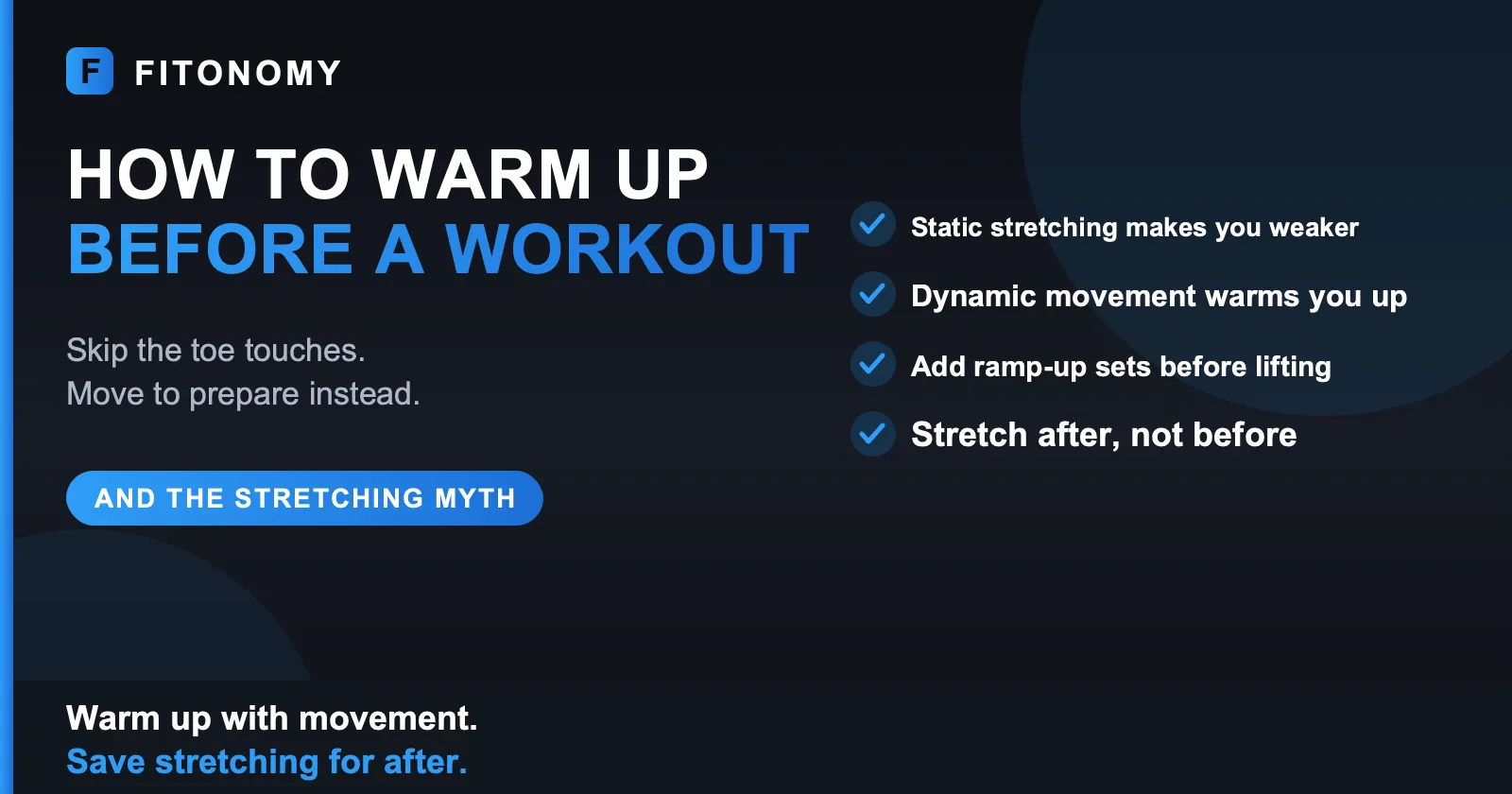
Most people get the warm up wrong in one of two ways. They skip it entirely and dive straight into heavy sets, or they do exactly what they were taught in school: sit down and hold long static stretches, touching their toes before they train. It turns out that second option can actively make you weaker for the session ahead.
A good warm up is worth the ten minutes, but it is not stretching. Here is what a warm up should actually be, why dynamic movement beats holding stretches, and what really reduces your injury risk.
Does warming up even matter?
Yes, and not just as injury insurance. A 2010 systematic review by Fradkin and colleagues, covering 32 high quality studies, found that warming up improved performance in 79 percent of the measures examined, with little evidence that it ever hurts. A proper warm up raises muscle temperature, gets blood flowing, increases your usable range of motion, and primes your nervous system, so your first working set is a real one, not a groggy throwaway.
Takeaway: Warming up improves performance in the large majority of cases and rarely hurts. It primes your muscles, joints, and nervous system so you train better from the first set.
The static stretching mistake
Here is the myth to drop: holding long static stretches before training does not prepare you, it temporarily weakens you. A 2013 meta analysis by Simic and colleagues, pooling 104 studies, found that pre exercise static stretching reduced strength by 5.4 percent, explosive performance by 2 percent, and power by around 2 percent. Those are meaningful losses if you are about to lift heavy or sprint.
The duration matters. A 2016 systematic review by Behm and colleagues found the performance hit grew with longer holds: static stretches of 60 seconds or more per muscle caused a 4.6 percent deficit, versus just 1.1 percent for shorter holds. So the long, held stretches people do before lifting are exactly the wrong dose at exactly the wrong time.
Takeaway: Long static stretches before training reduce strength (about 5 percent) and power. The longer you hold, the bigger the hit. Do not do them right before lifting or sprinting.
Dynamic beats static for warming up
The fix is to warm up with movement instead of holding still. In the same Behm review, dynamic stretching produced a small performance boost of about 1.3 percent, compared with a 3.7 percent drop from static stretching. Dynamic movements, such as leg swings, walking lunges, arm circles, and bodyweight squats, raise your temperature and open your range of motion while priming the exact patterns you are about to train, without the strength loss.
Takeaway: Warm up with dynamic movement, not static holds. Dynamic stretching slightly improves performance while static stretching reduces it. Move to warm up, do not sit and stretch.
Does stretching prevent injury?
This is the other half of the myth. Static stretching is widely believed to prevent injury, but the evidence does not support it. The Behm review found static stretching had no clear effect on injury rates. What does reduce injury is a proper warm up and, especially, strength training itself: a 2014 meta analysis by Lauersen and colleagues, covering more than 26,000 people, found that strength training reduced sports injuries to less than a third and overuse injuries by nearly half. And if you were stretching to ease muscle soreness, that does not work either, as we covered in our muscle soreness guide.
Takeaway: Static stretching does not clearly prevent injury or soreness. A proper warm up and, above all, regular strength training are what actually lower your injury risk.
What a good warm up looks like
Keep it simple and about ten minutes. Three steps.
1. General warm up: 5 minutes of easy cardio (walking, cycling, or an easy row) to raise your temperature and heart rate.
2. Dynamic mobility: a few minutes of movement for the areas you will train, such as leg swings, hip openers, arm circles, and bodyweight squats or lunges.
3. Specific warm up: for lifting, do a couple of lighter ramp up sets of the exercise before your working weight. This is the most underrated part, since it rehearses the exact movement and load. Before intervals, ease into the intensity rather than sprinting cold (see HIIT vs steady state).
New to this? Our first gym workout and strength training after 30 guides show how the warm up fits into a full session.
Takeaway: Warm up in about 10 minutes: 5 minutes easy cardio, a few minutes of dynamic mobility, then lighter ramp up sets of your first exercise. The ramp up sets matter most for lifting.
So where does static stretching belong?
Static stretching is not useless, it is just misplaced. If your goal is flexibility, it works, but its range of motion benefits are best pursued after your workout or on separate days, not in the minutes before you train. Used then, it improves flexibility without stealing strength from your session.
Takeaway: Save static stretching for after training or dedicated flexibility sessions. It builds range of motion fine, just not right before you lift.
Warm up methods compared
- Static stretching. Effect on performance: Reduces strength ~5 percent. Purpose: Flexibility, range of motion. When to use: After training or separate sessions.
- Dynamic stretching. Effect on performance: Slight boost (~1 percent). Purpose: Warm up, prime movement patterns. When to use: Before training.
- Light cardio. Effect on performance: Positive (raises temperature). Purpose: Raise heart rate and warmth. When to use: Start of warm up.
- Ramp up sets. Effect on performance: Positive (movement specific). Purpose: Rehearse the exact lift. When to use: Just before working sets.
Takeaway: Use light cardio, dynamic stretching, and ramp up sets before training. Reserve static stretching for afterward. Match the tool to the timing.
How Fitonomy helps
A good session is built, not improvised, and that includes how you start it. Fitonomy's AI Workout Planner structures your training so you know exactly what to do, warm up through working sets, instead of walking in cold or wasting ten minutes on the wrong stretches. Prepared properly, every session starts stronger and safer.
The bottom line
Warming up is worth it, but stretching is not the way to do it. Long static stretches before training measurably reduce your strength and do not prevent injury or soreness. Instead, spend about ten minutes on easy cardio, dynamic mobility, and a few ramp up sets, then get to work. Save the static stretching for after your session if flexibility is a goal. Warm up with movement, lift strong, and let regular training, not toe touches, be what keeps you healthy.
Sources
- Fradkin, A.J., Zazryn, T.R., Smoliga, J.M. (2010). Effects of Warming up on Physical Performance: A Systematic Review With Meta analysis. Journal of Strength and Conditioning Research. Read source
- Simic, L., Sarabon, N., Markovic, G. (2013). Does pre exercise static stretching inhibit maximal muscular performance? A meta analytical review. Scandinavian Journal of Medicine & Science in Sports. Read source
- Behm, D.G., Blazevich, A.J., Kay, A.D., McHugh, M. (2016). Acute effects of muscle stretching on physical performance, range of motion, and injury incidence in healthy active individuals: a systematic review. Applied Physiology, Nutrition, and Metabolism. Read source
- Lauersen, J.B., Bertelsen, D.M., Andersen, L.B. (2014). The effectiveness of exercise interventions to prevent sports injuries: a systematic review and meta analysis of randomised controlled trials. British Journal of Sports Medicine. Read source
- Herbert, R.D., de Noronha, M., Kamper, S.J. (2011). Stretching to prevent or reduce muscle soreness after exercise. Cochrane Database of Systematic Reviews. Read source
Frequently asked questions
Should you stretch before a workout? Not with long static stretches. Research shows holding static stretches before training reduces strength by around 5 percent and does not prevent injury. Instead, warm up with dynamic movement such as leg swings, lunges, and arm circles, plus light cardio and ramp up sets. Save static stretching for after your workout if flexibility is a goal.
Is static or dynamic stretching better before exercise? Dynamic stretching, clearly. A systematic review found dynamic stretching gave a small performance boost of about 1.3 percent, while static stretching caused a 3.7 percent performance drop. Dynamic movements warm you up and prime the patterns you are about to train without the strength loss that comes from holding static stretches beforehand.
Does warming up prevent injury? A proper warm up helps, but static stretching specifically has no clear effect on injury rates. The strongest injury prevention tool is strength training itself: a meta analysis of over 26,000 people found it reduced sports injuries to less than a third and overuse injuries by nearly half. So warm up with movement, and train consistently, to stay healthy.
How long should a warm up be? About 10 minutes is plenty. Spend roughly 5 minutes on easy cardio to raise your temperature, a few minutes on dynamic mobility for the areas you will train, and then a couple of lighter ramp up sets of your first exercise. The ramp up sets are the most valuable part for lifting because they rehearse the exact movement and load.
Should I stretch after a workout instead? If flexibility is your goal, yes, static stretching is better placed after training or in separate sessions, where it improves range of motion without reducing your strength for the workout. Just do not expect it to reduce muscle soreness, since research shows stretching has a negligible effect on delayed onset muscle soreness.
Does stretching make you weaker? Temporarily, yes, if you hold long static stretches right before training. Studies show static stretching acutely reduces strength by about 5 percent, and the effect is larger with holds of 60 seconds or more per muscle. This is short lived and specific to stretching immediately beforehand; stretching at other times does not make you weaker for your sessions.
Use water as the ordinary starting point, then adjust for session length, heat and your own sweat without forcing a universal amount. Workout Hydration Before During and After Exercise