You trained yesterday, and today getting off the couch is a project. The first question everyone asks is some version of "is this good?" The second is "how do I make it stop?" The honest answers are more useful, and more counterintuitive, than the gym folklore suggests.
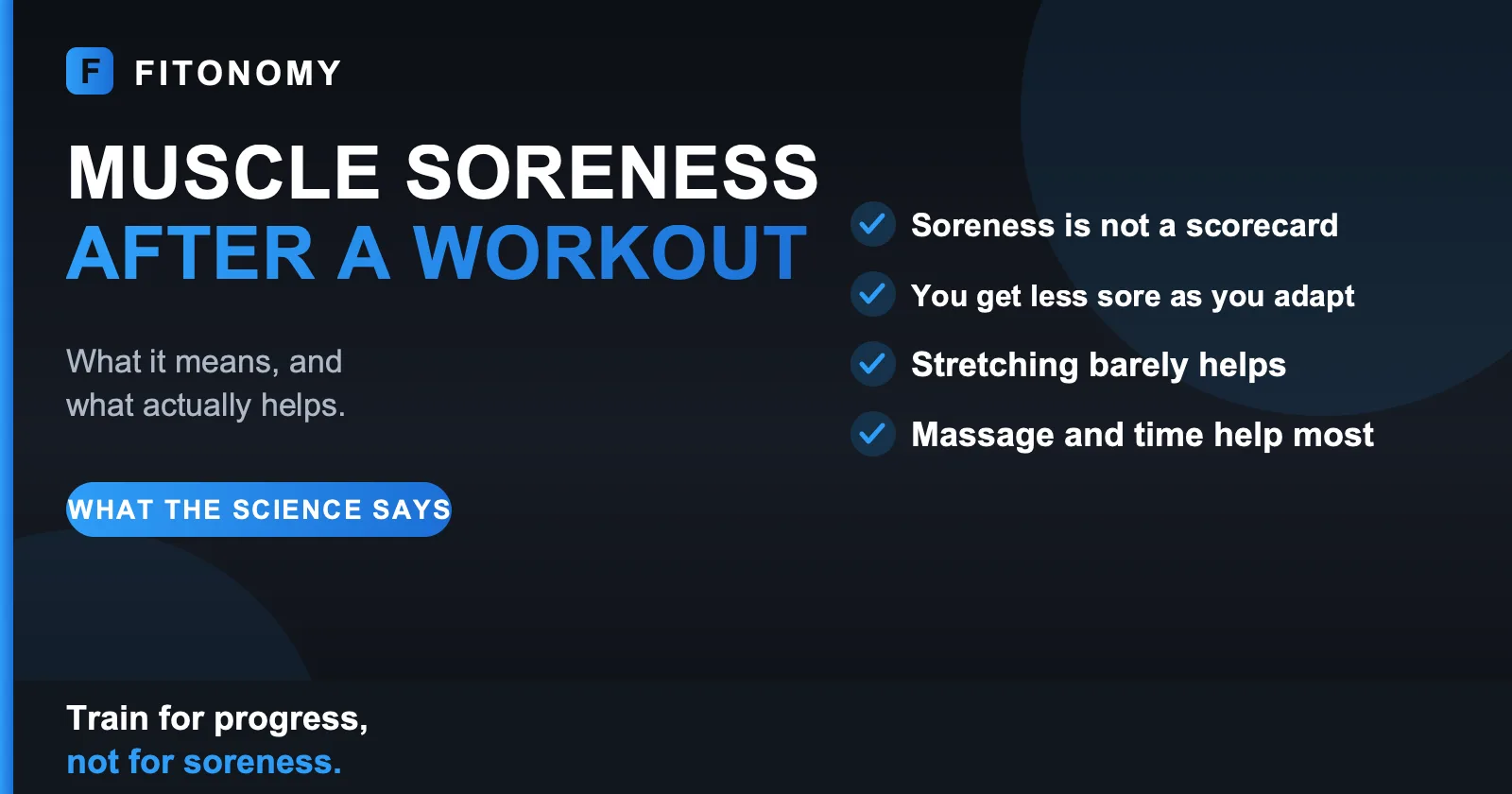
Muscle soreness is normal, mostly harmless, and a poor scorecard for whether your workout worked. Here is what it actually is, why chasing it is a mistake, and which of the dozen recovery tricks people swear by are actually backed by research.
What muscle soreness actually is
The stiff, tender feeling that shows up a day or two after a hard or unfamiliar session is called delayed onset muscle soreness, or DOMS. It typically appears 12 to 24 hours after exercise, peaks around 24 to 72 hours, and fades within a few days. It comes mainly from unfamiliar or eccentric movements (the lowering part of a lift), which cause microscopic disruption to muscle fibers and connective tissue, plus changes in how the nerves report pain.
One persistent myth to drop: it is not lactic acid. Lactate clears within an hour or two of training and has nothing to do with soreness that arrives the next morning.
Takeaway: Soreness (DOMS) is a normal response to unfamiliar or eccentric work, peaking 1 to 3 days later. It is not caused by lactic acid.
Myth: soreness means it was a good workout
This is the big one. Soreness is not a valid measure of whether a session built muscle. Schoenfeld and Contreras (2013) reviewed the evidence and concluded that postexercise soreness is not a reliable indicator of muscle damage or growth: muscles can grow with little soreness, and you can be very sore from a session that drove little adaptation. Soreness mostly tracks novelty and how much eccentric or unfamiliar work you did, not how much you built.
What actually drives muscle and strength is training volume, load, proximity to failure, and progressive overload, the things worth measuring instead. That is exactly why you should track sets, reps, and weight rather than how wrecked you feel (see our guide to tracking your workouts and the load and volume logic in strength training after 30).
Takeaway: Do not chase soreness. It reflects novelty, not results. Judge a workout by progressive overload, not by how sore you are the next day.
Why you get less sore over time (and that is fine)
New lifters are often alarmed when, after a few weeks, the brutal soreness stops. That is the repeated bout effect, and it is a good sign. McHugh (2003) described how a single bout of unfamiliar exercise protects the muscle against damage and soreness from the next similar bout, an adaptation that lasts for weeks and is specific to the muscle you trained.
In plain terms: your body adapts fast. The same workout that crushed you in week one barely registers by week four, even as you keep progressing. Less soreness does not mean less effective. It means you are adapting, which is the entire point.
Takeaway: Soreness drops sharply as you adapt (the repeated bout effect). Not being sore anymore is a sign of progress, not a sign your training stopped working.
What does NOT reliably help: stretching
Static stretching before or after exercise is the classic soreness remedy, and it basically does not work for this. A Cochrane review by Herbert and colleagues (2011), including a field trial of over 2,000 people, found stretching reduced soreness by about 4 points on a 100-point scale, an effect so small it is meaningless in practice. Stretching has other uses (mobility, feeling good), but preventing DOMS is not one of them.
Takeaway: Stretching does not meaningfully prevent or cure soreness (about 4 points out of 100). Do it for mobility if you enjoy it, not as a soreness fix.
What actually helps (a little)
No method erases soreness, but a few genuinely take the edge off. The largest review here, Dupuy and colleagues (2018), pooled 99 studies across 10 recovery methods and found massage was the most effective technique for reducing soreness and perceived fatigue, with compression garments and cold water immersion helping to a smaller degree. Foam rolling, which is essentially self-massage, also helps: Pearcey and colleagues (2015) found it reduced soreness and the performance drop that comes with it.
Gentle active recovery (easy movement, a walk, light cardio) increases blood flow and tends to feel better than sitting still. And the unglamorous basics do the heavy lifting: enough sleep and enough protein support the repair that actually resolves soreness. The honest framing is that these methods speed comfort modestly; time is the real cure.
Takeaway: Massage and foam rolling help most, with compression, cold water, and light active recovery offering smaller gains. Sleep and protein support repair. All are modest; time does most of the work.
Should you train when you are sore?
Mild to moderate soreness is fine to train through, especially if you work different muscles. Sore legs today? Train upper body. If a muscle is severely sore, reduce the load or volume for that muscle, or give it another day. Light movement often eases soreness more than complete rest.
One important distinction: DOMS is a dull, general tenderness across the muscle. Sharp pain, joint pain, or pain on one specific spot is not normal soreness and is a signal to stop and reassess.
Takeaway: Train through mild soreness, work other muscles when one group is wrecked, and back off load if very sore. Sharp or joint pain is not DOMS, so stop if you feel it.
Recovery methods, ranked by evidence
- Massage. Helps with soreness?: Yes, most. What the research says: Most effective method for DOMS and fatigue (Dupuy 2018).
- Foam rolling. Helps with soreness?: Modestly. What the research says: Reduces soreness and performance loss (Pearcey 2015).
- Cold water immersion. Helps with soreness?: Modestly. What the research says: Small positive effect (Dupuy 2018).
- Compression garments. Helps with soreness?: Modestly. What the research says: Small positive effect (Dupuy 2018).
- Active recovery (light movement). Helps with soreness?: Slightly. What the research says: Increases blood flow, tends to feel better than rest.
- Sleep and protein. Helps with soreness?: Supportive. What the research says: Fuel the repair that resolves soreness.
- Static stretching. Helps with soreness?: Not really. What the research says: About 4 of 100 points, negligible (Herbert 2011).
- Time. Helps with soreness?: The real fix. What the research says: Soreness resolves on its own in a few days.
Takeaway: If you want to do something, massage or foam roll. If you want the truth, sleep well, eat enough protein, move gently, and wait.
When soreness is a red flag
Rarely, severe soreness after extreme or unaccustomed exercise, especially with marked swelling and dark or cola-colored urine, can signal rhabdomyolysis, a medical emergency. Severe pain that does not improve over several days, or any sharp joint pain, also warrants a check with a professional. Ordinary DOMS is not dangerous, but know the difference.
Takeaway: Normal DOMS is harmless and fades in days. Dark urine, extreme swelling, or sharp or worsening pain are not normal, so seek medical advice.
How Fitonomy helps you avoid being wrecked
The smartest soreness strategy is not a recovery gadget, it is sensible progression so you never overreach in the first place. Fitonomy's AI Workout Planner progresses your load and volume gradually based on what you actually log, easing you into new movements instead of throwing a brutal session at you on day one. Pair that with the beginner approach in our first gym workout guide, and soreness becomes a mild, manageable part of training rather than something that derails your week.
The bottom line
Soreness is normal, it is not a scorecard, and it fades as you adapt. Do not train to get sore, and do not panic when you stop getting sore. If you want relief, massage and foam rolling help most, stretching basically does not, and time plus sleep and protein do the real work. Train through the mild stuff, respect sharp or joint pain, and judge your workouts by progressive overload, not by how hard it is to walk down the stairs the next day.
Sources
- Schoenfeld, B.J., Contreras, B. (2013). Is Postexercise Muscle Soreness a Valid Indicator of Muscular Adaptations? Strength and Conditioning Journal. https://journals.lww.com/nsca-scj/fulltext/2013/10000/is_postexercise_muscle_soreness_a_valid_indicator.2.aspx
- McHugh, M.P. (2003). Recent advances in the understanding of the repeated bout effect. Scandinavian Journal of Medicine & Science in Sports. https://onlinelibrary.wiley.com/doi/abs/10.1034/j.1600-0838.2003.02477.x
- Herbert, R.D., de Noronha, M., Kamper, S.J. (2011). Stretching to prevent or reduce muscle soreness after exercise. Cochrane Database of Systematic Reviews. https://pubmed.ncbi.nlm.nih.gov/21735398/
- Dupuy, O., et al. (2018). An Evidence-Based Approach for Choosing Post-exercise Recovery Techniques to Reduce Markers of Muscle Damage, Soreness, Fatigue, and Inflammation: A Systematic Review With Meta-Analysis. Frontiers in Physiology. https://pmc.ncbi.nlm.nih.gov/articles/PMC5932411/
- Pearcey, G.E.P., et al. (2015). Foam Rolling for Delayed-Onset Muscle Soreness and Recovery of Dynamic Performance Measures. Journal of Athletic Training. https://pmc.ncbi.nlm.nih.gov/articles/PMC4299735/
Frequently asked questions
Is being sore after a workout a good sign? Not necessarily. Soreness is not a valid indicator of whether a workout built muscle. Research shows muscles can grow with little soreness and you can be very sore from a session that drove little adaptation. Soreness mostly reflects how new or eccentric the exercise was. Judge your workouts by progressive overload (more reps, weight, or sets over time), not by how sore you feel.
Why am I so sore after working out? Delayed onset muscle soreness comes mainly from unfamiliar or eccentric exercise (the lowering phase of movements), which causes microscopic disruption to muscle fibers and connective tissue plus changes in pain signaling. It is most pronounced when an exercise is new to you. It is not caused by lactic acid, which clears within an hour or two of training.
How long does muscle soreness last? DOMS usually appears 12 to 24 hours after exercise, peaks around 24 to 72 hours, and resolves within a few days. As you repeat a workout, soreness drops sharply due to the repeated bout effect, an adaptation that protects the muscle and lasts for weeks. If severe soreness lasts well beyond a few days, or comes with dark urine or sharp joint pain, see a professional.
Should I work out when I am sore? Mild to moderate soreness is usually fine to train through, especially if you work different muscle groups (train upper body if your legs are sore). If a muscle is severely sore, reduce its load or volume or give it another day. Light movement often eases soreness more than complete rest. Sharp pain or joint pain is not normal soreness and is a signal to stop.
What actually helps sore muscles? Massage helps most, according to a meta-analysis of 99 studies, with foam rolling (self-massage), cold water immersion, and compression garments offering smaller benefits. Light active recovery feels better than sitting still, and adequate sleep and protein support the repair that resolves soreness. All effects are modest. Time is the real cure, with soreness fading on its own in a few days.
Does stretching prevent muscle soreness? No, not meaningfully. A Cochrane review including over 2,000 people found stretching before or after exercise reduced soreness by only about 4 points on a 100-point scale, which is negligible. Stretching is useful for mobility and can feel good, but it is not an effective way to prevent or treat delayed onset muscle soreness.