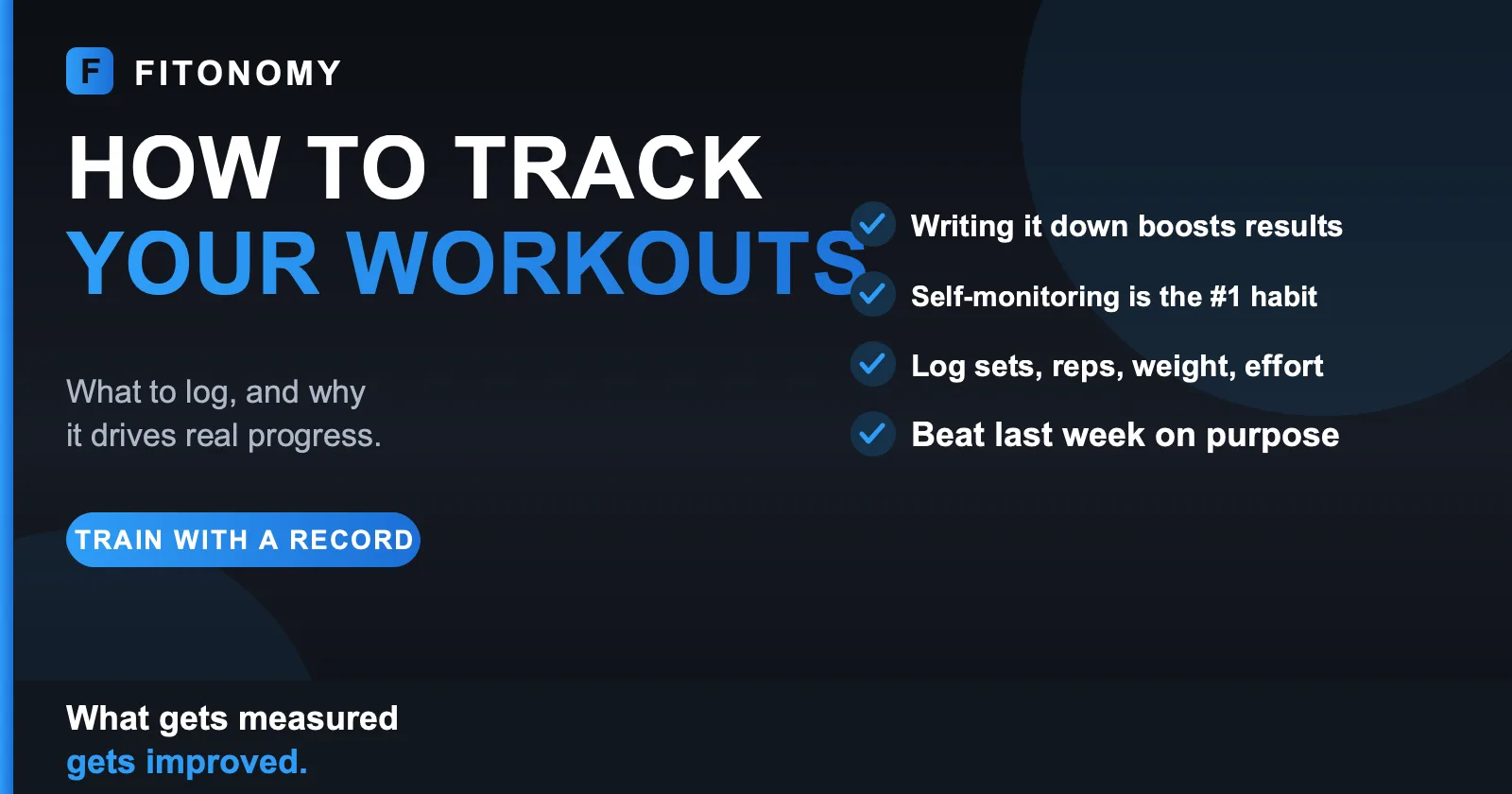
Most people train hard and remember almost none of it. Ask someone what they benched two Mondays ago and you get a shrug. That shrug is the problem. Knowing what you did last time makes it easier to compare sessions and decide when a small increase is appropriate.
Tracking your workouts is a simple, inexpensive way to make training decisions easier to review. Research on monitoring goals suggests that recording progress can help, but logging is a tool rather than a requirement for getting stronger. Here is what to log and how to use it.
If you need a session to record, use our first gym workout guide. When you review the log, the guide to when to increase your weights helps you decide whether to repeat the load, add a repetition or try a small increase.
Why tracking works (the evidence is strong)
This is not gym bro folklore. The behavior science on self monitoring is some of the most robust in the field.
A 2016 meta analysis in Psychological Bulletin pooled 138 studies covering nearly 20,000 people and asked a simple question: does monitoring your progress toward a goal actually help you reach it? The answer was yes, with a moderate effect (d = 0.40). Two details matter for lifters. The effect was stronger when people physically recorded their progress rather than just keeping it in their heads, and stronger still when the record was made public.
The pattern repeats across behavior change research. Michie and colleagues (2009), reviewing 122 interventions across nearly 45,000 people, found self monitoring was the single most effective behavior change technique they studied, explaining more of the difference between programs than any other. Pairing self monitoring with goal review and feedback pushed effectiveness from 0.26 to 0.42, a meaningful jump. And in the tech version of the same idea, Brickwood and colleagues (2019) found that simply wearing an activity tracker increased physical activity (steps standardized mean difference 0.24, moderate to vigorous activity 0.27).
Takeaway: Recording what you do is not busywork. Across tens of thousands of people, monitoring progress reliably improves results, and writing it down beats keeping it in your head.
How a record helps you plan progression
For strength and muscle specifically, tracking is not just motivational, it is mechanical. The principle that drives almost all results is progressive overload: gradually doing more over time. The American College of Sports Medicine's position stand on resistance training is explicit that progressive overload is what continues to drive adaptation, and that the exact model matters less than consistently achieving that overload.
A record makes it easier to compare your current training with previous sessions. You can progress without a written log, but memory may be less reliable for recalling the details. Volume is the clearest example. A 2017 meta analysis by Schoenfeld, Ogborn, and Krieger found a dose response relationship in which each additional weekly set was associated with roughly a 0.37 percent increase in muscle size, with about 10 sets per muscle per week as a strong target. Counting sets in a log gives you a convenient way to review weekly volume and changes over time.
Takeaway: A record can make progressive overload easier to plan and review. It helps you compare sessions, but it is not a requirement for improving strength or building muscle.
What to actually track
You do not need to log everything. Track the few things that drive decisions and ignore the rest.
The essentials, per exercise:
- Exercise name. So you compare like with like.
- Sets and reps completed. The raw volume.
- Weight used. The load you are trying to progress.
- Effort. How hard the set was, usually as reps in reserve (how many you had left) or a 1 to 10 rating. This is what tells you whether to add weight next time.
Worth tracking weekly or monthly, not per set:
- Bodyweight and a couple of measurements, if body composition is a goal.
- A one line note when something is useful: a tweak that helped, a niggle to watch, a machine setting.
What to skip: most people do not need to log rest periods to the second, tempo, or every macro of every meal to benefit. Start with the four essentials. Precision you will not maintain is worse than a simple habit you keep.
Takeaway: Log exercise, sets, reps, weight, and effort. Add bodyweight and short notes occasionally. Skip the rest until you have a reason for it.
Notebook, spreadsheet, or app?
Any method that you actually keep up beats the perfect method you abandon. That said, the options are not equal, and the research hint from earlier applies: the easier it is to record and review, the more the habit sticks.
- Memory only. Setup effort: None. Shows last session instantly: Depends on recall. Progress trends: Harder to review. Structure and reminders: No. Best for: Simple familiar routines when you are comfortable relying on memory.
- Notebook. Setup effort: Low. Shows last session instantly: Slowly, by flipping back. Progress trends: Manual. Structure and reminders: No. Best for: People who hate screens.
- Spreadsheet. Setup effort: Medium. Shows last session instantly: Yes, if you build it. Progress trends: Yes, if you build it. Structure and reminders: No. Best for: Data minded DIYers.
- Workout app. Setup effort: Low. Shows last session instantly: Yes, automatically. Progress trends: Yes, automatically. Structure and reminders: Yes. Best for: Most people.
The honest read: a notebook is fine and far better than nothing. A spreadsheet is powerful if you enjoy maintaining one. An app wins for most people because it surfaces last session's numbers the moment you start the exercise, charts your trends without effort, and adds the reminders and structure that the behavior research links to better adherence.
Takeaway: Pick the method you will keep using. For most people that is an app, because it makes recording and reviewing nearly frictionless.
How to use your log to actually progress
A log you never read is just a diary. The point is to use last session's numbers to decide this session's. The simplest reliable method is double progression.
Pick a rep range, for example 8 to 12. Start at a weight where you can do 8. Each session, try to add reps within the range. Once you hit the top (12 on all sets) with good form and a rep or two still in reserve, increase the weight next time and drop back to the bottom of the range. Repeat. Your log makes this obvious: you can see at a glance that last week was 3 sets of 10 at 60 pounds, so today you aim for 11 or 12.
This is also where effort tracking earns its place. If last session's sets were all easy (3 or 4 reps in reserve), add weight sooner. If they were grinding (0 to 1 in reserve), hold and add reps instead. For a deeper walk through setting volume and intensity, see our guides to strength training after 30 and how to use an exercise library to build the sessions you are tracking.
Takeaway: Use double progression. Read last session's numbers, then beat them by a rep or a small load increase. The log turns "train hard" into "train measurably harder."
Common tracking mistakes
- Logging weight but not effort. Two sets of 10 at the same weight can be worlds apart in difficulty. An effort note adds useful context when deciding whether to progress.
- Tracking everything. Logging rest to the second and tempo on day one is how the habit dies by week two. Start minimal.
- Never reviewing. The Psychological Bulletin finding was about monitoring progress, not just recording it. Glance back before each session and review the trend every few weeks.
- Restarting from zero. A messy, continuous log beats a perfect log you abandon and restart monthly. Keep the streak going even when entries are sloppy.
Takeaway: Log effort, keep it minimal, and actually look back. The review is where tracking turns into progress.
How Fitonomy approaches it
The reason apps win on adherence is that they remove the friction the research keeps pointing to. Fitonomy's Workout Logger records your sets, reps, weight, and effort and keeps the history, so last session's numbers are in front of you when you start. Because that data feeds the AI planner, the plan progresses off what you actually did rather than a fixed schedule, which is the same loop we covered in our piece on whether AI workout planners work. Whether you use an app, a spreadsheet, or a notebook, the principle is identical: record it, read it, beat it.
The bottom line
A workout log gives you a practical way to compare sessions. Research on monitoring progress found improved goal attainment on average (d = 0.40), but recording numbers does not guarantee results. Log the four essentials, choose a method you will keep using, and review the trend before deciding whether to repeat a load or make a small increase. Progress does not depend on writing everything down or beating the previous session every time.
Sources
- Harkin, B., et al. (2016). Does Monitoring Goal Progress Promote Goal Attainment? A Meta Analysis of the Experimental Evidence. Psychological Bulletin. Read source
- Michie, S., et al. (2009). Effective Techniques in Healthy Eating and Physical Activity Interventions: A Meta Regression. Health Psychology. Read source
- Brickwood, K.J., et al. (2019). Consumer Based Wearable Activity Trackers Increase Physical Activity Participation: Systematic Review and Meta Analysis. JMIR mHealth and uHealth. Read source
- American College of Sports Medicine (2009). Progression Models in Resistance Training for Healthy Adults: Position Stand. Medicine & Science in Sports & Exercise. Read source
- Schoenfeld, B.J., Ogborn, D., Krieger, J.W. (2017). Dose response relationship between weekly resistance training volume and increases in muscle mass. Journal of Sports Sciences. Read source
Frequently asked questions
Should I track my workouts? Yes. Self monitoring is one of the most evidence backed habits in fitness. A 2016 meta analysis of 138 studies found that monitoring progress toward a goal reliably improves goal attainment (effect size d = 0.40), and the effect was stronger when progress was physically recorded rather than kept in memory. For strength training, tracking can make progressive overload easier to plan and review, although a written record is not required.
What should I track in a workout? Log four essentials per exercise: the exercise name, sets and reps completed, the weight used, and how hard the set felt (reps in reserve or a 1 to 10 effort rating). Track bodyweight and a couple of measurements weekly if body composition is a goal, and add short notes when useful. Skip rest times and tempo at first, since precision you will not maintain is worse than a simple habit you keep.
Is a workout app better than a notebook? Any method you keep up beats the perfect method you abandon, so a notebook is far better than nothing. That said, an app wins for most people because it shows last session's numbers instantly, charts progress automatically, and adds reminders and structure, the features behavior research links to better adherence. A spreadsheet is a strong middle option if you enjoy maintaining one.
Does tracking workouts actually build more muscle? Tracking can help you make more consistent training decisions, but it does not build muscle by itself or guarantee greater muscle growth. Recording weight, repetitions and sets makes it easier to compare sessions and review weekly volume. Those records can support appropriate adjustments as your ability improves.
How do I use my workout log to get stronger? Use double progression. Pick a rep range such as 8 to 12, and each session try to add reps using last session's numbers as the target. Once you reach the top of the range on all sets with a rep or two still in reserve, increase the weight and drop back to the bottom of the range. Your effort ratings tell you when to add load versus add reps.
How often should I review my workout log? Glance at last session's numbers before each workout so you know what to beat, and review the longer trend every few weeks. The research benefit comes from monitoring progress, not just recording it, so a log you never read does little. Reviewing also tells you when to change your program if progress has stalled.
Record how a session felt, compare similar work, and use effort as context rather than a score to maximize. Log Workout Effort Without Chasing Exhaustion
Compare similar sessions, read several fields together, and carry one useful question into your next planned workout. Review Your Workout History Before the Next Session