Open any exercise library and you get the same thing: hundreds of movements, neatly filmed, sorted by muscle, and absolutely no instructions on what to actually do with them. It is a dictionary, not a sentence. Knowing that the cable row exists does not tell you how many sets to do, when to do it, or whether it belongs in your week at all.
That gap is where most people stall. They scroll a library, pick whatever looks interesting, and end up with a workout that hits biceps three ways and legs never. A good exercise library is genuinely useful, but only once you know the handful of rules that turn a list of exercises into a structured plan. Here is how to do that, with the research that backs each step.
What an exercise library actually is (and why a good one matters)
An exercise library is a searchable catalog of movements, usually with a demonstration video or images, a muscle target, and sometimes equipment filters. The best ones show proper technique, because the single thing a library can do that a static list cannot is teach you how to perform the movement. That matters more than it sounds: doing the right exercise with sloppy form is how people stall or get hurt.
The library is the raw material. The skill is selection and structure. Think of the next five steps as the recipe that turns the pantry into a meal.
Step 1: Pick movement patterns, not just muscles
The most common mistake is shopping by muscle ("I want abs and arms") instead of by movement. Your body works in a small number of fundamental patterns, and a balanced workout covers them rather than chasing individual muscles. The core patterns are: squat (knee dominant), hinge (hip dominant), horizontal push, horizontal pull, vertical push, vertical pull, and a core or carry.
Build around those and you train your whole body with no gaps, no overlap, and far fewer imbalances. Use the library's muscle filters second, to fill in a lagging area, not first.
Here is a full-body template assembled entirely from movements any decent library will have.
- Squat (knee dominant). Example exercises from a library: Goblet squat, leg press, dumbbell squat. Sets and reps: 3 sets of 8 to 12.
- Hinge (hip dominant). Example exercises from a library: Romanian deadlift, hip thrust, back extension. Sets and reps: 3 sets of 8 to 12.
- Horizontal push. Example exercises from a library: Push-up, dumbbell bench press. Sets and reps: 3 sets of 8 to 12.
- Horizontal pull. Example exercises from a library: Dumbbell row, seated cable row. Sets and reps: 3 sets of 8 to 12.
- Vertical push. Example exercises from a library: Overhead press, machine shoulder press. Sets and reps: 2 sets of 8 to 12.
- Vertical pull. Example exercises from a library: Lat pulldown, assisted pull-up. Sets and reps: 2 sets of 8 to 12.
- Core or carry. Example exercises from a library: Plank, dead bug, farmer carry. Sets and reps: 2 to 3 sets.
Takeaway: Filter the library by movement pattern first. Cover the seven patterns and you have a complete workout before you have even thought about specific muscles.
Step 2: Decide how many sets (the volume that drives results)
Once you know the movements, the next question is how much. This is where guessing costs you, because volume has the clearest dose-response relationship in all of training.
A 2017 meta-analysis by Schoenfeld, Ogborn, and Krieger pooled the data and found a graded relationship between weekly sets and muscle growth: each additional weekly set per muscle was associated with roughly a 0.37 percent increase in muscle size, and groups performing 10 or more sets per muscle per week saw the best results. That 10 sets figure has since become the common evidence-based benchmark for a working target.
In practice, that does not mean 10 sets in one session. It means about 10 hard sets per muscle spread across your training week. The template above already lands most muscles in a sensible range once you train it a couple of times a week.
Takeaway: Aim for roughly 10 sets per muscle group per week as a starting target, then adjust. More sets generally means more growth, up to the point your recovery can keep up.
Step 3: Choose a rep range and load you can actually push
People agonize over rep ranges far more than the science says they should. For building muscle, the load matters less than the effort.
A 2017 systematic review and meta-analysis by Schoenfeld and colleagues compared low-load (lighter weight, higher reps) against high-load (heavier weight, lower reps) training. When sets were taken close to failure, muscle growth was similar across the whole spectrum of loads. The one clear difference: heavier loads produced greater gains in maximal strength. So if your goal is size, anything from about 6 to 20 reps works as long as the set is genuinely hard. If your goal is raw strength, bias toward heavier weights and lower reps.
For most people building a general workout, 8 to 12 reps is a practical middle: heavy enough to build strength, manageable enough to accumulate volume with good form.
Takeaway: Pick a weight that makes the last 1 to 3 reps genuinely difficult. The rep range is flexible. The effort is not.
Step 4: Order your exercises (this part has a rule)
Exercise order is one of the few sequencing questions with a clear answer. The American College of Sports Medicine's position stand on resistance training recommends performing large muscle group exercises before small ones, and multi-joint (compound) exercises before single-joint (isolation) exercises.
The logic is energy. Compound lifts like squats, presses, and rows demand the most from you, so you want to hit them while you are fresh. Burn yourself out on biceps curls first and your rows will suffer. Do the big movements first, finish with the small isolation work.
Takeaway: Order each session big to small: compound, multi-joint movements first, isolation movements last.
Step 5: Actually use the form videos
This is the step people skip, and it is the entire point of a library over a plain list. A demonstration shows you depth, tempo, and positioning that a name and a muscle tag never could. Watch the movement before you load it, and check yourself against it when something feels off.
This is also where libraries differ most in quality. A grainy gif on a loop is not the same as a clear video that shows the setup, the working range, and common mistakes. If you are choosing a tool, the quality of the form guidance is the feature that actually changes your results.
Takeaway: Treat the form video as instruction, not decoration. It is the part of the library that protects your joints and makes the exercise work.
How much variety do you need?
Once people discover a library has 500 exercises, the temptation is to use all of them. Resist it. Constantly swapping movements means you never get good at any of them or track progress on them.
The evidence supports a middle path. A 2019 study by Baz-Valle and colleagues found that varying exercise selection improved trainees' motivation while producing similar muscle adaptations compared with a fixed routine, and some research suggests a degree of variation can help target different regions of a muscle. But too much rotation can blunt progress, because you lose the ability to add weight to a movement you repeat. The practical answer: keep a stable core of movements you progress for 6 to 8 weeks, and use the library to rotate one or two accessory exercises for variety and motivation.
Takeaway: Keep your main lifts stable so you can progress them. Use the library's depth to rotate a couple of accessories, not the whole plan.
How to split it across the week
A library helps you build a session. Frequency decides how those sessions stack into a week. A 2016 meta-analysis by Schoenfeld, Ogborn, and Krieger found that training each muscle at least twice per week produced superior hypertrophy compared with once per week when total volume was equated.
That points most people toward two or three full-body sessions, or an upper/lower split trained four days, rather than the classic "one muscle per day" bodybuilder split that hits everything just once. If you want a deeper look at minimum effective frequency, our guide to strength training after 30 covers how little you can do and still progress, and the hybrid training guide shows how to fold conditioning into the same week.
Takeaway: Hit each muscle at least twice a week. Two or three full-body sessions built from the library beats a once-a-week split for most goals.
Putting it together
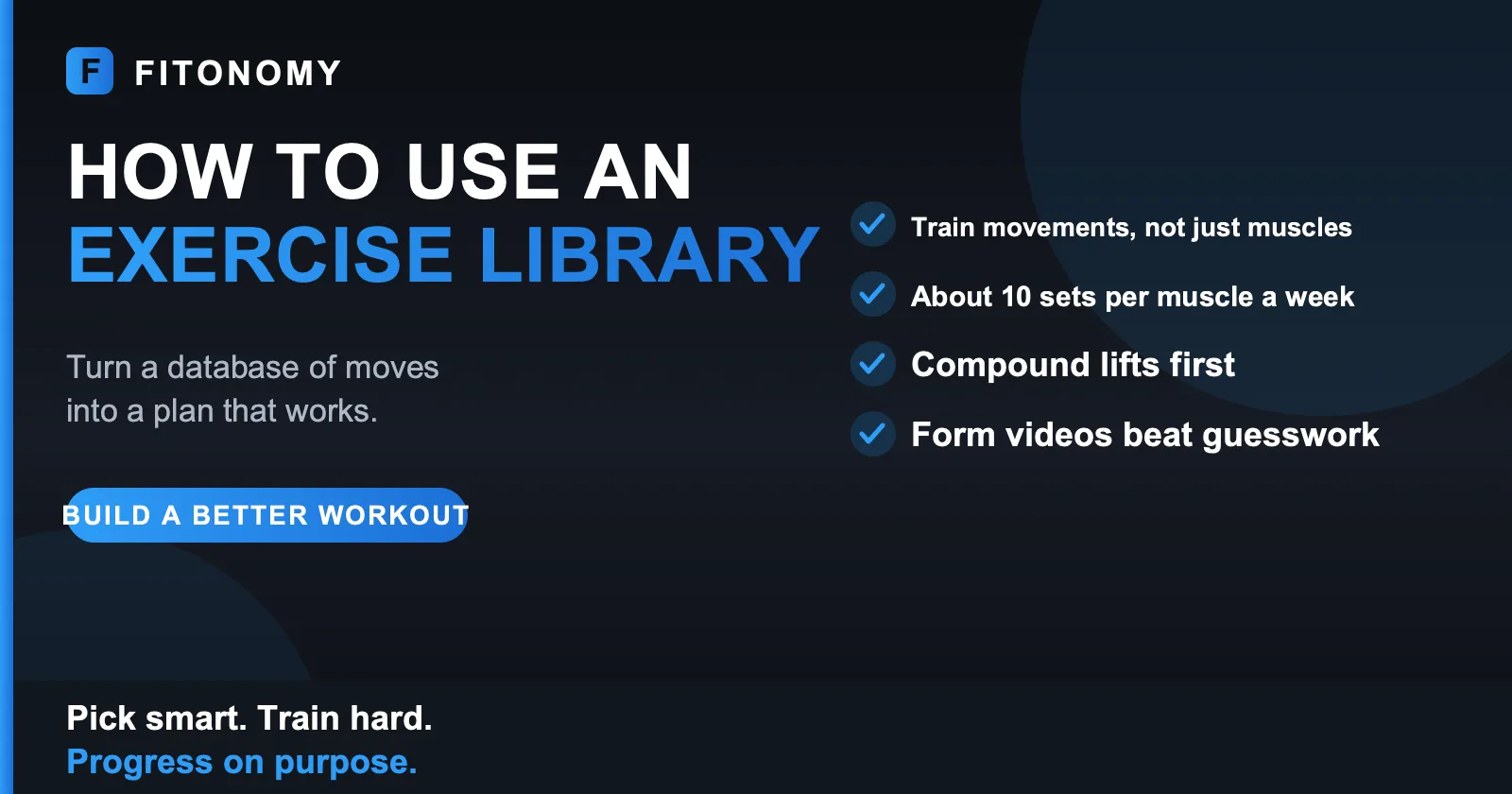
Here is the whole method in order. Open your library and filter by movement pattern. Pick one exercise for each of the seven patterns. Assign about 10 sets per muscle across your week. Choose a load that makes 8 to 12 reps hard. Order each session compound first, isolation last. Watch the form video before you load up. Keep your main lifts stable, rotate an accessory or two, and train each muscle at least twice a week.
That is a complete, evidence-based program built from nothing but a good library and a few rules.
Where a planner comes in
The honest catch is that doing all of this by hand takes knowledge and time. This is exactly the problem an AI workout planner solves: it does the selection, volume, and ordering for you and progresses it off your logged performance. We covered whether those tools actually work in our piece on AI workout planners. Fitonomy pairs its Exercise Library, with video form guidance for each movement, to an AI planner that assembles those movements into a structured program and a logger that tracks your progression, so the library is not just a reference, it is wired into a plan. Whether you build it yourself or let a planner do it, the principles above are what a good program is made of.
The bottom line
An exercise library is a tool, not a workout. The value is not in how many exercises it contains, it is in knowing how to choose from it. Pick by movement pattern, aim for about 10 sets per muscle per week, push each set close to failure in a rep range you can control, do the big lifts first, learn the form from the video, and train each muscle twice a week. Follow that and a library stops being an overwhelming list and becomes the most flexible training tool you own.
Frequently asked questions
What is an exercise library? An exercise library is a searchable catalog of exercises, usually with a demonstration video or images, the target muscles, and equipment filters. The best ones teach proper technique, which is the main advantage over a plain list of exercise names. A library is the raw material for a workout, but you still need to select and structure the movements yourself or with a planner.
How do I use an exercise library to build a workout? Filter by movement pattern rather than by muscle. Pick one exercise for each pattern: squat, hinge, horizontal push, horizontal pull, vertical push, vertical pull, and a core or carry. Aim for about 10 sets per muscle per week, choose a load that makes 8 to 12 reps hard, and order each session with compound movements first and isolation last. Use the form videos to learn each movement before loading it.
How many exercises should a workout have? For a full-body session, around 5 to 7 exercises that cover the main movement patterns is plenty. What matters more than the number of exercises is total weekly volume. Research shows roughly 10 sets per muscle per week is a strong target, spread across two or more sessions, with each set taken close to failure.
How many sets per muscle per week should I do? A 2017 meta-analysis found a dose-response relationship in which each additional weekly set was associated with about a 0.37 percent increase in muscle size, and 10 or more sets per muscle per week produced the best results. Around 10 hard sets per muscle per week is a sensible starting target, adjusted up or down based on your recovery.
Do I need to change my exercises often? No. Constantly swapping exercises makes it hard to progress, because you lose the ability to add weight to a movement you repeat. Research found that exercise variation improved motivation with similar muscle gains, so the practical approach is to keep a stable core of main lifts you progress for 6 to 8 weeks and rotate only one or two accessory movements for variety.
Are exercise library apps worth it? A library app is worth it if the form guidance is high quality and it connects to a way of building and tracking a plan. The catalog alone is just a reference. The value comes from clear demonstration videos plus a planner or logger that turns the movements into a structured, progressing program rather than a random list of exercises.