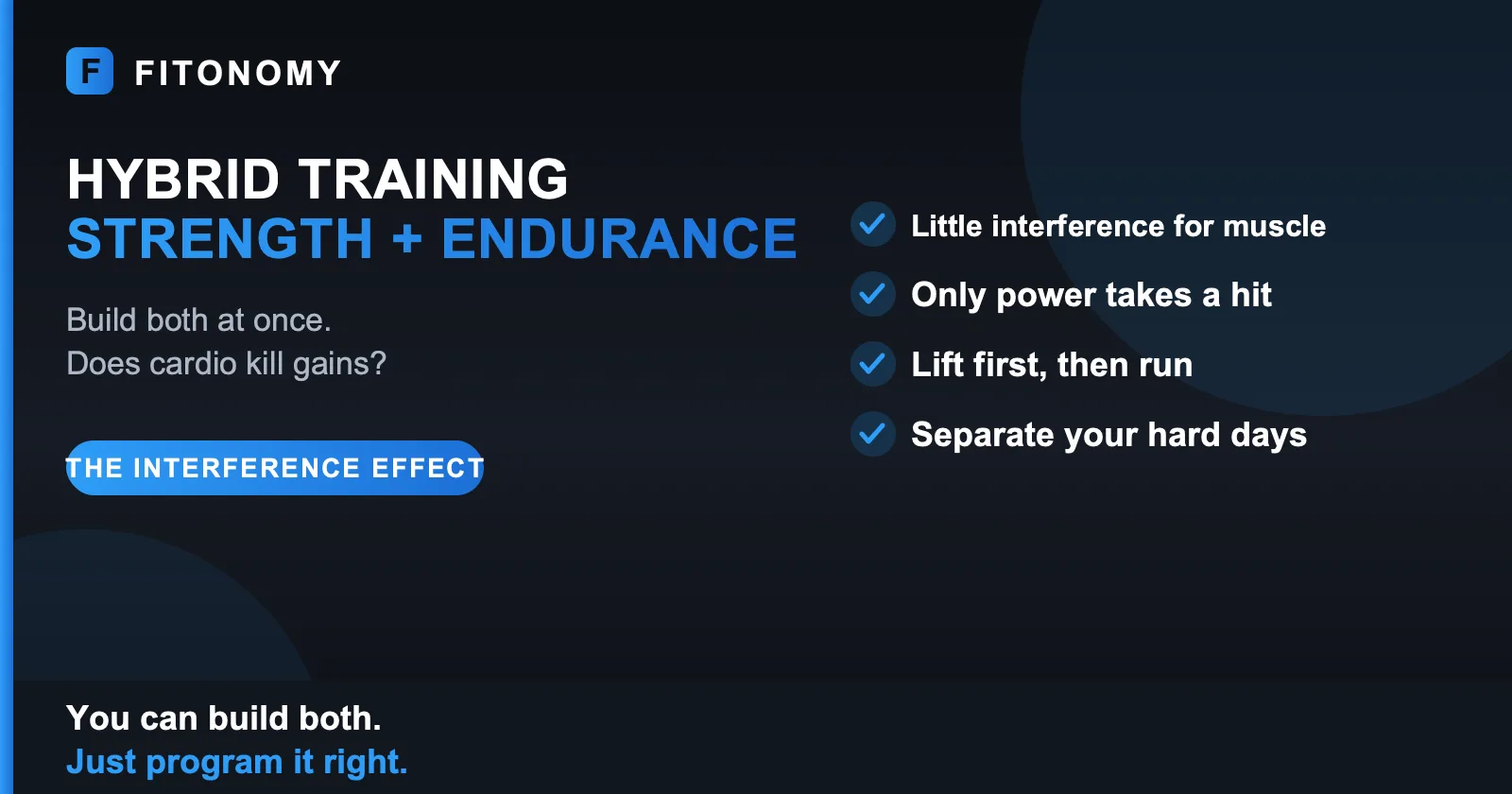
Can you get strong and build muscle while also running, cycling, or rowing for endurance? Or does all that cardio quietly undo your lifting? This is one of the oldest fears in training, known as the interference effect, and it keeps people stuck doing only one thing when they want both.
The good news is that the modern research is far more reassuring than the myth. Hybrid training, also called concurrent training, works for most goals, as long as you program it sensibly. Here is what actually interferes, what does not, and exactly how to build strength and endurance at the same time without sabotaging either.
What hybrid training is
Hybrid training means pursuing strength (or muscle) and endurance in the same training block, rather than picking one. Think of someone who lifts three days a week and runs or cycles two or three more, aiming to be both strong and aerobically fit. It is how most general-fitness trainees, many athletes, and anyone who wants to look good and perform actually train.
The worry has always been that the two adaptations fight each other. Lifting tells your body to build and strengthen muscle; endurance tells it to become efficient and economical. Do both, the theory went, and you get worse at each. So is that true?
Takeaway: Hybrid (concurrent) training is chasing strength and endurance together. The classic fear is that the two adaptations interfere. The research says it is more nuanced than that.
The interference effect: real, but smaller than you think
Start with the study that made the fear famous. A 2012 meta-analysis by Wilson and colleagues found genuine interference: compared with lifting alone, concurrent training produced smaller gains in muscle size (effect size 0.85 versus 1.23) and, especially, power (0.55 versus 0.91). Two details mattered: running caused significant decrements while cycling did not, and the interference got worse as endurance frequency and duration climbed.
But the picture changed as more data came in. A large 2022 update by Schumann and colleagues, pooling 43 studies, found no meaningful interference at all for muscle hypertrophy (standardized mean difference of essentially zero) or for maximal strength, regardless of whether people cycled or ran, trained once or several times a week, or did both in one session or on separate days. A separate 2022 review by Lundberg and colleagues agreed that whole-muscle growth is not compromised by adding endurance.
So where did the interference go? Mostly to one specific quality: explosive power. Schumann found that explosive performance (think jump height and sprint speed) was reduced by roughly 28 percent under concurrent training, particularly when strength and endurance were crammed into the same session.
Takeaway: For building muscle and maximal strength, modern evidence shows little to no interference when training is managed. The one quality that suffers is explosive power, and mainly when you do both in a single session.
So who actually needs to worry?
The honest verdict: if your goals are muscle, general strength, fitness, and body composition, hybrid training is fine. You can build strength and endurance together and expect good progress in both. The people who need to be careful are those chasing maximal explosive power, sprinters, jumpers, Olympic lifters, where every bit of fast force counts. For everyone else, the interference effect is a manageable detail, not a reason to avoid cardio.
Takeaway: Recreational lifters and general-fitness trainees can build strength, muscle, and endurance together. Only power-focused athletes need to program around interference carefully.
How to program hybrid training so the two do not collide
The difference between hybrid training that works and hybrid training that stalls is in the details below.
- Separate the sessions when you can. Most interference shows up when strength and endurance share one session. Putting them on different days, or at least 6 or more hours apart, largely removes the problem.
- If you must combine them, lift first. A 2018 meta-analysis by Murlasits and colleagues found that doing strength before endurance produced about 6.91 percent better lower-body strength gains than the reverse order, with no downside to your aerobic gains.
- Favor cycling over running if strength is the priority. Wilson found running interfered with strength and size while cycling did not, likely because of its higher eccentric and impact load on the same muscles you lift with.
- Keep endurance volume in check. Interference scaled with endurance frequency and duration, so do not bury three lifting days under marathon mileage. Match the dose to your main goal.
- Prioritize your primary goal. Bias your weekly volume toward whichever matters more. If strength leads, keep cardio supportive; if endurance leads, accept that strength gains will be steadier rather than maximal. For the strength side, our strength training after 30 guide covers the minimum effective dose, and for the cardio side, HIIT vs steady-state helps you pick your conditioning.
- Recover hard. Doing two kinds of training raises the recovery bill, so sleep and protein matter even more (see sleep and muscle and how much protein).
Takeaway: Separate sessions when possible, lift before cardio if combined, lean toward cycling for strength, cap endurance volume, prioritize your main goal, and recover well. Those six rules neutralize most interference.
A sample weekly hybrid plan
Here is a balanced six-day template that builds both, with strength and endurance separated to minimize interference. Adjust the bias toward whichever goal leads.
- Monday. Focus: Strength. Session: Full-body or upper-body lifting.
- Tuesday. Focus: Endurance. Session: Easy steady-state cardio (zone 2), 30 to 45 min.
- Wednesday. Focus: Strength. Session: Lower-body lifting.
- Thursday. Focus: Endurance. Session: Intervals or HIIT, 20 to 25 min.
- Friday. Focus: Strength. Session: Full-body or push/pull lifting.
- Saturday. Focus: Endurance. Session: Longer easy cardio (cycle, row, or brisk walk).
- Sunday. Focus: Recovery. Session: Rest or light mobility.
Keep hard lifting and hard intervals on different days where you can, and if a lift and a run must share a day, lift first and put the run later.
Takeaway: Three strength days and three endurance days, kept apart, builds both. Separate the two hard efforts and lift first whenever they overlap.
Hybrid training is great for body composition
Beyond strength and fitness, training both ways is a strong recipe for losing fat while keeping muscle. A 2025 meta-analysis by Campbell and colleagues comparing concurrent, resistance-only, and aerobic-only training found concurrent training to be an effective strategy for improving body composition, combining the muscle-preserving stimulus of lifting with the energy expenditure and health benefits of cardio. Pair it with a modest calorie deficit and you have a powerful body-composition setup.
Takeaway: Hybrid training pairs muscle retention with cardio's calorie burn and health benefits, making it one of the best approaches for losing fat while keeping muscle.
Common hybrid-training mistakes
- Doing everything in one exhausting session, which is exactly where interference is worst.
- Running huge mileage while expecting maximal strength gains. High endurance volume is the clearest interference driver.
- Doing cardio before heavy lifting and wondering why the weights feel heavy. Lift first.
- Under-recovering. Two training stresses need more sleep and protein, not the same as training one way.
- Treating soreness from the new combined load as a problem rather than a normal adaptation (see our muscle soreness guide).
Takeaway: Avoid one-session overload, runaway cardio volume, cardio-before-lifting, and under-recovery. Those four mistakes cause most of the stalling people blame on interference.
How Fitonomy helps
The hard part of hybrid training is the scheduling: fitting strength and cardio into a week without the two colliding. Fitonomy's AI Workout Planner builds and sequences both around your available days and primary goal, so your lifting and conditioning support each other instead of competing, and it progresses each based on what you log. It turns the programming rules above into a plan you can just follow.
The bottom line
Hybrid training works. The interference effect is real but narrow: for muscle and general strength, modern research shows little to no penalty from adding endurance, and only explosive power takes a meaningful hit, mostly when you combine both in one session. Separate your hard sessions, lift before you run, favor cycling when strength leads, keep endurance volume sensible, and recover well. Do that and you can genuinely build strength and endurance at the same time, and end up fitter, stronger, and leaner than chasing either alone.
Sources
- Wilson, J.M., et al. (2012). Concurrent Training: A Meta-Analysis Examining Interference of Aerobic and Resistance Exercises. Journal of Strength and Conditioning Research. https://pubmed.ncbi.nlm.nih.gov/22002517/
- Schumann, M., et al. (2022). Compatibility of Concurrent Aerobic and Strength Training for Skeletal Muscle Size and Function: An Updated Systematic Review and Meta-Analysis. Sports Medicine. https://link.springer.com/article/10.1007/s40279-021-01587-7
- Lundberg, T.R., et al. (2022). The Effects of Concurrent Aerobic and Strength Training on Muscle Fiber Hypertrophy: A Systematic Review and Meta-Analysis. Sports Medicine. https://pubmed.ncbi.nlm.nih.gov/35476184/
- Murlasits, Z., et al. (2018). The physiological effects of concurrent strength and endurance training sequence: A systematic review and meta-analysis. Journal of Sports Sciences. https://pubmed.ncbi.nlm.nih.gov/28783467/
- Campbell, L., et al. (2025). Comparison of concurrent, resistance, or aerobic training on body fat loss: a systematic review and meta-analysis. Journal of the International Society of Sports Nutrition. https://pubmed.ncbi.nlm.nih.gov/40405489/
Frequently asked questions
Does cardio kill your gains? For most people, no. The fear comes from the interference effect, but modern research is reassuring. A large 2022 meta-analysis found no meaningful reduction in muscle size or maximal strength from adding endurance training when it is managed sensibly. The one quality that genuinely suffers is explosive power, and mainly when strength and cardio are done in the same session. Recreational lifters can do cardio without losing their gains.
Can you build muscle and do cardio at the same time? Yes. Reviews of concurrent training show that whole-muscle growth and maximal strength are not meaningfully compromised by also training endurance, as long as you do not bury your lifting under excessive cardio volume. Separating the two into different sessions and keeping endurance volume reasonable lets you build muscle and improve cardio fitness at the same time.
Should you do cardio or lift weights first? If you have to do both in one session, lift first. A 2018 meta-analysis found that performing strength before endurance produced about 6.91 percent better lower-body strength gains than the reverse order, with no penalty to aerobic improvements. Doing cardio first fatigues you before the lifting that drives strength. When possible, separate them onto different days entirely.
Is running or cycling better for hybrid training? If strength and muscle are your priority, cycling tends to interfere less than running. The 2012 meta-analysis found running caused significant decrements in strength and size while cycling did not, likely because running adds eccentric and impact stress to the same leg muscles you train. If you love running, you can still lift well; just manage the volume and keep hard runs away from leg day.
How many days a week should I do hybrid training? A common effective setup is three strength sessions and two to three endurance sessions per week, kept on separate days where possible. The exact split depends on your main goal: bias more volume toward strength if that leads, or toward endurance if that does. The key is keeping hard lifting and hard cardio apart and leaving enough recovery between them.
Is hybrid training good for fat loss? Yes, it is one of the best approaches. Combining resistance training, which preserves muscle, with cardio, which adds energy expenditure and health benefits, is highly effective for improving body composition. A 2025 meta-analysis found concurrent training an effective strategy for fat loss. Paired with a modest calorie deficit, hybrid training helps you lose fat while keeping the muscle you build.