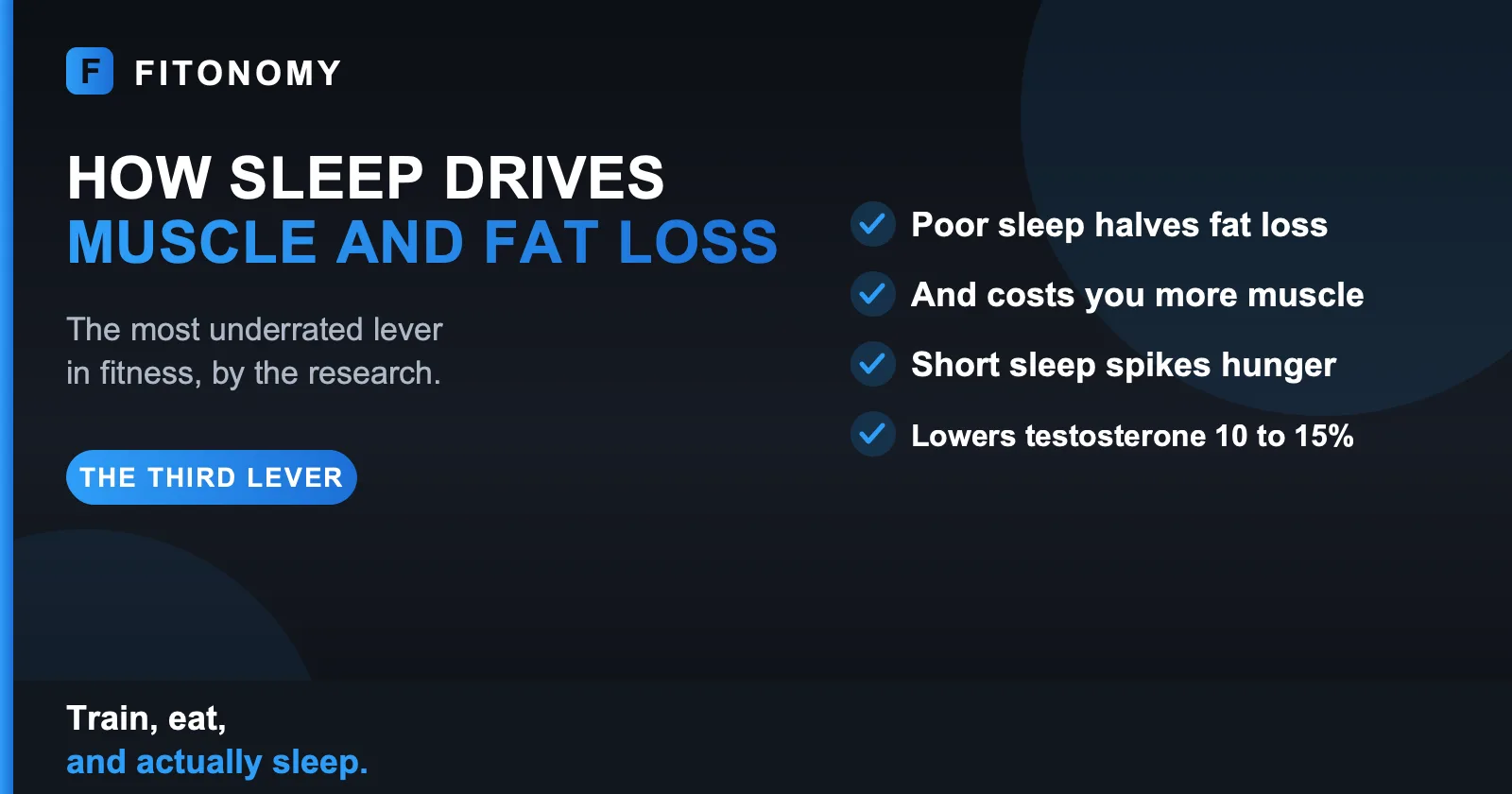
You can nail your training and your diet and still spin your wheels, because there is a third lever most people quietly ignore: sleep. It is not a soft, optional extra. It is the window when your body actually repairs muscle, balances the hormones that control hunger and growth, and decides whether the weight you lose comes from fat or muscle.
The research on this is more dramatic than most people expect. Skimp on sleep and you do not just feel tired; you measurably blunt fat loss, lose more muscle, eat more, and recover worse. Here is exactly what sleep does, with the studies behind it, and how much you actually need.
Sleep decides whether you lose fat or muscle
The most striking study here put dieters in a lab and changed only one thing: how long they slept. Nedeltcheva and colleagues (2010) had overweight adults eat the same calorie-restricted diet while sleeping either 8.5 hours or 5.5 hours a night. Both groups lost the same total weight, but the composition was completely different. The well-rested group lost 1.4 kg of fat and 1.5 kg of lean mass. The sleep-deprived group lost only 0.6 kg of fat and a brutal 2.4 kg of lean mass.
Read that again: short sleep cut fat loss by 55 percent and increased muscle loss by 60 percent, on the identical diet. Sleep did not change how much they lost, it changed what they lost. If you are dieting on poor sleep, you are dieting away your muscle.
Takeaway: On the same diet, short sleep cut fat loss by 55 percent and increased muscle loss by 60 percent. Sleep decides whether the scale drop is fat or muscle.
Why short sleep makes you eat more
Part of the reason poor sleep sabotages fat loss is that it hijacks your appetite hormones. Spiegel and colleagues (2004) found that curtailing sleep lowered leptin (the fullness hormone) by 18 percent and raised ghrelin (the hunger hormone) by 28 percent. The result was a 24 percent jump in hunger and a 23 percent jump in appetite, with the strongest cravings for calorie-dense, carb-heavy foods.
So a calorie deficit that is hard on good sleep becomes much harder on bad sleep, because your body is actively pushing you to eat more of exactly the wrong things. If you want the mechanics of running a deficit, our guide to setting a calorie deficit covers it, but sleep is the hidden variable that makes or breaks adherence.
Takeaway: Short sleep lowers fullness signals and raises hunger (leptin down 18 percent, ghrelin up 28 percent, hunger up 24 percent), driving cravings for junk and making a deficit far harder to hold.
Sleep, hormones, and building muscle
Sleep is also when the muscle-building machinery runs. Most growth hormone is released during deep sleep, and testosterone, which supports muscle repair and growth, depends heavily on it. Leproult and Van Cauter (2011) found that just one week of sleeping 5 hours a night lowered young men's testosterone by 10 to 15 percent, the equivalent of aging 10 to 15 years hormonally.
Combine the appetite effects with the hormonal ones and the picture is clear: poor sleep creates a body chemistry that stores fat and breaks down muscle, the exact opposite of what your training is trying to achieve. Protein supports repair (see how much protein to build muscle), but the repair itself largely happens while you sleep.
Takeaway: Deep sleep drives growth hormone, and short sleep cut testosterone by 10 to 15 percent in a week. The hormones that build muscle depend on sleep.
Better sleep, better training
Sleep does not just protect your body composition; it improves the workouts that drive it. Mah and colleagues (2011) had collegiate basketball players extend their sleep to around 10 hours in bed for several weeks. Their sprint times improved (16.2 to 15.5 seconds), shooting accuracy rose by 9 percent, and reaction time and mood improved too.
More sleep meant better performance, which means better training quality, which means better results. Tired training is worse training: less force, fewer reps, sloppier form, and a higher chance of cutting the session short.
Takeaway: Extending sleep improved athletes' speed, accuracy, and reaction time. Better sleep means harder, higher-quality training and better gains.
The big-picture link
Step back from the lab and the population data agrees. Cappuccio and colleagues (2008) pooled studies covering all ages and found short sleepers were significantly more likely to be obese, with about 55 percent higher odds in adults (odds ratio 1.55) and 89 percent higher in children. Short sleep is not just correlated with worse training outcomes; it tracks with worse body composition across entire populations.
Takeaway: Across large populations, short sleepers have about 55 percent higher odds of obesity. The pattern holds well beyond the lab.
Short sleep vs adequate sleep, side by side
- Fat loss on a diet. Short sleep (~5 to 6 h): Up to 55 percent less fat lost. Adequate sleep (~7 to 9 h): Full fat-loss benefit.
- Muscle retention. Short sleep (~5 to 6 h): Much more lean mass lost. Adequate sleep (~7 to 9 h): Muscle largely preserved.
- Hunger and cravings. Short sleep (~5 to 6 h): Higher (ghrelin up, leptin down). Adequate sleep (~7 to 9 h): Normal appetite regulation.
- Testosterone. Short sleep (~5 to 6 h): Down 10 to 15 percent. Adequate sleep (~7 to 9 h): Maintained.
- Training performance. Short sleep (~5 to 6 h): Slower, weaker, sloppier. Adequate sleep (~7 to 9 h): Faster, stronger, sharper.
Takeaway: On nearly every metric that matters for muscle and fat loss, adequate sleep wins decisively. Short sleep undermines the work you do in the gym and kitchen.
How much sleep, and how to get it
Most adults need 7 to 9 hours, and if you train hard, aim for the upper half of that range. A few evidence-aligned habits help:
- Keep a consistent schedule. Same sleep and wake times, even on weekends, stabilizes your body clock.
- Make the room dark, cool, and quiet. These are the conditions deep sleep needs.
- Cut caffeine after early afternoon. It has a long half-life and quietly wrecks sleep depth.
- Wind down off screens before bed. Bright light and stimulation delay sleep onset.
- Treat sleep like training. Schedule it and protect it rather than letting it be the first thing you sacrifice.
Takeaway: Aim for 7 to 9 hours, lean to the higher end if you train hard, and protect it with a consistent schedule and a dark, cool, screen-free wind-down.
How Fitonomy fits
Fitness has three levers: training, nutrition, and recovery. Fitonomy handles the first two, with an AI Workout Planner that builds and progresses your program and a Meal Planner that structures your eating. Sleep is the third lever, and it is the one entirely in your hands. Get all three working together, train hard, eat to your goal, and sleep enough to recover, and the results compound. Skip the sleep, and you are leaving most of the other two on the table. It is the same reason soreness and recovery matter, covered in our guide to muscle soreness.
The bottom line
Sleep is not the boring afterthought of fitness; it is where a lot of the actual progress happens. Short sleep slashes fat loss, accelerates muscle loss, spikes hunger, lowers testosterone, and degrades your training, all measurably. Aim for 7 to 9 hours, protect it like you protect your workouts, and you will get more out of every session and every meal. It is the cheapest, most underrated performance enhancer there is, and it is free.
Sources
- Nedeltcheva, A.V., et al. (2010). Insufficient Sleep Undermines Dietary Efforts to Reduce Adiposity. Annals of Internal Medicine. https://pmc.ncbi.nlm.nih.gov/articles/PMC2951287/
- Spiegel, K., et al. (2004). Sleep Curtailment in Healthy Young Men Is Associated with Decreased Leptin Levels, Elevated Ghrelin Levels, and Increased Hunger and Appetite. Annals of Internal Medicine. https://www.acpjournals.org/doi/10.7326/0003-4819-141-11-200412070-00008
- Leproult, R., Van Cauter, E. (2011). Effect of 1 Week of Sleep Restriction on Testosterone Levels in Young Healthy Men. JAMA. https://pmc.ncbi.nlm.nih.gov/articles/PMC4445839/
- Mah, C.D., et al. (2011). The Effects of Sleep Extension on the Athletic Performance of Collegiate Basketball Players. Sleep. https://pubmed.ncbi.nlm.nih.gov/21731144/
- Cappuccio, F.P., et al. (2008). Meta-Analysis of Short Sleep Duration and Obesity in Children and Adults. Sleep. https://pmc.ncbi.nlm.nih.gov/articles/PMC2398753/
Frequently asked questions
How many hours of sleep do I need to build muscle? Most adults need 7 to 9 hours, and if you train hard, aim for the upper half of that range. Sleep is when most growth hormone is released and when muscle repair happens, and short sleep lowers testosterone, so consistently getting enough is part of the muscle-building process, not separate from it.
Does sleep affect fat loss? Significantly. In a controlled study, dieters who slept 5.5 hours instead of 8.5 hours lost 55 percent less fat and 60 percent more muscle on the exact same calorie-restricted diet. Sleep does not change how much weight you lose so much as whether that weight comes from fat or muscle, so poor sleep undermines a diet from the inside.
Can lack of sleep cause muscle loss? Yes, especially while dieting. Sleep-restricted dieters in one study lost far more lean mass than well-rested ones on the same diet. Short sleep also lowers testosterone (by 10 to 15 percent in one week of 5-hour nights) and reduces the hormonal support for muscle repair, so chronic short sleep makes it harder to keep, let alone build, muscle.
Does poor sleep make you hungrier? Yes. Sleep curtailment lowers leptin (the fullness hormone) by about 18 percent and raises ghrelin (the hunger hormone) by about 28 percent, increasing hunger by roughly 24 percent, with the strongest cravings for calorie-dense, carb-heavy foods. This is a major reason a calorie deficit is much harder to maintain on poor sleep.
Is sleep more important than working out? They are not really in competition; sleep is what makes your training pay off. Without enough sleep you recover worse, perform worse, lose more muscle, and eat more. Think of training, nutrition, and sleep as three levers. Neglecting any one of them limits the other two, so the goal is to get all three working together rather than ranking them.
Does sleep affect testosterone? Yes. A study found that just one week of sleeping 5 hours a night lowered testosterone in healthy young men by 10 to 15 percent, a drop comparable to aging 10 to 15 years. Because testosterone supports muscle repair and growth, chronically short sleep works directly against your training goals.