Everyone starts a fitness routine motivated. That is the easy part. Two weeks in, the alarm goes off on a cold morning, work is stressful, and the motivation that felt bottomless in January is nowhere to be found. This is the exact moment fitness plans die, and it has almost nothing to do with willpower.
Here is the uncomfortable truth the research keeps confirming: motivation is unreliable, and building your consistency on it is like building a house on sand. The people who train for years are not more motivated than you. They have just stopped depending on motivation. They built systems instead. Below is what actually keeps people exercising, backed by the behavior science, and none of it requires you to feel like it.
Why motivation fails you (this is normal, not a personal flaw)
Start with the number that explains almost everything. A 2013 meta-analysis by Rhodes and de Bruijn found that 46 percent of people who intend to exercise fail to follow through. Nearly half. These are not lazy people, they genuinely planned to work out and did not. Researchers call this the intention-behavior gap, and it is the single most important thing to understand about consistency.
Motivation is an emotion, and emotions are weather. They change with your sleep, your stress, the season, and a hundred things you do not control. Relying on motivation means you only train when the weather is good. The whole game is building something that keeps you going when it is not, so that showing up does not require a good mood.
Takeaway: Almost half of people who intend to exercise do not, and it is not about willpower. Stop trying to feel motivated and start building a system that works without it.
How long does it actually take to build a workout habit?
Longer than the internet promises, and the "21 days" rule is a myth. A widely cited 2010 study by Lally and colleagues tracked people forming new habits and found it took a median of 66 days for a behavior to become automatic, with a range from 18 to as many as 254 days depending on the person and how hard the habit was. Exercise, being complex, sits at the harder end.
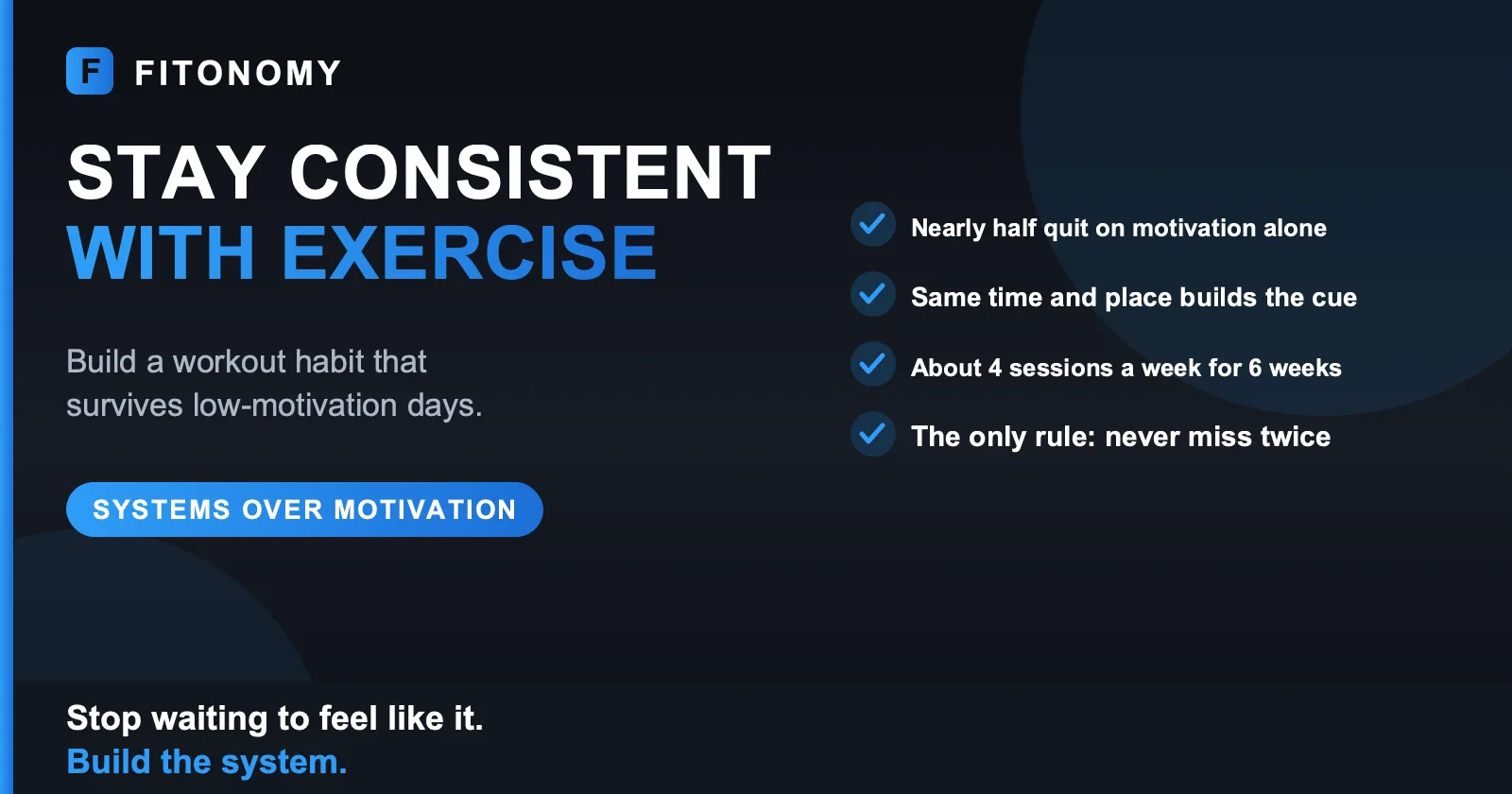
For the gym specifically, a 2015 study by Kaushal and Rhodes followed new gym members and found a clear threshold: you need at least four sessions per week for about six weeks before exercise starts to feel automatic. Fewer than four times a week, and the habit struggled to take hold. So the first six weeks are the hump. Get through them and the behavior starts carrying itself.
Takeaway: Plan for roughly 6 to 10 weeks, not 21 days, and aim for about 4 sessions a week early on. The start is the hardest part by design. It gets easier once automaticity kicks in.
The tactics that actually work
Consistency is a skill you engineer, not a virtue you are born with. These are the interventions with the strongest evidence behind them.
Use if-then plans (implementation intentions). Instead of "I will work out more," decide the exact when and where in advance: "If it is 7 am on Monday, Wednesday, and Friday, then I will train before breakfast." This one tactic is remarkably powerful. A 2006 meta-analysis of 94 studies by Gollwitzer and Sheeran found implementation intentions had a medium-to-large effect (d equals 0.65) on actually achieving goals. Writing down the trigger is half the battle.
Anchor it to a stable time and place. The Kaushal and Rhodes gym study found that people who trained in a consistent context, the same time and same location, built stronger habits, because your brain starts using the cue (waking up, leaving work) to trigger the behavior automatically. Random workout times never become automatic.
Bundle it with something you enjoy. A 2014 study by Milkman and colleagues let people access tempting audiobooks only at the gym. Those in the full version visited 51 percent more often than the control group. Save a show, a podcast, or a playlist for your workouts only. The reward pulls you in on the days discipline will not.
Start smaller than feels necessary. The same research on habit formation shows simpler behaviors automate faster. A workout you will actually do beats a perfect workout you dread. Our guide to strength training after 30 shows how little it takes to get real results, which makes the habit far easier to sustain than a punishing daily grind.
Track it. Watching a streak grow is its own reward and a daily reminder, which is why we lean on logging your workouts. Do not break the chain.
Takeaway: If-then plans (d equals 0.65), a fixed time and place, bundling in something you enjoy (+51 percent attendance), starting tiny, and tracking your streak are the five highest-leverage moves. Use all five.
What works vs what does not
- Relying on motivation. Why it fails or works: Motivation is an emotion that comes and goes. Evidence: 46% of intenders never act (Rhodes 2013).
- "I will work out more" goals. Why it fails or works: No trigger, so nothing initiates the behavior. Evidence: Vague goals underperform if-then plans.
- If-then implementation intentions. Why it fails or works: Pre-decides when and where, removing the choice. Evidence: Medium-to-large effect, d = 0.65 (Gollwitzer 2006).
- Same time and place. Why it fails or works: Builds an automatic cue to action. Evidence: Stronger habits in stable contexts (Kaushal 2015).
- Temptation bundling. Why it fails or works: Pairs the workout with an instant reward. Evidence: +51% gym visits (Milkman 2014).
- All-or-nothing mindset. Why it fails or works: One missed day spirals into quitting. Evidence: Missing once does not break habit formation (Lally 2010).
What to do when you miss a day (do not spiral)
This is where most people actually quit, not from missing a workout but from what they do next. They treat one missed day as proof they failed, and the guilt turns one skipped session into a skipped week and then a skipped month. It is the all-or-nothing trap.
The research is reassuring here. Lally's habit study found that missing a single opportunity to perform the behavior did not meaningfully hurt the habit-formation process. One skipped workout is statistically irrelevant. What matters is the next one. The rule that keeps people consistent for years is simple: never miss twice. Miss a day, fine, life happens. Just do not let it become two in a row. Plan for imperfect weeks, and build a schedule with enough rest days and recovery that you are not setting an impossible standard in the first place.
Takeaway: Missing one workout does not undo your progress, but quitting does. Follow one rule: never miss twice. Consistency is about the long average, not a perfect record.
Make the decision disappear
Every workout you have to decide on is a workout motivation can talk you out of. The most consistent people remove the decision entirely. The plan is set, the time is booked, the gym bag is packed the night before. Decision made once, not renegotiated every morning when you are tired.
The reason so many people stall is decision friction, not laziness. Not knowing what to do that day, whether today is a training day, or if your plan is even working is enough hesitation for the habit to break. Removing that friction is exactly what a good app is for (see whether AI workout planners actually work), and it is why beginners especially benefit from a plan handed to them rather than built from scratch (our first gym workout guide is a good starting point).
Takeaway: Pre-decide everything you can. A booked, planned session you just have to show up for beats a daily negotiation with yourself. Remove the choice and you remove the chance to bail.
The Fitonomy angle: consistency by design
The behavior science points in one direction: consistency comes from removing friction, fixing a cue, and never having to rely on motivation. That is precisely what an app can automate. Fitonomy hands you a structured plan so there is no daily "what should I do today," schedules your sessions with reminders that act as the consistent cue the research says you need, and tracks your streak so the progress is visible and rewarding. It turns "do I feel like training" into "just open the app and follow the plan," which is the whole point. You can build your routine in the Fitonomy app and let the structure carry you through the days motivation does not show up.
Takeaway: The app exists to make the research automatic: a set plan removes decisions, reminders create the cue, and streak tracking rewards showing up. Consistency becomes the default instead of a daily fight.
The bottom line
You do not have a motivation problem, you have a systems problem, and systems are fixable. Stop waiting to feel like it. Set an if-then plan with a fixed time and place, start smaller than feels impressive, bundle in something you enjoy, track the streak, and follow one rule when life gets in the way: never miss twice. Push through the first six weeks and the habit starts doing the work for you. That is how people train for years, not because they are more motivated than you, but because they stopped needing to be.
Frequently asked questions
How long does it take to build a workout habit? Longer than the "21 days" myth. A 2010 study by Lally found habits take a median of 66 days to become automatic, with a range of 18 to 254 days. For the gym specifically, research by Kaushal and Rhodes found you need about four sessions a week for roughly six weeks before exercise starts to feel automatic.
Why can't I stay consistent with exercise even when I want to? Because you are relying on motivation, which is an emotion that comes and goes. A 2013 meta-analysis found 46 percent of people who intend to exercise fail to follow through. It is not a willpower flaw, it is the intention-behavior gap, and the fix is building a system (fixed time, if-then plans, tracking) rather than waiting to feel motivated.
How many days a week should I work out to build a habit? Research on new gym members found about four sessions per week for six weeks was the minimum to form an exercise habit. Training fewer than four times a week made the habit much harder to establish early on, though any consistent schedule beats an inconsistent one.
What should I do if I miss a workout? Do not spiral. Lally's habit research found that missing a single session does not meaningfully hurt habit formation. The problem is not the missed day, it is quitting afterward. Follow one rule: never miss twice. One skipped workout is fine, just do not let it become two in a row.
How do I stay motivated to work out? The honest answer is to stop depending on motivation. Use if-then plans (which have a medium-to-large effect on goal achievement), train at the same time and place to build an automatic cue, bundle workouts with something you enjoy (one study boosted gym visits 51 percent), and track your streak. These systems keep working on the days motivation does not show up.
Use one missed session as information, choose the next realistic action, and resume without automatically making the next workout harder. Return After a Missed Workout Without Punishment