Type "ai workout planner" into an app store and you will get hundreds of results, each promising a personalized program built in seconds. The pitch is hard to ignore: the structure of a coached plan, adapting to your progress, for the price of a coffee per month instead of hundreds of dollars per session. The obvious question is whether any of that holds up, or whether you are paying for a template with a chatbot bolted on.
The honest answer is that it depends on what the planner actually does under the hood, and on whether you follow it. The training principles that good planners automate are well supported by research. The catch is that an app only helps if it keeps you training, and most of the published evidence on fitness apps is about exactly that problem. Here is what the studies show, where AI planners genuinely win, and who still needs a human.
What an AI workout planner actually does
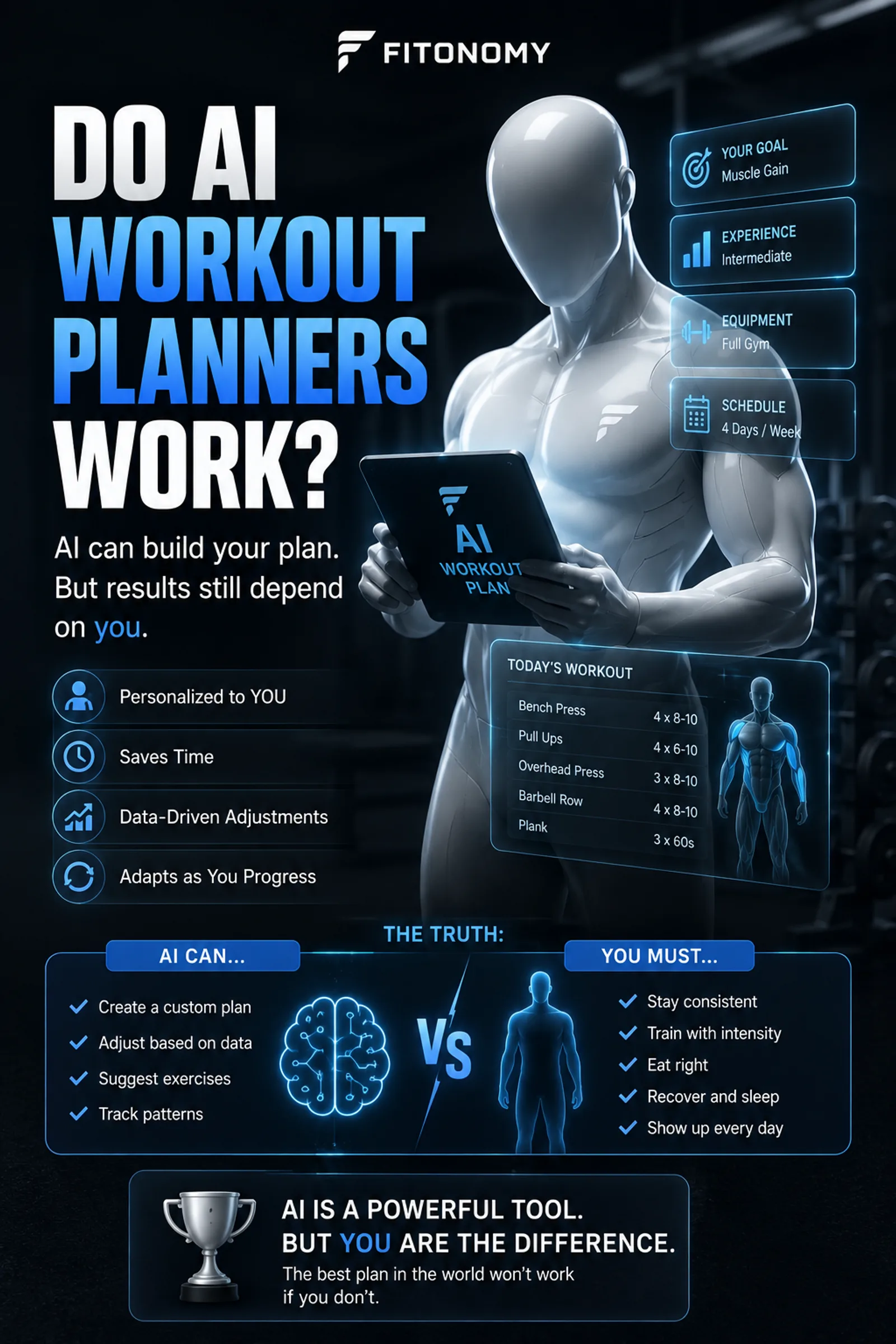
Strip away the marketing and an AI workout planner is software that turns your inputs into a structured, progressing program. You tell it your goal, your experience level, how many days you can train, and what equipment you have. It selects exercises, sets your sets and reps, and, crucially, changes the plan over time based on what you log.
That last part is what separates a real planner from a static PDF. The good ones use a principle called autoregulation: instead of locking you into "add 5 pounds every week no matter what," they adjust load and volume based on your recent performance and how hard your sets felt, often using a rating of perceived exertion or reps in reserve. This is the same logic a competent coach applies when they look at your last session and decide whether to push or hold. The American College of Sports Medicine's position stand on progression is blunt about why this matters: progressive overload, the gradual increase in stress on the body, is what drives continued adaptation, and the specific model matters far less than achieving that overload consistently and individually.
So the question "do AI workout planners work" really splits into two: does the training logic they automate work, and does delivering it through an app actually change what you do?
What the research says about the training logic
Autoregulation is the engine of a modern AI planner, and it has been tested directly against fixed, percentage based programs.
A 2021 systematic review and meta-analysis in Frontiers in Physiology pooled eight studies (166 trained subjects, 5 to 10 week programs) comparing autoregulated training against fixed loading for maximum strength. Autoregulation came out ahead with a standardized mean difference of 0.64 (95% CI 0.43 to 0.85), which is a moderate effect. In practical terms that worked out to roughly 4.65 kg more on the back squat and 3.21 kg more on the bench press one rep max. The advantage was largest in shorter programs (SMD 0.87 under 8 weeks) and the autoregulatory progressive resistance exercise approach ranked best of the methods tested.
It is worth being precise here, because not every analysis is so one sided. A separate meta-analysis on load and volume autoregulation found that when load autoregulation was compared against a well designed standardized program, the strength difference was small and not statistically significant (SMD 0.21, p = 0.09). The takeaway is not that adaptive logic is magic, but that it is at least as good as a carefully built fixed program and tends to edge it out, while being far easier to run automatically. A piece of software can autoregulate every set for every user. A paper template cannot.
The practical reading: a planner that genuinely adjusts to your logged performance is applying sound, evidence based programming. A planner that just spits out a fixed split and never changes is a digital template, and you should treat it like one.
What the research says about the app part
Here is where the skepticism is earned. Having a good plan and following a good plan are different things, and the evidence on fitness apps is mostly about adherence.
A 2019 systematic review and meta-analysis in the Journal of Medical Internet Research looked at whether smartphone apps increase objectively measured physical activity. Across nine studies and 1,740 participants, apps produced a mean increase of about 477 steps per day, but the result was not statistically significant overall (95% CI -229.57 to 1183.07, p = 0.19), and the effect was clearest in the short term, under three months. In other words, an app can nudge behavior, but the nudge is modest and tends to fade.
A 2022 meta-analysis of 12 randomized controlled trials on app based interventions for weight management found small to moderate effects on body weight, body mass index, and body fat. The detail that matters most for choosing a planner: the apps that worked best were the ones with reminders, self reporting, and human coaching built in. Reviews of behavior change techniques in fitness apps point the same direction. Goal setting, self monitoring, and feedback are consistently linked to better outcomes, while bare bones apps that only show you a list of exercises tend to underdeliver.
Put the two bodies of evidence together and a clear picture emerges. The programming logic in a good AI planner works. Whether you get results depends on whether the app is built to keep you logging, progressing, and coming back, because the moment you stop following it, the best algorithm in the world does nothing.
AI workout planner vs the alternatives
Most "AI planner versus personal trainer" comparisons online are thin and skip the static template, which is the option most people are actually choosing between. Here is the fuller picture.
- Typical cost. AI workout planner: Free to about 15 USD per month. Human personal trainer: Roughly 40 to 100+ USD per session. Generic template or PDF: Free to one time fee. Fully DIY: Free.
- Personalization. AI workout planner: Data driven, from your profile and logged performance. Human personal trainer: Highest, reads your body and mood in real time. Generic template or PDF: None after purchase. Fully DIY: Depends entirely on your knowledge.
- Adapts as you progress. AI workout planner: Yes, if it autoregulates. Human personal trainer: Yes. Generic template or PDF: No. Fully DIY: Only if you know how.
- Real time form feedback. AI workout planner: No (video guides only). Human personal trainer: Yes. Generic template or PDF: No. Fully DIY: No.
- Accountability. AI workout planner: Reminders, streaks, logging. Human personal trainer: Strong, a person is expecting you. Generic template or PDF: None. Fully DIY: None.
- Availability. AI workout planner: 24/7. Human personal trainer: Scheduled sessions. Generic template or PDF: 24/7. Fully DIY: 24/7.
- Best for. AI workout planner: Self motivated beginners to intermediates who want structure cheaply. Human personal trainer: Injuries, complex goals, hands on coaching, those who need real accountability. Generic template or PDF: Someone who just wants a starting point. Fully DIY: Experienced lifters who can program themselves.
The pattern is consistent with the research. AI planners are strong on cost, availability, and applying progression logic automatically. Humans are still ahead on the things software cannot see: live form correction, navigating injuries, and the simple accountability of a person who notices when you skip.
Where AI planners genuinely win
For the broad middle of people, beginners through solid intermediates with no injuries and a normal goal like losing fat, building muscle, or just training consistently, an AI planner removes the single biggest barrier: not knowing what to do. It answers what to train, how much, and when to push harder, and it keeps answering as you change. You also get cost (a year of most planners costs less than one month of twice weekly personal training), instant availability, and zero scheduling friction.
If you want the deeper version of how to set sensible volume and intensity, our guide to strength training after 30 walks through the minimum effective dose, and the hybrid training guide covers combining strength and conditioning without burning out.
Where they fall short, and who should not rely on one
AI planners cannot watch you move, so they cannot fix your squat depth or catch a compensating shoulder. They are weak on complex injury rehabilitation and on highly specialized goals like competitive powerlifting peaking or return to sport after surgery. And because some tools generate plans with a general purpose language model, you can occasionally get exercises that do not fit your stated equipment or, rarely, advice that is simply wrong, so the program is worth a sanity check.
You should lean toward a qualified human, at least to start, if you are rehabbing a real injury, managing a medical condition that affects training, brand new to lifting and anxious about form, or chasing a specialized competitive goal. For almost everyone else, an AI planner is a reasonable and affordable way to train with structure.
How to tell a good AI planner from a glorified template
Use this checklist before you commit:
- It adapts. The plan changes based on what you log, not just on your initial answers. If week six looks identical to week one regardless of your performance, it is a template.
- It captures effort. It asks how hard sets felt (RPE or reps in reserve) or tracks your weights and reps, because that is the input autoregulation needs.
- It has form guidance. Exercise demonstrations or videos matter, since the app cannot correct you in person.
- It is built for adherence. Reminders, logging, and progress views are the features the research links to actual results.
- It respects your equipment and schedule. A good planner programs around what you have, not a generic gym.
How Fitonomy approaches it
Fitonomy's AI Workout Planner is built around that checklist. It generates a personalized program from your goals, fitness level, schedule, and the equipment you actually have, then pairs it with an exercise library of video form guides and a workout logger so the plan can progress off real data rather than a fixed schedule. The logging and reminders are the adherence layer the studies keep pointing to, and the video guidance covers the form gap that pure text plans leave open. It is not a replacement for hands on coaching through an injury, and it does not pretend to be, but for building and following a structured plan it does the job a good planner is supposed to do.
The bottom line
Do AI workout planners actually work? Yes, with two honest caveats. The adaptive training logic they automate is backed by research, with autoregulation showing a moderate edge over fixed loading for strength (SMD 0.64). And fitness apps do change behavior, but modestly, and mostly when they are built to keep you engaged. Choose a planner that genuinely adapts and is designed to keep you logging, actually follow it, and you will get most of the benefit of structured coaching for a tiny fraction of the cost. Treat it as a magic button you can ignore, and no algorithm will save you.
Frequently asked questions
Do AI workout planners actually work? Yes, with caveats. The adaptive training logic good planners automate is well supported. A 2021 meta-analysis in Frontiers in Physiology found autoregulated training beat fixed loading for maximum strength with a moderate effect (SMD 0.64, 95% CI 0.43 to 0.85). Separately, research on fitness apps shows they change behavior modestly and mainly when they include reminders, logging, and coaching features that drive adherence. The plan works if you follow it, so engagement features matter as much as the programming.
Are AI workout planners as good as a personal trainer? For applying progression logic and providing structure at low cost, they are competitive. For things software cannot see, they are not. A human trainer corrects your form in real time, manages injuries, and provides face to face accountability. An AI planner cannot watch you move. For self motivated beginners and intermediates with no injuries, a planner covers most needs. For rehab, medical conditions, or specialized competitive goals, a qualified human is the safer choice.
How does an AI workout planner work? You provide your goal, experience level, available days, and equipment. The planner selects exercises and sets your sets and reps, then adjusts load and volume over time based on what you log and how hard your sets feel, often using rating of perceived exertion or reps in reserve. This autoregulation is what separates a real planner from a static template that never changes.
Are free AI workout planners any good? Some are, but free tools often skip the features that drive results. Research links goal setting, self monitoring, feedback, and reminders to better outcomes, and many bare bones free apps lack them. A free planner that genuinely adapts to your logged performance and helps you stay consistent can work well. One that only displays a fixed list of exercises is effectively a template.
Is it safe to follow an AI generated workout plan? For healthy adults without injuries, generally yes, especially with planners that include video form guidance. Be cautious with tools built on general purpose AI, which can occasionally suggest exercises that do not fit your equipment or give incorrect advice, so a quick sanity check helps. If you have an injury, a medical condition that affects training, or are completely new and unsure about form, consult a qualified professional first.
Who should not rely on an AI workout planner? People rehabilitating a real injury, managing a medical condition that affects exercise, complete beginners who are anxious about form, and athletes chasing specialized competitive goals such as powerlifting peaking or return to sport. These cases need the real time judgment and hands on correction that only a human can provide. For most other goals, an AI planner is a reasonable and affordable option.