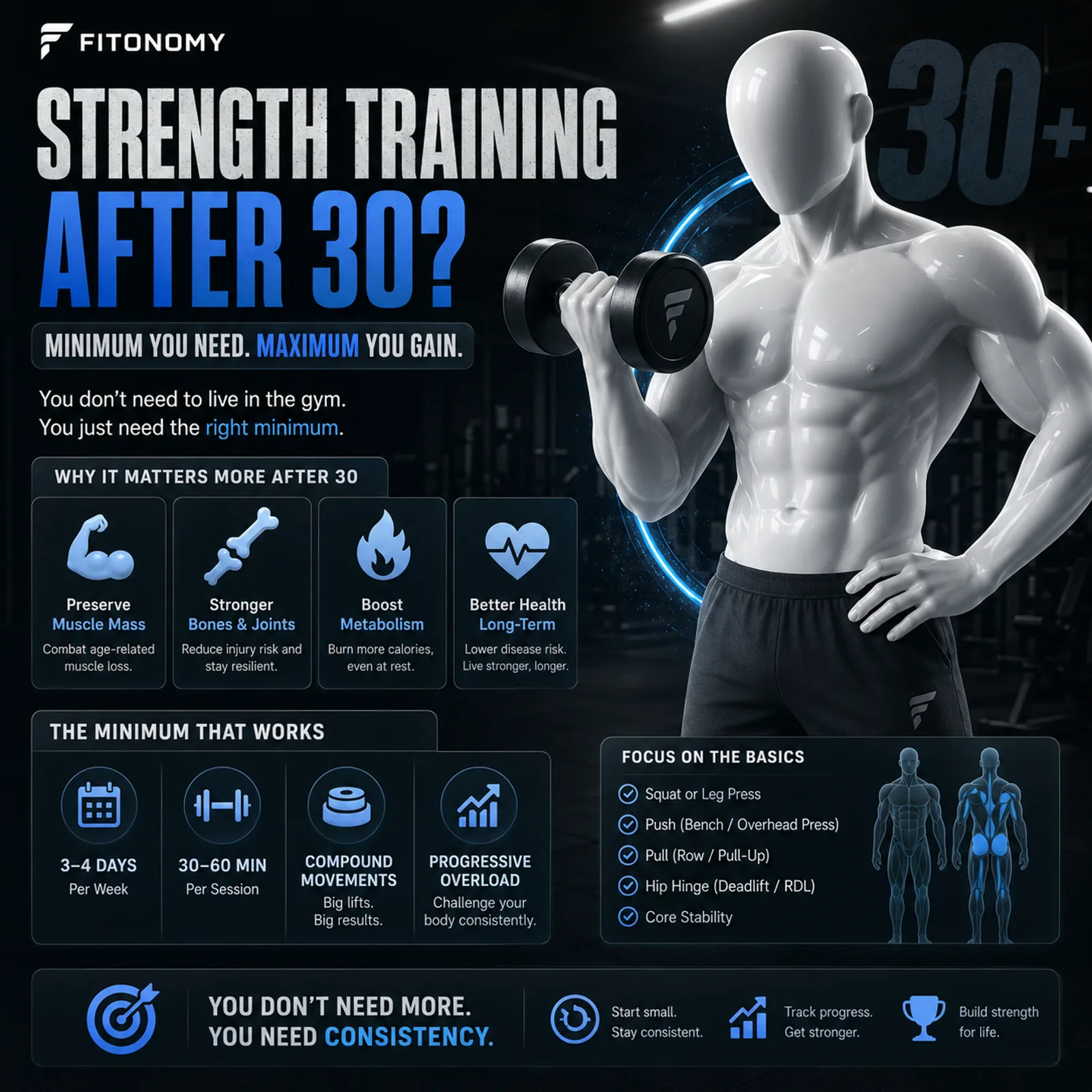
Most strength-training advice was written for people who love the gym. You probably don't. You're 32, you have meetings, kids, or both, and you have maybe 90 minutes a week to spend on this.
Good news: that's enough.
The latest evidence (including a brand-new ACSM position stand published this year) says the minimum effective dose is much lower than the fitness internet wants you to believe. The harder problem is showing up.
Here's how much you actually need, what changes after 30, and what the research says about getting away with less.
What changes after 30 (the case for lifting at all)
You start losing muscle. Slowly at first, then less slowly. Muscle mass decreases approximately 3 to 8 percent per decade after the age of 30 and this rate of decline is even higher after the age of 60. Strength and power decline to a greater extent than does muscle mass, meaning the function (lifting groceries, climbing stairs, getting up from the floor) goes faster than the mass.
Resistance training is the main lever you have. Strength training is the only activity proven to slow the progression of sarcopenia and reduce its effects.
Cardio matters too, but it doesn't replace this. Even if you walk daily, you'll continue losing muscle without resistance work.
Takeaway: After 30, lifting isn't optional if you want to keep the body you have. The question is just how much.
The 2026 ACSM update: the headline finding
The American College of Sports Medicine recently published its first major resistance-training position stand since 2009. It synthesized 137 systematic reviews and over 30,000 participants.
The headline finding is striking: the most meaningful gains come from a simple shift, moving from no resistance training to any form of resistance training. While specific training variables can be tweaked, the primary goal for most adults should be regular participation in any form of resistance training.
Lead author Stuart Phillips put it plainly: the best resistance training program is the one you'll actually stick with. Training all major muscle groups at least twice a week matters far more than chasing a perfect or complex training plan. Whether it's barbells, bands, or bodyweight, consistency and effort drive results.
The position stand also notes that many popular training concepts are not strictly necessary for general health and fitness. Training to fatigue or momentary muscle failure, using specific types of equipment, and complex periodization did not consistently impact outcomes for the average healthy adult.
Takeaway: The most evidence-based answer to "how much strength training do I need after 30?" is two sessions a week, all major muscle groups, with effort. Everything beyond that is optimization, not the foundation.
How little can you actually do? (The minimum effective dose)
Here's where the research gets interesting for the time-crunched.
A 2020 systematic review and meta-analysis specifically examined the minimum effective dose for 1RM strength gains. The conclusion: a single set performed minimum 1 time and maximum 3 times per week was sufficient to induce significant 1RM strength gains. The pooled effect was an estimated increase for overall 1RM of 12.09 kg (95 percent CI 8.16 to 16.03), including 17.48 kg on the squat and 8.25 kg on the bench press.
In plain English: one hard set, 1 to 3 times a week, produced about 26 lbs of squat strength gain on average.
A 2021 review on the minimum dose for maintaining performance went further. Strength and muscle size (at least in younger populations) can be maintained for up to 32 weeks with as little as 1 session of strength training per week and 1 set per exercise, as long as exercise intensity is maintained. In older populations, maintaining muscle size may require up to 2 sessions per week and 2 to 3 sets per exercise. The authors flagged the key variable: exercise intensity seems to be the key variable for maintaining physical performance over time, despite relatively large reductions in frequency and volume.
The Mayo Clinic states it more bluntly: a single set of 12 to 15 repetitions with the proper weight can build muscle efficiently in most people and can be as effective as three sets of the same exercise.
The catch is effort. A minimum dose only works if the set is hard. You should finish a set unable to do another rep with good form, or close to it.
Takeaway: If you take each set to near-failure with good form, one hard set of each major exercise, two times a week, is enough to drive measurable strength gains. That's roughly 30 to 45 minutes of total weekly lifting.
Frequency: 2 vs 3 vs 5 days a week
The research on frequency is consistent and underwhelming for the gym devotees.
Schoenfeld's 2016 meta-analysis on frequency found that when total weekly volume is matched, 1, 2, and 3 sessions per week per muscle group produce similar hypertrophy. More recent reviews confirm that training frequency did not affect changes in muscle mass once volume is accounted for.
For older adults specifically, two sessions per week may offer greater benefit compared to once weekly training for improving muscle strength, yet it remains unclear how much a third session per week adds.
So the practical answer for over-30 readers:
- 2 sessions per week: the floor. Nearly all evidence-based outcomes hit at this dose.
- 3 sessions per week: small additional benefit, mostly for strength, not size.
- 4 to 5 sessions per week: for people who enjoy it. Diminishing returns kick in fast.
Takeaway: Two full-body sessions per week beat three split-body sessions you don't actually finish. Pick frequency for adherence, not optimization.
How long should each session be?
Short. Shorter than you think.
Mayo Clinic's recommendation: you can see significant improvement in your strength with just two or three 20 or 30 minute strength training sessions a week.
The math holds up. If you do 6 compound exercises (squat, hinge, push, pull, lunge, carry) with 2 sets of each at moderate effort, that's roughly 25 to 35 minutes including rest. Twice a week is 50 to 70 minutes total.
That's the minimum. If you have more time, add a set or an extra exercise, not an extra day.
Takeaway: 30 minutes, twice a week, gets the job done. Stop over-engineering this.
What to actually do (a starter template)
The 2026 ACSM update emphasizes major muscle groups, not specific equipment. Bodyweight, bands, dumbbells, machines all work if effort is real.
A simple, evidence-aligned template for someone over 30 starting from zero:
Session A (e.g. Tuesday)
- Goblet squat, 2 sets of 8 to 12
- Dumbbell row, 2 sets of 8 to 12
- Push-up (or bench press), 2 sets of 8 to 12
- Glute bridge, 2 sets of 12 to 15
- Plank, 2 sets of 30 seconds
Session B (e.g. Friday)
- Romanian deadlift (DB or KB), 2 sets of 8 to 12
- Overhead press, 2 sets of 8 to 12
- Walking lunge, 2 sets of 8 per leg
- Lat pulldown or band pulldown, 2 sets of 10 to 12
- Dead bug, 2 sets of 30 seconds
Pick weights heavy enough that the last 1 to 2 reps of each set feel hard. As soon as 12 reps feel easy, increase the weight or reps.
Takeaway: Two full-body sessions per week, 5 to 6 movements each, hit the major muscle groups. You don't need a split routine until you want one for variety.
What about lifting heavy? Or going to failure?
The 2026 ACSM update is explicit: training to fatigue or momentary muscle failure did not consistently impact outcomes for the average healthy adult. Going close to failure is enough. Going all the way to failure adds fatigue, recovery cost, and injury risk without proportional gains.
For loading, a wide load range works. Older adults can start as low as 30 to 60 percent of 1RM and progress to 70 to 85 percent as conditioning allows. You don't need to be hitting 5-rep maxes to drive adaptation in your 30s.
Takeaway: Train hard, not maximal. Leaving one to three reps in the tank at the end of each set is the sweet spot for results and recovery.
Pairing strength with cardio (and protein)
Two strength sessions a week is the foundation. To round out the picture for fat loss and longevity, pair them with brisk walking or another cardio modality on most other days.
Protein matters more than usual at this age. Recent recommendations suggest a daily intake of 1 to 1.3 grams of protein per kilogram of body weight for older adults who do resistance training, roughly 0.7 to 0.9 grams per pound. Without it, you've done the work but not given your body the raw materials.
The bottom line
Two full-body sessions a week, 30 minutes each, with effort, hits the major muscle groups and clears almost every threshold the research cares about. One hard set is enough to start. Two is better. Three is optimization.
The science doesn't reward complexity. It rewards consistency. After 30, the most underrated thing you can do is the same simple workout, twice a week, for ten years.
That's it. That's the program.
Sources
- Currier, B.S., Phillips, S.M., et al. (2026). Resistance Training Prescription for Muscle Function, Hypertrophy, and Physical Performance in Healthy Adults: An Overview of Reviews. Medicine & Science in Sports & Exercise.
- Androulakis-Korakakis, P., et al. (2020). The Minimum Effective Training Dose Required to Increase 1RM Strength in Resistance-Trained Men. Sports Medicine. https://pubmed.ncbi.nlm.nih.gov/31797219/
- Spiering, B.A., et al. (2021). Maintaining Physical Performance: The Minimal Dose of Exercise. J Strength Cond Res. https://pubmed.ncbi.nlm.nih.gov/33629972/
- Nuzzo, J.L., et al. (2024). Resistance Exercise Minimal Dose Strategies. Sports Medicine. https://link.springer.com/article/10.1007/s40279-024-02009-0
- Schoenfeld, B.J., Ogborn, D., Krieger, J.W. (2016). Effects of Resistance Training Frequency on Muscle Hypertrophy. Sports Medicine. https://pubmed.ncbi.nlm.nih.gov/27102172/
- Mayo Clinic. Strength training: Get stronger, leaner, healthier. https://www.mayoclinic.org/healthy-lifestyle/fitness/in-depth/strength-training/art-20046670
Frequently asked questions
Is 2 days a week of strength training enough after 30? Yes. Training all major muscle groups twice per week is the high-leverage threshold for healthy adults. Frequency meta-analyses show that, when weekly volume is matched, 2 and 3 sessions per week produce similar muscle and strength gains.
What's the minimum I can do and still see results? A 2020 meta-analysis found a single set, performed 1 to 3 times per week, was enough to drive significant 1RM strength gains, averaging around 12 kg of total 1RM increase. The catch: the set has to be hard, and you have to keep increasing the load over time.
Do I have to lift heavy after 30? No. Load can range from roughly 30 to 85 percent of 1RM and still produce results, especially if you're newer to lifting. Effort matters more than absolute weight. Stop each set 1 to 3 reps before failure with good form.
How long should each strength session take? 20 to 30 minutes is enough for a full-body session of 5 to 6 compound exercises with 2 sets each. Longer sessions aren't required for general health and body composition outcomes.
Can I still build muscle after 30? Yes. Resistance-training adaptations remain robust through middle age and beyond. The rate of muscle loss in untrained adults is 3 to 8 percent per decade after 30, but consistent resistance training slows or reverses that trajectory.