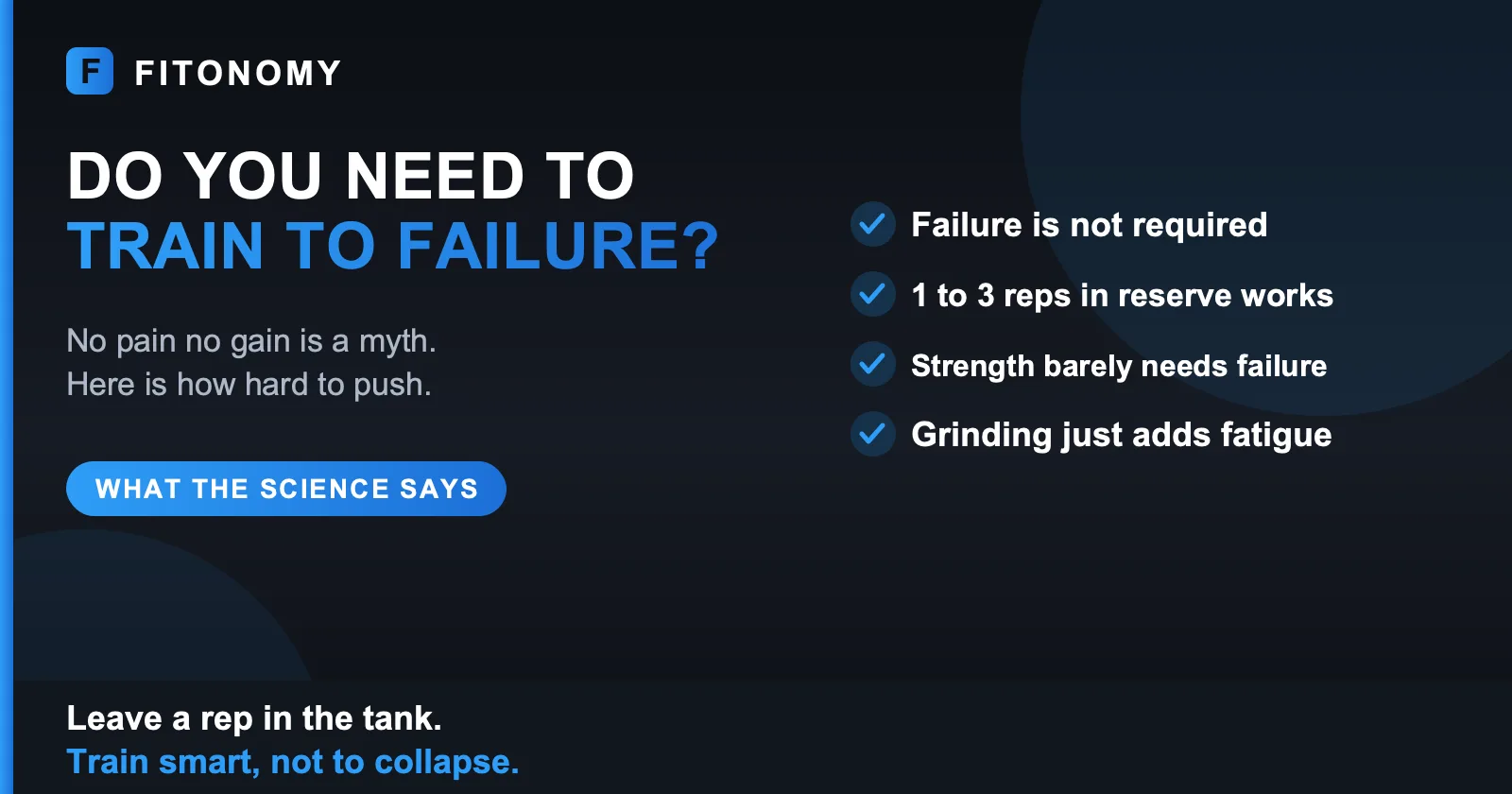
Somewhere along the way, fitness culture decided that a set only counts if it ends in trembling collapse. No pain, no gain. Grind every rep until you physically cannot move the weight, or you left gains on the table. It is a hardcore-sounding rule, and it is mostly wrong.
The research is clear and a little freeing: you do not need to train to failure to build muscle or get strong. Stopping a couple of reps short works nearly as well, and it costs you far less in fatigue, recovery, and risk. Here is exactly how hard you actually need to push.
What "training to failure" and RIR mean
Training to failure means doing a set until you cannot complete another rep with good form. The alternative is stopping short by a known margin, measured as reps in reserve (RIR), the number of reps you could still have done. Two reps in reserve means you stopped when you had two good reps left. Proximity to failure is just how close you push, and it turns out to be one of the most misunderstood training variables.
Takeaway: Training to failure means going until you cannot do another rep. Reps in reserve (RIR) is how many you leave in the tank. How close you push is proximity to failure.
Do you need failure to build muscle?
Mostly, no. A 2022 meta-analysis by Grgic and colleagues found no significant difference between training to failure and stopping short for muscle growth or strength. A 2023 meta-analysis by Refalo and colleagues looked specifically at proximity to failure and found only a trivial hypertrophy advantage to going closer (effect size around 0.19), concluding that stopping one to three reps short of failure produces essentially the same muscle growth as grinding all the way in trained adults.
A 2024 dose-response analysis by Robinson and colleagues refined this: muscle growth does inch up as you train closer to failure, but the effect is small, and it can be matched by simply doing a bit more volume shy of failure. So failure offers, at most, a minor hypertrophy bonus, not a requirement.
Takeaway: For muscle, training to failure gives at most a trivial edge over stopping one to three reps short. You can build essentially the same muscle without ever hitting failure.
Do you need failure for strength?
No, and this one is clearer. The 2024 Robinson analysis found that strength gains are largely unaffected by how close you train to failure. In fact, the 2022 Grgic meta found that when volume was matched, non-failure training slightly favored strength. Strength is built by lifting heavy with good technique and quality, and pushing to failure on heavy compound lifts mostly just adds fatigue and technical breakdown without adding strength.
Takeaway: For strength, proximity to failure barely matters, and stopping short can even be better. Lift heavy with good form and leave failure alone on your big lifts.
The hidden cost of always going to failure
If failure is not necessary, why avoid it? Because it is expensive. Training to failure generates far more fatigue, takes longer to recover from, and degrades your form on the final grinding reps, which raises injury risk. That extra fatigue also eats into the total quality volume you can do, and volume is a bigger driver of growth than squeezing out one more failed rep: a 2017 meta-analysis by Schoenfeld and colleagues found muscle grows with weekly volume, roughly 0.37 percent more per additional set. If failure forces you to cut later sets short or train less often (see our rest days and muscle soreness guides), it can cost you more volume than it gains.
Takeaway: Constant failure adds fatigue, recovery time, and injury risk, and it can reduce the quality volume that actually drives growth. The cost usually outweighs the tiny benefit.
The practical sweet spot
Aim to take most sets to about one to three reps in reserve, hard and challenging, but not to collapse. That captures nearly all the muscle and strength benefit while keeping fatigue manageable. Save actual failure for the occasional last set of a safe isolation exercise (like a leg extension or curl), where form breakdown is low risk, and keep it away from heavy compounds like squats and deadlifts. Judging your RIR is a skill worth developing, and it is the same effort-based autoregulation that research supports for progress (a 2021 meta-analysis by Zhang and colleagues found autoregulating effort beat rigid fixed loading, effect size 0.64). Track your reps and effort so you can push a little harder over time (see tracking your workouts and the load logic in strength training after 30).
Takeaway: Take most sets to 1 to 3 reps in reserve. Reserve true failure for safe isolation moves, avoid it on heavy compounds, and use effort (RIR) to guide progression.
Training to failure vs leaving reps in reserve
- Muscle growth. Training to failure: Slight edge at most. 1 to 3 reps in reserve: Nearly the same.
- Strength gain. Training to failure: No advantage, sometimes worse. 1 to 3 reps in reserve: Equal or better.
- Fatigue and recovery. Training to failure: High. 1 to 3 reps in reserve: Manageable.
- Injury and form risk. Training to failure: Higher (form breaks down). 1 to 3 reps in reserve: Lower.
- Sustainable weekly volume. Training to failure: Reduced. 1 to 3 reps in reserve: Higher.
- Best for. Training to failure: Occasional isolation sets. 1 to 3 reps in reserve: Most sets, most people.
Takeaway: Leaving one to three reps in reserve matches or beats training to failure on nearly every measure that matters, while costing far less. It is the better default.
How Fitonomy helps
Knowing how hard to push, set by set, is exactly the kind of thing a good plan handles for you. Fitonomy's AI Workout Planner programs your sets, reps, and target effort and progresses the load over time, so you train hard enough to grow without grinding every set into the ground and paying for it in recovery. It turns effort management from guesswork into a plan you can follow.
The bottom line
You do not need to train to failure. The research shows that stopping one to three reps short builds nearly the same muscle and the same or better strength, while sparing you the fatigue, recovery cost, and injury risk that constant failure brings. Push your sets hard, leave a rep or two in the tank on most of them, save true failure for the occasional safe isolation set, and put your energy into consistent volume and progression over time. Training smart beats training to collapse.
Sources
- Grgic, J., et al. (2022). Effects of resistance training performed to repetition failure or non-failure on muscular strength and hypertrophy: A systematic review and meta-analysis. Journal of Sport and Health Science. https://pmc.ncbi.nlm.nih.gov/articles/PMC9068575/
- Refalo, M.C., et al. (2023). Influence of Resistance Training Proximity-to-Failure on Skeletal Muscle Hypertrophy: A Systematic Review with Meta-analysis. Sports Medicine. https://pmc.ncbi.nlm.nih.gov/articles/PMC9935748/
- Robinson, Z.P., et al. (2024). Exploring the Dose-Response Relationship Between Estimated Resistance Training Proximity to Failure, Strength Gain, and Muscle Hypertrophy: A Series of Meta-Regressions. Sports Medicine. https://link.springer.com/article/10.1007/s40279-024-02069-2
- Schoenfeld, B.J., Ogborn, D., Krieger, J.W. (2017). Dose-response relationship between weekly resistance training volume and increases in muscle mass. Journal of Sports Sciences. https://pubmed.ncbi.nlm.nih.gov/27433992/
- Zhang, X., et al. (2021). Effects of Autoregulation vs. Fixed Loading on Maximal Strength: A Systematic Review and Meta-Analysis. Frontiers in Physiology. https://pmc.ncbi.nlm.nih.gov/articles/PMC7994759/
Frequently asked questions
Do you need to train to failure to build muscle? No. Meta-analyses show that stopping one to three reps short of failure builds essentially the same muscle as training to failure, with only a trivial advantage to going all the way. You can build muscle very effectively without ever hitting failure, as long as you train hard and accumulate enough weekly volume. Failure is an option, not a requirement.
Is training to failure better for strength? No. Research shows strength gains are largely unaffected by how close you train to failure, and when volume is matched, stopping short can even be slightly better for strength. Strength comes from lifting heavy with good technique. Pushing heavy compound lifts to failure mostly adds fatigue and form breakdown without adding strength.
How many reps short of failure should I stop? About one to three reps in reserve for most sets. That means stopping when you could still do one to three more good reps. This captures nearly all the muscle and strength benefit of a set while keeping fatigue and injury risk low. It is challenging but controlled, which is the sweet spot for consistent progress.
Is training to failure bad for you? Not bad in small doses, but costly if overused. Training to failure generates much more fatigue, takes longer to recover from, and degrades form on the last reps, which raises injury risk, especially on heavy compound lifts. It also reduces the quality volume you can do overall. Occasional failure on safe isolation exercises is fine; constant failure is counterproductive.
What is RIR (reps in reserve)? Reps in reserve is how many more reps you could have done at the end of a set. Two RIR means you stopped with two good reps left. It is a simple way to gauge effort: most sets should end at one to three RIR. Learning to estimate RIR lets you train hard consistently and progress the load over time without grinding to failure every set.
Should beginners train to failure? Beginners especially should avoid it. Form tends to break down near failure, and beginners are still learning technique, so failure raises injury risk with little added benefit. New lifters make excellent progress leaving two to three reps in reserve, focusing on learning the movements and adding weight or reps gradually rather than grinding every set to exhaustion.