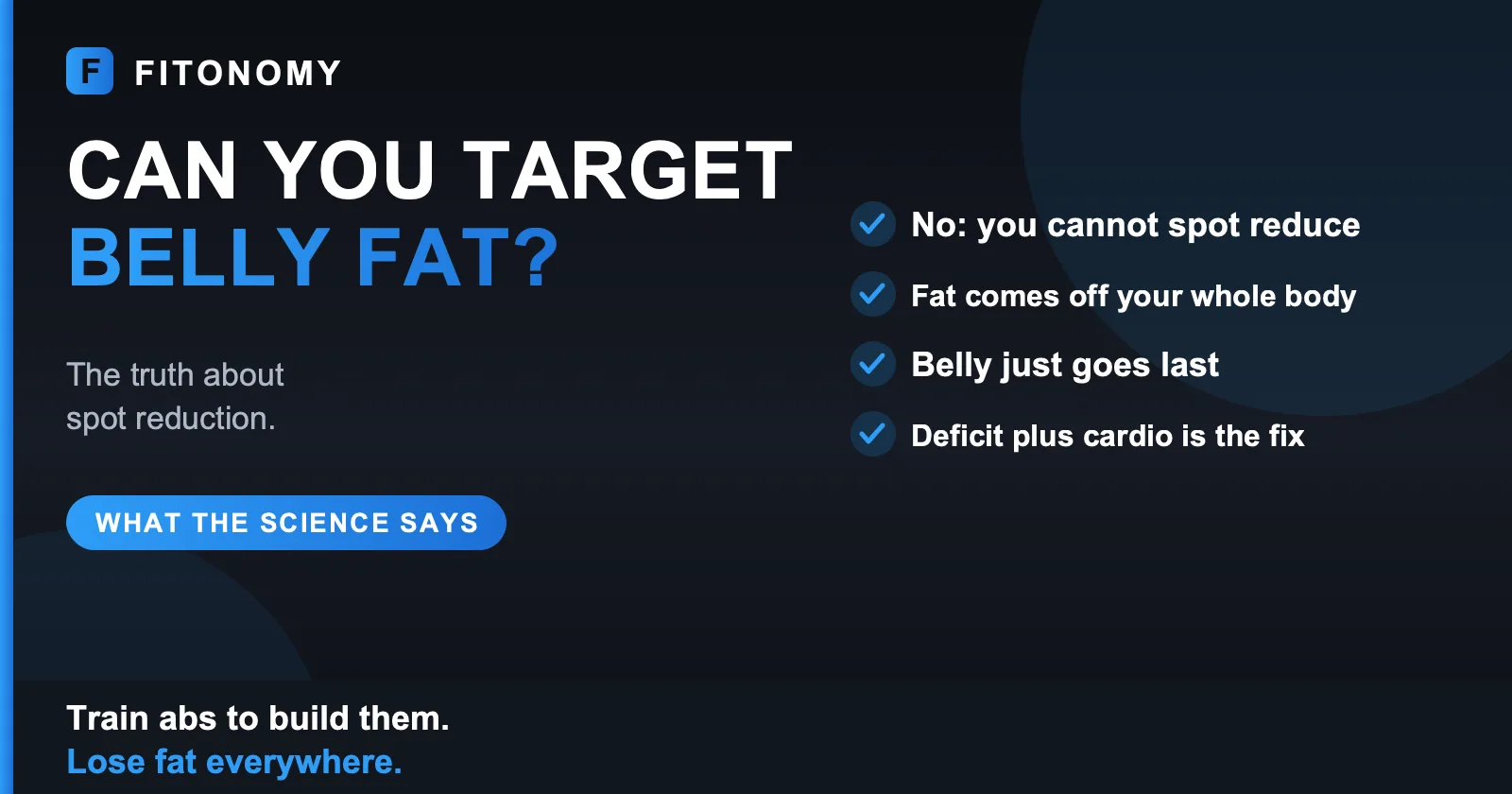
Every fitness feed is full of the same promise: do this ab routine to melt belly fat, these moves to blast love handles, this waist trainer to shrink your middle. The idea, called spot reduction, is that exercising a body part burns the fat sitting on top of it. It is one of the most appealing ideas in fitness, and one of the most thoroughly debunked.
The research gives a clear, slightly annoying answer: you cannot target where you lose fat. Here is the evidence, why your body works this way, and what actually does reduce belly fat (because the news is not all bad).
What spot reduction claims
Spot reduction is the belief that training a specific muscle burns the fat directly above it. Crunches for belly fat, inner-thigh machines for thigh fat, arm exercises for arm fat. It feels intuitive: work the area, lose the fat there. The problem is that it is not how fat loss works.
Takeaway: Spot reduction is the idea that exercising a body part burns the fat over it. It is intuitive, popular, and wrong.
The evidence that it does not work
Researchers have tested this directly and repeatedly, and the results line up.
In a 2011 study by Vispute and colleagues, participants did seven abdominal exercises five days a week for six weeks while keeping their diet constant. The result: no change in belly fat, abdominal circumference, or body fat. Six weeks of dedicated ab work moved nothing.
A cleverer test came from Kostek and colleagues (2007), who had 104 people train only one arm for 12 weeks. If spot reduction were real, the trained arm should lose more fat. MRI scans showed the opposite: fat loss was generalized across the body, not concentrated in the worked arm.
And pulling it all together, a systematic review and meta-analysis by Ramirez-Campillo and colleagues pooled 13 studies and 1,158 people training one limb versus the other. The result was a pooled effect size of essentially zero (-0.03), meaning no localized fat loss at all. The verdict across the literature is consistent: spot reduction does not happen.
Takeaway: Multiple studies, including a meta-analysis of over 1,100 people, find no spot reduction. Training one area does not burn the fat there; fat comes off your whole body.
Why your body works this way
The reason is simple once you see it. The fat stored under your skin is not plumbed directly into the muscle beneath it. To use fat for fuel, your body breaks it down and ships it through the bloodstream to wherever it is needed, drawing from stores all over your body, not just the area you are exercising. A crunch burns a tiny number of calories and builds the ab muscle, but it does not reach into the fat layer on top and burn it specifically.
So when you lose fat, you lose it systemically, in a pattern your body chooses, not the one you target.
Takeaway: Fat is broken down and transported through the blood from stores all over the body, not pulled from the muscle you are training. That is why exercising a spot cannot slim that spot.
Why belly fat feels so stubborn
If you lose fat everywhere, why does the belly (or hips and thighs) seem to be the last to go? Because where you store and lose fat first is largely genetic and hormonal, and not something you control. Most people have certain "stubborn" areas, often the lower belly and lower back for men, and hips and thighs for women, that the body holds onto and releases last. You will lose fat from there eventually, but only after the easier stores go first. It is an order-of-operations problem, not a targeting problem.
Takeaway: Stubborn belly fat is not resistant to a specific exercise; it is simply where your genetics make you lose fat last. Keep the deficit going and it does come off, just later than the rest.
What actually reduces belly fat
Here is the good news: belly fat absolutely can be reduced, just through overall fat loss, not targeting. Three things drive it.
1. A calorie deficit. This is the only thing that actually burns fat, from everywhere including your belly. It is won mostly in the kitchen (see our guide to setting a calorie deficit).
2. Exercise that burns calories and builds muscle. Cardio supports the deficit and resistance training preserves and builds muscle. Notably, a 2018 meta-analysis by Maillard and colleagues found that interval training is effective at reducing total, abdominal, and even deep visceral fat (see HIIT vs steady-state and walking vs running for choosing your cardio).
3. Patience and consistency. Since stubborn areas go last, the belly often shows progress later than your face or arms. Stay in the deficit and it follows.
Takeaway: Belly fat comes off through an overall calorie deficit plus exercise, the same way all fat does. Interval training is especially effective at cutting abdominal and visceral fat.
So should you still do ab exercises?
Yes, just for the right reason. Training your core builds the ab muscles, improves strength and posture, and means that once you lose the fat covering them, there is actually something defined underneath. Ab work is worth doing to build the muscle, not to burn the fat. Think of it as sculpting the statue while the deficit removes the cover.
Takeaway: Keep doing ab and core work to build strength and definition, just not as a fat-burning tool. The muscle you build shows once overall fat loss reveals it.
Myth versus reality
- Crunches burn belly fat. What the research shows: 6 weeks of ab work changed no abdominal fat.
- Train an area to slim it. What the research shows: One-arm training produced generalized, not local, fat loss.
- You can choose where you lose fat. What the research shows: Fat loss order is genetic and systemic.
- Waist trainers and ab belts melt fat. What the research shows: No fat is burned; they do not create a deficit.
- Ab workouts are useless. What the research shows: They build the muscle that shows once fat drops.
Takeaway: You cannot spot-reduce, gadgets do not work, and the belly is just last in line. Overall fat loss is the only lever, and ab training builds what shows underneath.
How Fitonomy helps
Since belly fat comes off through an overall deficit plus training, the system that works is the same one for any fat-loss goal. Fitonomy's Meal Planner structures the calorie deficit that actually burns the fat, and its AI Workout Planner builds the training that supports it and develops the muscle underneath. Together they target the real driver of belly fat, your overall energy balance, instead of a body part.
The bottom line
You cannot target belly fat, and no exercise, gadget, or routine changes that. Fat is mobilized from all over your body in an order your genetics set, which is why stubborn areas go last. The only thing that reduces belly fat is overall fat loss, driven by a calorie deficit and supported by exercise, with interval training especially good at trimming abdominal and visceral fat. Keep training your core to build it, stay patient through the stubborn phase, and the belly comes off the same way the rest of you does.
Sources
- Vispute, S.S., et al. (2011). The Effect of Abdominal Exercise on Abdominal Fat. Journal of Strength and Conditioning Research. https://pubmed.ncbi.nlm.nih.gov/21804427/
- Kostek, M.A., et al. (2007). Subcutaneous Fat Alterations Resulting from an Upper-Body Resistance Training Program. Medicine & Science in Sports & Exercise. https://pubmed.ncbi.nlm.nih.gov/17596788/
- Ramirez-Campillo, R., et al. (2022). A proposed model to test the hypothesis of exercise-induced localized fat reduction (spot reduction), including a systematic review with meta-analysis. Human Movement. https://www.researchgate.net/publication/355379614_A_proposed_model_to_test_the_hypothesis_of_exercise-induced_localized_fat_reduction_spot_reduction_including_a_systematic_review_with_meta-analysis
- Maillard, F., et al. (2018). Effect of High-Intensity Interval Training on Total, Abdominal and Visceral Fat Mass: A Meta-Analysis. Sports Medicine. https://link.springer.com/article/10.1007/s40279-017-0807-y
- Sacks, F.M., et al. (2009). Comparison of Weight-Loss Diets with Different Compositions of Fat, Protein, and Carbohydrates. New England Journal of Medicine. https://pubmed.ncbi.nlm.nih.gov/19246357/
Frequently asked questions
Can you target belly fat with exercise? No. Spot reduction does not work. Studies, including a meta-analysis of over 1,100 people, show that exercising a specific area does not burn the fat over it. Fat is mobilized from stores all over your body through the bloodstream, not pulled from the muscle you are training. You lose fat in a systemic pattern set by your genetics, not where you choose.
Do ab exercises burn belly fat? Not specifically. In a controlled study, six weeks of abdominal exercise five days a week produced no change in belly fat when diet was held constant. Ab exercises build the core muscles, which is worthwhile, but they do not burn the fat covering them. Belly fat is reduced by overall fat loss, not by working the area underneath it.
Why is belly fat so hard to lose? Because where you lose fat first is genetic and hormonal, and the belly (along with hips and thighs) is often where the body holds on longest. You do lose fat from there, but only after easier stores go first. It is an order-of-operations issue, not a sign that belly fat needs a special exercise. Staying in a calorie deficit eventually reduces it.
How do you actually lose belly fat? Through overall fat loss. The main driver is a calorie deficit, which burns fat from all over your body including the belly. Support it with exercise: cardio to help the deficit and resistance training to keep muscle. Interval training is particularly effective at reducing abdominal and visceral fat. There is no shortcut to the belly specifically, only consistent overall fat loss.
Do waist trainers or fat-burner belts work? No. Waist trainers, sauna belts, and similar gadgets do not burn fat, because nothing about them creates the calorie deficit that fat loss requires. Any temporary change is water loss or compression, not fat loss. They cannot override the fact that fat is lost systemically through energy balance, not squeezed off one area.
Should I still do ab workouts? Yes, but for the right reason. Core training builds the abdominal muscles, improves strength and posture, and means there is something defined underneath once you lose the fat covering it. Do ab work to build the muscle, not to burn belly fat. The deficit removes the cover; your training builds what shows when it does.