You start training, you eat more protein, you show up three times a week, and then you stand in front of the mirror after two weeks looking for the payoff. Nothing. Same arms, same everything. This is the moment most people quit, and it is the single biggest misunderstanding about building muscle.
Here is the honest answer. Real muscle growth begins earlier than you can see it, becomes visible on a timescale of weeks not days, and moves at a pace measured in fractions of a pound per week. That sounds slow, but it compounds into something dramatic over a year. Below is a realistic month by month timeline, the actual numbers for how fast you can gain, and why the mirror lies to you at the start.
Why the first few weeks feel like nothing is happening
Your muscles do start responding to training almost immediately, but not in the way you would notice. In the first four to six weeks, most of your progress is neural. Your nervous system gets better at recruiting muscle fibers, so you get noticeably stronger while the muscle itself has barely changed size. A classic finding by Moritani and deVries showed that early strength gains are driven mostly by neural adaptation, with actual muscle size becoming the dominant factor only after roughly the first three to five weeks.
There is a second trap in the early data. When researchers led by Damas tracked the time course of muscle growth, they found that the swelling and damage from your first few workouts inflates muscle size measurements before any true growth has happened. Real, measurable hypertrophy that is not just fluid and inflammation shows up around week three to four, and clearly measurable changes in muscle cross section appeared only after about nine weeks of consistent training in their subjects. So the early puffiness is not muscle, and the early strength is mostly skill. The muscle is coming, it is just behind the curtain.
Takeaway: For the first month you get stronger from your nervous system, not bigger from new muscle. Early size changes are largely swelling. Do not judge progress by the mirror in weeks one to four.
When will you actually see muscle?
For most beginners training properly, visible changes in the mirror arrive somewhere around eight to twelve weeks. Friends and family who see you often may not notice, but people who have not seen you in a couple of months usually will. By three to four months of consistent, progressive training with enough protein and sleep, the change is real and photographable. This is why every honest coach tells you to commit to at least twelve weeks before deciding whether a program works.
The catch is that "consistent" is doing a lot of work in that sentence. The timeline assumes you actually train hard, add weight or reps over time, eat enough protein, and sleep. Miss those and the clock resets.
Takeaway: Expect visible muscle around 8 to 12 weeks, and clear results by 3 to 4 months of consistent training. Give any program a minimum of 12 weeks before judging it.
How much muscle can you actually gain per month?
This is where expectations need a hard reset. Even under good conditions, muscle is built slowly. Two well-known evidence-based models put realistic numbers on it.
Lyle McDonald's model, aimed at men, estimates about 20 to 25 pounds of muscle in your first proper year, then roughly 10 to 12 pounds in year two, 5 to 6 pounds in year three, and 2 to 3 pounds after that. That first year works out to around 2 pounds of muscle per month, dropping to about 1 pound per month in year two. Alan Aragon's model uses percentage of bodyweight per month: beginners around 1 to 1.5 percent, intermediates 0.5 to 1 percent, and advanced lifters 0.25 to 0.5 percent. For a 175 pound beginner that is roughly 1.75 to 2.6 pounds a month.
Two important caveats. Women typically build muscle at roughly half the monthly poundage of men, largely due to lower testosterone and smaller starting muscle mass, though the rate of gain relative to their own potential is similar and the training approach is identical (more on that in our guide to whether lifting makes women bulky). And these are best-case rates. Real-world gains often land 20 to 40 percent lower because of inconsistent training, under-eating protein, or poor sleep.
### Realistic monthly muscle gain by training age
- Beginner (year 1). Men (approx, per month): 1.5 to 2 lb. Women (approx, per month): 0.75 to 1 lb. % of bodyweight per month: 1 to 1.5%.
- Intermediate (year 2). Men (approx, per month): 0.75 to 1 lb. Women (approx, per month): 0.4 to 0.5 lb. % of bodyweight per month: 0.5 to 1%.
- Advanced (year 3+). Men (approx, per month): 0.25 to 0.5 lb. Women (approx, per month): 0.1 to 0.25 lb. % of bodyweight per month: 0.25 to 0.5%.
Takeaway: A realistic ceiling is about 2 pounds of muscle a month as a beginner, roughly 1 pound in year two, and a fraction of that later. Women gain about half the poundage. Any "10 pounds of muscle in a month" claim is fat, water, or fiction.
Newbie gains: why beginners grow fastest
There is good news buried in those numbers. The single biggest muscle-building window of your life is your first year, the period lifters call newbie gains. Untrained muscle is extremely responsive, so beginners can build muscle and lose fat at the same time, something that becomes very hard later. This is why your first year deserves your best effort. You will never gain this fast again, so wasting it on a half-committed routine is the most expensive mistake in lifting.
The reason gains slow down is not that you are doing something wrong. It is that as you approach your genetic potential, each additional pound of muscle takes more time and more precise training to earn. Progress does not stop, it just downshifts.
Takeaway: Your first 12 months are your fastest. Beginners can even build muscle and lose fat simultaneously. Treat year one as the highest-leverage training you will ever do.
What actually controls how fast you build muscle
The timeline above assumes you get the big rocks right. Four factors move the needle far more than any supplement or workout hack.
Progressive overload. Muscle grows in response to being asked to do more over time, more weight, more reps, or more quality sets. Volume is a primary driver: a 2017 meta-analysis by Schoenfeld and colleagues found muscle growth rises with weekly sets, at roughly 0.37 percent more growth per additional set per week, with about 10 or more hard sets per muscle per week being a solid target. Tracking your lifts so you can beat last week is the mechanism, and it is why we lean on logging your workouts and the load progression in strength training after 30.
Protein and calories. You cannot build tissue without raw materials. A 2018 meta-analysis by Morton and colleagues found that gains in fat-free mass from lifting plateau at around 1.6 grams of protein per kilogram of bodyweight per day, so more than that adds little. You also need roughly maintenance calories or a slight surplus to build efficiently. Our protein guide breaks down the exact numbers.
Recovery and sleep. Muscle is built between sessions, not during them. Short sleep blunts muscle gain and shifts body composition the wrong way, which is why we treat sleep and sensible rest days as part of the program, not optional extras.
Effort and consistency. You need to train close enough to failure to stimulate growth, though you do not need to grind every set into the ground (see training to failure). And you need to keep showing up. A perfect program done half the time loses to a good program done every week.
Takeaway: Progressive overload, enough protein (about 1.6 g/kg), real recovery, and consistency control your rate of gain. Supplements like creatine help at the margins, but these four are the whole game.
Muscle memory: rebuilding is faster than building
If you have trained seriously before and then took a long break, you are not starting from zero. This is muscle memory, and it appears to be real. A 2022 systematic review and meta-analysis by Rahmati and colleagues examined myonuclei, the cell nuclei your muscles add during growth, and found evidence they can persist through periods of detraining, which may prime previously trained muscle to regrow faster than it was originally built. The research is still debated and not fully settled, but the practical pattern is well documented in the gym: people who once carried muscle regain it noticeably faster than a true beginner builds it. So a comeback after months off is far quicker than the first climb.
Takeaway: Regaining lost muscle is faster than building it the first time, likely thanks to retained myonuclei. A long layoff is a setback, not a reset to zero.
A realistic month by month expectation
Here is the whole timeline in one place, for a committed beginner doing the basics right.
- Weeks 1 to 4. What is actually happening: Neural adaptation, some swelling, minimal true growth. What you will notice: Strength climbing fast, little visual change.
- Weeks 4 to 8. What is actually happening: True hypertrophy underway. What you will notice: Better pumps, clothes fitting differently, early definition.
- Weeks 8 to 12. What is actually happening: Measurable muscle gain. What you will notice: Visible changes in the mirror, others start to notice.
- Months 3 to 6. What is actually happening: Steady beginner gains. What you will notice: Clear, photographable difference.
- Months 6 to 12. What is actually happening: Peak newbie-gains window. What you will notice: The biggest transformation of your training life.
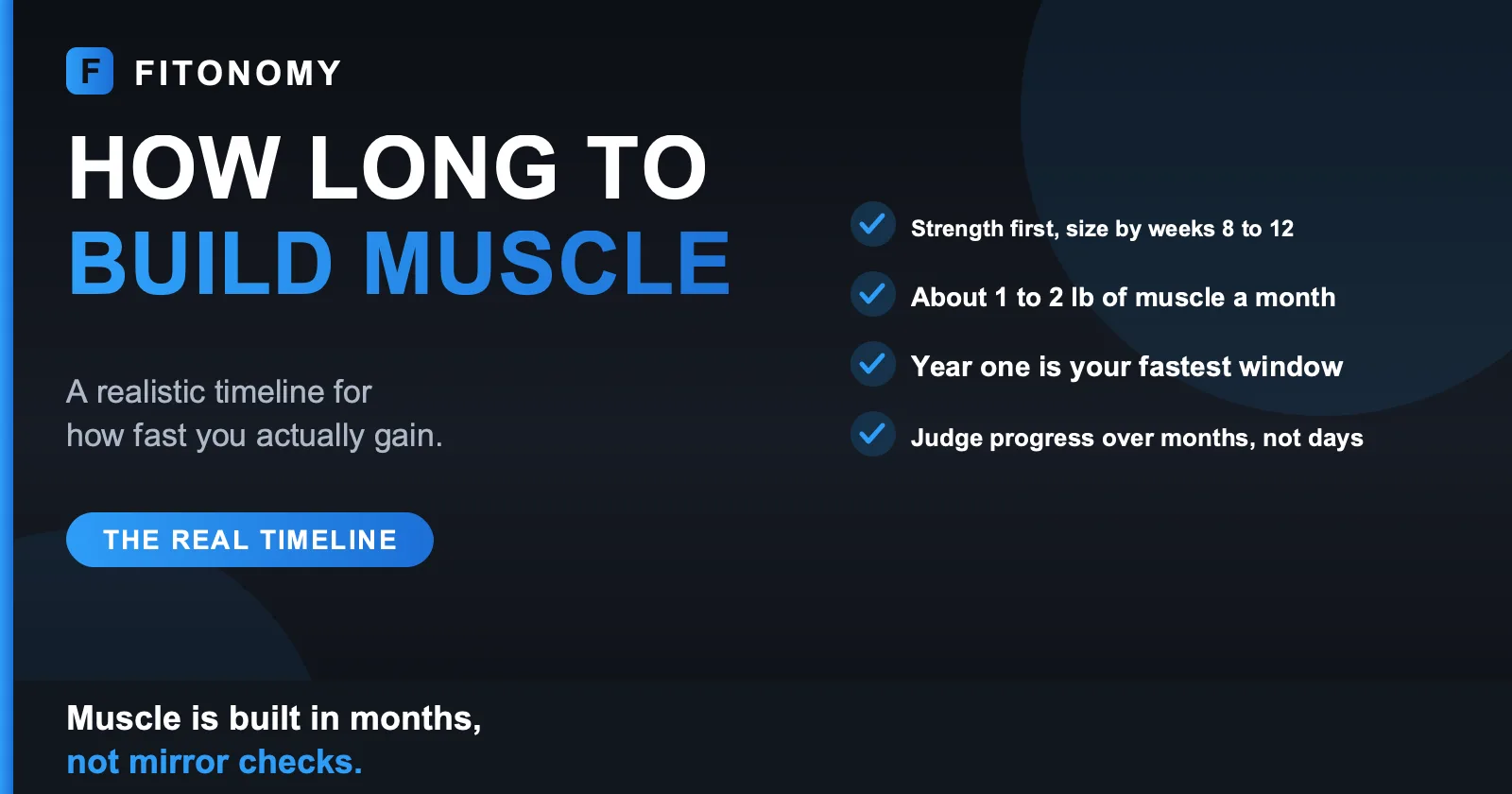
Takeaway: Strength first, then visible muscle by weeks 8 to 12, then a major change over 6 to 12 months. Judge yourself over months, not days.
The Fitonomy angle: measure the trend, not the mirror
The core problem with building muscle is that the daily change is far too small to see. Two pounds of muscle a month is about half a pound a week, invisible to your own eyes in the bathroom mirror. This is exactly why people quit right before it works.
The fix is to stop measuring on the wrong timescale. Fitonomy's progress tracking logs your strength numbers and body metrics over weeks, so the slow upward trend becomes visible even when any single day looks flat, and the AI Workout Planner keeps nudging your weights and reps upward so progressive overload actually happens instead of you repeating the same workout for months. When the data shows your working weights climbing week over week, you know muscle is being built, whether or not today's mirror agrees. You can start with the Fitonomy app and let the numbers, not your mood, tell you if it is working.
Takeaway: Muscle gain is too slow to see day to day, so track the multi-week trend in strength and measurements. If your numbers are climbing, you are building, even when the mirror is undecided.
The bottom line
Building muscle takes longer than the internet promises and rewards you more than you expect if you stay the course. Expect strength in weeks, visible muscle in two to three months, and a genuine transformation over your first year, at a realistic pace of roughly one to two pounds of muscle per month as a beginner. Get progressive overload, protein, sleep, and consistency right, judge yourself over months instead of days, and the timeline takes care of itself.
Frequently asked questions
How long does it take to build noticeable muscle? For most beginners training consistently with enough protein and sleep, visible muscle shows up around 8 to 12 weeks, with a clear, photographable change by 3 to 4 months. The first month is mostly strength gains from neural adaptation, not visible size.
How much muscle can you gain in a month? Realistically about 1.5 to 2 pounds of muscle per month for a male beginner, roughly half that for women, and less as you get more advanced (around 1 pound per month in year two). Any claim of gaining 5 to 10 pounds of muscle in a month is fat, water, or marketing.
Why am I not seeing muscle growth after a few weeks? Because in the first four to six weeks your gains are mostly neural, meaning you get stronger while the muscle itself has barely changed size, and early size changes are largely swelling from training. True visible growth typically takes 8 to 12 weeks of consistent progressive training.
Do beginners build muscle faster than experienced lifters? Yes. Your first year is the fastest muscle-building window of your life, often called newbie gains, and beginners can even build muscle and lose fat at the same time. Gains slow as you approach your genetic potential, but they do not stop.
Can you regain lost muscle faster than building it the first time? Usually yes. This is muscle memory. Research on myonuclei suggests previously trained muscle can regrow faster than it was originally built, so coming back after a long break is quicker than starting from scratch, even though the science is still being refined.