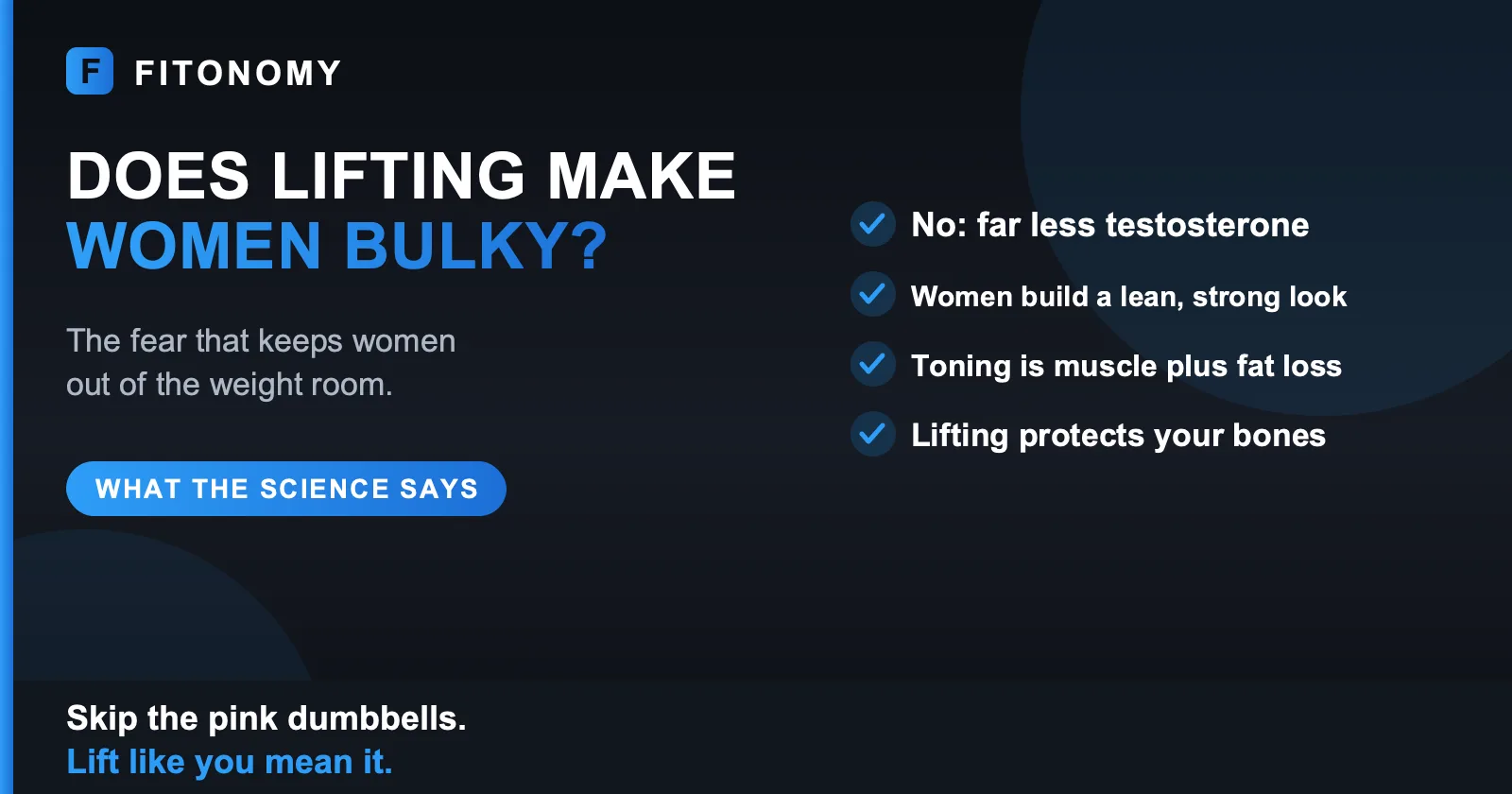
It is the single most common reason women avoid the weights room: the fear of waking up bulky. Pick up a dumbbell, the worry goes, and you will balloon into a bodybuilder. So women stick to light pink weights and endless cardio, and miss out on the most effective tool for the lean, strong look they actually want.
Here is the truth the research makes very clear: women do not get bulky by accident. It is physiologically difficult, and lifting weights builds exactly the opposite of what most people fear. Let us walk through why, and how women should actually train.
Why women do not bulk up
The simplest reason is hormonal. Testosterone is the primary driver of large muscle growth, and women have far less of it than men, on the order of ten to twenty times less. That hormonal difference puts a natural ceiling on how much absolute muscle size a woman will build, and it is why the dramatic, bulky physiques people picture take men years of dedicated effort, specific genetics, and sometimes drugs to achieve.
The data backs this up. A 2025 Bayesian meta-analysis by Refalo and colleagues found that absolute increases in muscle size slightly favored men (a standardized mean difference of 0.19), meaning women added less raw size from the same training. The "accidental bulk" most people fear is not on the table for the vast majority of women.
Takeaway: Women have roughly ten to twenty times less testosterone than men, which caps absolute muscle size. Research confirms women add less raw size from the same training, so accidental bulk is essentially a myth.
But women build muscle just as effectively
Here is the empowering flip side. While women gain less absolute size, they build muscle and strength just as well relative to their starting point. A 2020 meta-analysis by Roberts and colleagues found no significant difference between men and women in relative muscle growth, and women actually gained upper-body strength at a faster relative rate than men.
In other words, lifting is highly effective for women. It just produces a lean, strong, athletic look rather than a bulky one. The result of a woman lifting hard is the exact physique most women say they want, defined and capable, not oversized.
Takeaway: Women build muscle and strength just as effectively as men in relative terms, and even gain upper-body strength faster. Lifting gives women a lean, strong shape, not a bulky one.
The "toning" myth
A lot of confusion comes from the word "toning." There is no separate toning process. The lean, defined look people call toned is simply the combination of building some muscle and losing the fat that covers it. You literally cannot get toned without building muscle, which means lifting is the path to it, not the thing to avoid.
This also debunks the pink-dumbbell approach. Light weights for very high reps are not a special "toning" method; they are just a less effective way to build the muscle that creates definition. Women get better results training the same way anyone does: challenging weights, compound movements, and progressive overload, the principles in our strength training after 30 and build muscle at home guides.
Takeaway: Toning is just building muscle and losing fat; there is no separate toning mechanism. Light weights are not a special method, so women get better results lifting challenging weights like everyone else.
What lifting actually does for women
Far from making women bulky, strength training delivers benefits that matter enormously for women specifically:
- A lean, strong shape. Building muscle and pairing it with a sensible calorie deficit creates the defined look directly.
- Stronger bones. This is huge. A 2025 meta-analysis found resistance training significantly improves bone mineral density at the spine and hip in postmenopausal women, making it one of the best defenses against the osteoporosis that disproportionately affects women.
- Better metabolic health and an easier time managing weight, since muscle is metabolically active tissue.
- Real-world strength and confidence, from carrying groceries to feeling capable in your body.
Takeaway: Lifting gives women a lean shape, dramatically stronger bones (key for preventing osteoporosis), better metabolic health, and real strength and confidence. The benefits are too good to skip over a myth.
How women should train
The same principles that work for men work for women, because the underlying physiology of building muscle is the same. Use challenging weights you can control for about 8 to 12 reps, focus on compound movements, apply progressive overload over time, and eat enough protein (around 1.6 grams per kilogram of bodyweight, which applies to women just as it does to men, see our protein guide). There is no need for a separate, watered-down "women's program." Train hard, eat well, recover, and the results follow.
Takeaway: Women should train like anyone serious about results: challenging weights, compound lifts, progressive overload, and enough protein. No special light-weight "women's program" is needed.
Myth versus reality
- Lifting makes women bulky. What the research shows: Far less testosterone caps absolute size; women add less raw muscle.
- Light weights tone, heavy weights bulk. What the research shows: Toning is building muscle plus losing fat; challenging weights work best.
- Cardio is better for women's shape. What the research shows: Lifting builds the lean, defined look cardio alone cannot.
- Women should train differently than men. What the research shows: The same principles build muscle in both sexes.
- Lifting makes women look masculine. What the research shows: It builds a lean, strong, athletic physique.
Takeaway: Almost every "weights will ruin my figure" belief is a myth. The reality is that lifting is the most direct route to the strong, lean look most women actually want.
How Fitonomy helps
You do not need a separate women's app or a watered-down plan, you need an effective program that fits your goal. Fitonomy's AI Workout Planner builds a progressive strength program around your level, schedule, and equipment, whether your goal is strength, shape, or both. It applies the same evidence-based principles that work for everyone, so you can train with confidence instead of fear of the weights.
The bottom line
Lifting weights will not make you bulky. The hormonal reality makes accidental bulk almost impossible for women, while the same training builds muscle and strength just as effectively in relative terms, producing the lean, strong, defined look most women want. On top of that, it protects your bones, supports your metabolism, and builds real confidence. So skip the pink dumbbells and the fear, pick up challenging weights, and train like you mean it. The research could not be clearer that it works in your favor.
Sources
- Roberts, B.M., Nuckols, G., Krieger, J.W. (2020). Sex Differences in Resistance Training: A Systematic Review and Meta-Analysis. Journal of Strength and Conditioning Research. https://journals.lww.com/nsca-jscr/fulltext/2020/05000/sex_differences_in_resistance_training__a.30.aspx
- Refalo, M.C., et al. (2025). Sex differences in absolute and relative changes in muscle size following resistance training in healthy adults: a systematic review with Bayesian meta-analysis. PeerJ. https://pmc.ncbi.nlm.nih.gov/articles/PMC11869894/
- Zhang, S., et al. (2025). Optimal resistance training parameters for improving bone mineral density in postmenopausal women: a systematic review and meta-analysis. Journal of Orthopaedic Surgery and Research. https://pmc.ncbi.nlm.nih.gov/articles/PMC12107943/
- Schoenfeld, B.J., Ogborn, D., Krieger, J.W. (2016). Effects of Resistance Training Frequency on Measures of Muscle Hypertrophy: A Systematic Review and Meta-Analysis. Sports Medicine. https://pubmed.ncbi.nlm.nih.gov/27102172/
- Morton, R.W., et al. (2018). A systematic review, meta-analysis and meta-regression of the effect of protein supplementation on resistance training-induced gains in muscle mass and strength in healthy adults. British Journal of Sports Medicine. https://pmc.ncbi.nlm.nih.gov/articles/PMC5867436/
Frequently asked questions
Will lifting weights make me bulky? Almost certainly not. Women have roughly ten to twenty times less testosterone than men, which is the main driver of large muscle growth, so accidental bulk is physiologically very difficult. Research shows women add less absolute muscle size than men from the same training. Lifting builds a lean, strong, defined look for women, not a bulky one.
Should women lift heavy or light weights? Challenging weights, the same as men. Light weights for very high reps are not a special toning method, just a less effective way to build the muscle that creates definition. Aim for weights you can control for about 8 to 12 hard reps, focus on compound movements, and progress over time. There is no need for a watered-down women's program.
Is cardio better than weights for women? Not for shaping your body. Cardio supports fat loss and health, but the lean, defined look most women want comes from building muscle, which only resistance training does. The best approach combines lifting for muscle and shape with some cardio and a sensible diet. Lifting also uniquely strengthens bones, which matters a great deal for women.
How do women get toned? Toning is simply building muscle and losing the fat that covers it; there is no separate toning process. That means the path to a toned look is lifting challenging weights to build muscle, combined with a modest calorie deficit to reveal it. You cannot get toned without building some muscle, so resistance training is the tool, not something to avoid.
Will lifting weights make me look manly? No. The hormonal profile that produces a masculine, heavily muscled look is not present in women, who have far less testosterone. Strength training builds a lean, strong, athletic physique. The dramatic muscularity people associate with looking manly requires extreme training, specific genetics, and often pharmaceutical help that does not apply to a woman lifting weights normally.
Do women need to train differently than men? No. The physiology of building muscle and strength is the same in both sexes, so the same principles apply: challenging weights, compound movements, progressive overload, and enough protein. Research shows women build muscle just as effectively as men in relative terms. There is no need for a separate, lighter women's training approach.