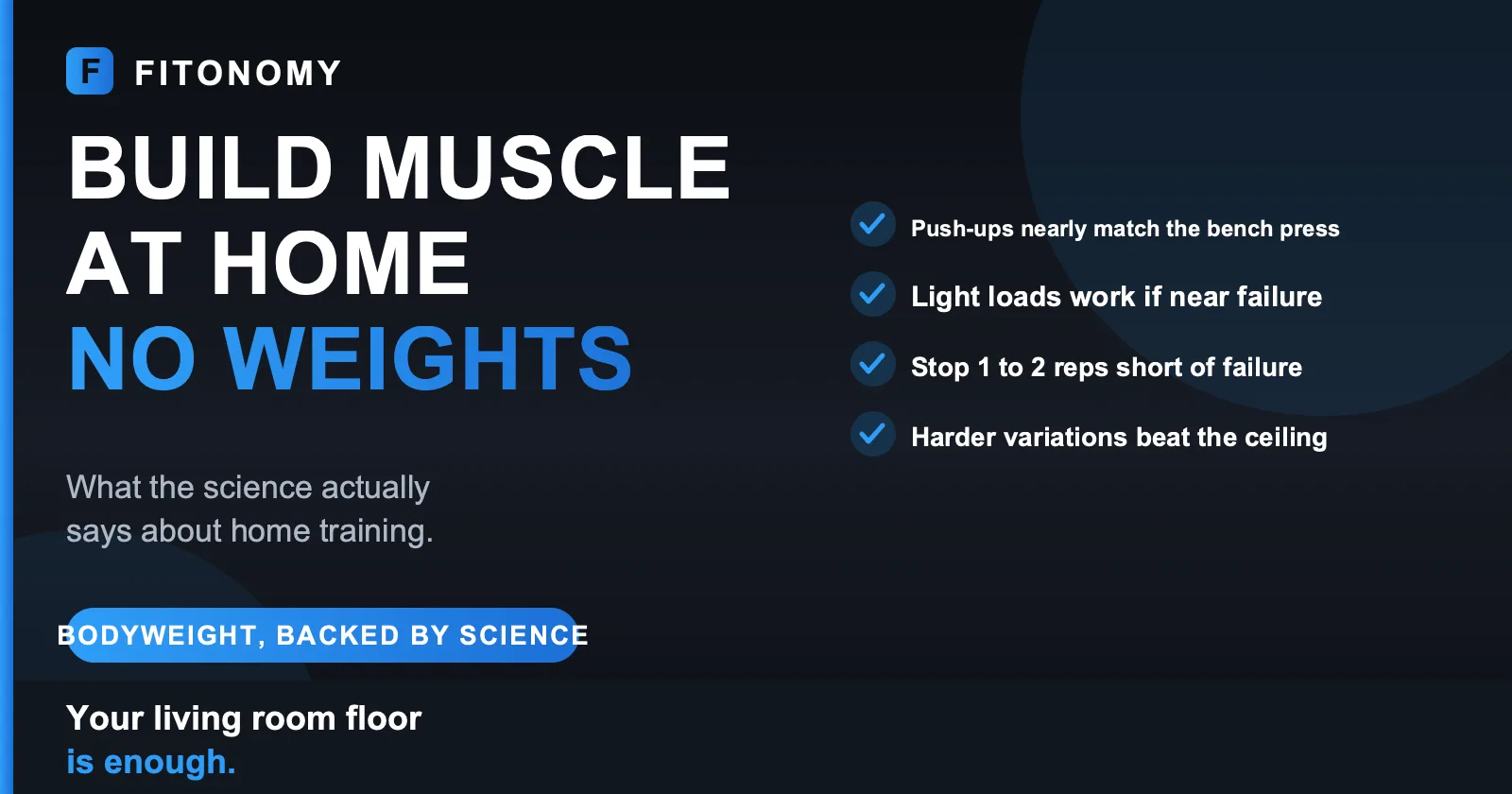
Short answer: yes. You can build real, visible muscle at home with nothing but your own bodyweight, and the research backing that is stronger than most people assume. The longer answer has a catch, and that catch is the whole reason some people gain muscle from home workouts while others spin their wheels for a year and quit.
This is not a motivational pep talk. It is what the controlled studies actually found, where bodyweight training matches a barbell, where it falls behind, and how to close the gap. If you have ever wondered whether you are wasting your time doing push-ups on your living room floor, here is the honest version.
The short answer, and the catch
Muscle does not know what is creating tension. It responds to mechanical tension, hard effort, and a reason to adapt. A loaded barbell is one convenient way to deliver that. Your bodyweight, leverage, and good programming are another. The catch is simple: bodyweight training only works when the exercise is actually hard for the muscle you are targeting, and when it keeps getting harder over time. A set of 30 easy push-ups is cardio. A set of 8 push-ups you can barely finish is a growth stimulus. Same movement, completely different outcome.
Take that catch seriously and the rest of this article is just detail.
What actually builds muscle (it is not the equipment)
Three things drive muscle growth, and none of them require a gym.
First, mechanical tension. A muscle has to work against meaningful resistance through a range of motion. Second, effort, meaning you take the set close enough to failure that the hard reps happen. Third, progressive overload, meaning the demand goes up over weeks and months so the muscle has a reason to keep adapting. Food and sleep then let the adaptation actually happen.
Notice what is missing from that list: a specific machine, a barbell, or a number on a dumbbell. Equipment is a delivery method for tension and progression, not the source of growth. That is why the question is not "do I have weights" but "can I create enough tension and keep increasing it." At home, with the right exercise selection, you usually can.
The proof: push-ups nearly matched the bench press
The cleanest test of this came from Kikuchi and Nakazato (Journal of Exercise Science and Fitness, 2017). They took 18 men, split them into a push-up group and a barbell bench press group, and matched the load so the push-up group worked at roughly 40% of their bench press one-rep max. Both groups trained twice a week for 8 weeks, taking sets to failure.
The results are the headline of this entire topic. Chest (pectoralis major) thickness grew 18.3% in the push-up group versus 19.4% in the bench press group. Triceps grew 9.5% versus 10.3%. Statistically, those differences were not meaningful. A bodyweight movement, programmed properly, produced essentially the same chest and triceps growth as a barbell.
There was one honest exception. Biceps thickness only increased significantly in the bench press group, not the push-up group. That is not a knock on bodyweight training in general. It is a reminder that push-ups do not train the biceps, so a home program has to include pulling movements (rows, chin-ups on a sturdy bar or under a table) to cover what pressing misses. Coverage is on you, not on the lack of weights.
Does the load matter? Light works, but you have to earn it
This is where people get misled in both directions. One camp says you must lift heavy or you are wasting your time. The other says load does not matter at all. The evidence sits in between.
A meta-analysis by Schoenfeld and colleagues (Journal of Strength and Conditioning Research, 2017) pooled 21 studies comparing lighter loads (60% of one-rep max or less) against heavier loads, all taken to failure. Muscle growth was similar across the loading spectrum. For strength, though, heavy training won clearly: gains in one-rep max strength were significantly greater with heavier loads. So for size, light loads taken to failure compete with heavy ones. For maximal strength, external load still matters. (If you are over 30 and mainly want to hold onto strength, here is how much strength training you actually need.)
There is a floor, though, and it matters a lot for home training. Lasevicius and colleagues (European Journal of Sport Science, 2018) compared 20%, 40%, 60%, and 80% of one-rep max with training volume equated. Growth was similar from 40% to 80%, but 20% lagged badly. Vastus lateralis (thigh) cross-sectional area grew 8.9% at 20% load versus 19.5% at 80%. Elbow flexors grew 11.4% versus 25%. The takeaway for home lifters: very easy resistance does not cut it. Your bodyweight exercises need to land in a range that genuinely challenges the muscle, roughly where a set leaves you within a couple of reps of failure, not where you could do 40 more.
How close to failure do you need to go?
If you are not adding plates, effort becomes your main lever, so this question matters more at home than in a gym. Refalo and colleagues (Sports Medicine, 2023) meta-analyzed proximity to failure and found only a small advantage for training to failure over stopping short for hypertrophy, with an effect size around 0.19 (and a confidence interval that just touched zero). In plain terms: stopping one to three reps shy of failure grows about as much muscle as grinding every set into the ground, with less fatigue and lower injury risk.
That is good news for home training. You do not need to reach total failure on every set, which can be sketchy without a spotter or a rack. You do need to get close. The practical rule: most working sets should end when you have one to three honest reps left in the tank. If you finish a set and could clearly do ten more, the exercise is too easy and it is time to make it harder.
Bodyweight vs free weights vs machines, side by side
Here is the honest comparison, based on the evidence above.
- Bodyweight (home, no equipment): muscle growth is near-equal to weights when effort and progression are high; strength gains are good for beginners but plateau sooner; convenience is unbeatable; cost is zero; the real weakness is a progression ceiling on lower-body and pulling movements.
- Free weights (barbell, dumbbells): muscle growth is excellent; strength gains are the best of the three because you can load heavy; convenience is lower (space, cost, setup); the strength of the option is precise, easy progression by adding weight.
- Machines: muscle growth is excellent and beginner-friendly; strength transfers less to free movement; convenience depends on gym access; the strength of the option is stability, which lets you push close to failure safely.
The pattern is clear. For building muscle, the three are far closer than gym marketing suggests. For maximal strength and for never running out of load, free weights pull ahead. At home, your job is to engineer the progression that a stack of plates would otherwise hand you.
The catch nobody mentions: the progression ceiling
This is the real reason some people stall at home. With weights, progression is trivial: add 2.5 kg. With bodyweight, gravity gives you a fixed load, so once an exercise gets easy you stop growing unless you change the demand. Beating the ceiling is a skill, and it is mostly mechanical.
Five levers do the job, and most of them come down to choosing exercises that are hard enough and progressing them. Harder variations: move from regular push-ups to feet-elevated, then to archer or one-arm progressions; from squats to split squats to pistol squats. Tempo: take three to four seconds to lower, which increases time under tension without any equipment. More reps and sets: add reps each week and add a set when a movement gets comfortable, since total hard volume drives growth. Reduced leverage and range: deficit push-ups, pause reps, and longer ranges all raise difficulty. And a small amount of equipment: a 20 dollar resistance band or a doorway pull-up bar removes almost every remaining ceiling, especially for back and biceps, the two areas pure floor work struggles to load.
Lower body is where the ceiling bites hardest, because legs are strong and bodyweight squats become endurance quickly. The fix is unilateral work. A pistol squat or a hard split squat variation loads one leg with most of your bodyweight, which is plenty of resistance for real growth.
Do not skip the protein
Training is the signal, food is the raw material, and home lifters skip this more than gym-goers. Morton and colleagues (British Journal of Sports Medicine, 2018) meta-analyzed protein supplementation across resistance training studies and found that higher protein intake meaningfully improved muscle and strength gains, with the benefit plateauing around 1.6 grams of protein per kilogram of bodyweight per day. Above that, the pooled data showed no extra gain.
For an 80 kg person that is roughly 128 grams of protein a day. You can build muscle at home with perfect push-up form, but if you are eating 60 grams of protein a day you are leaving most of your results on the table. This single variable separates a lot of "bodyweight does not work for me" stories from the people getting results.
A simple no-equipment week that respects the science
You do not need a complicated split. Two to four full-body sessions a week, each taken close to failure, covers it. A workable week:
- Day 1 (push focus): push-up variation, pike push-ups for shoulders, triceps dips between two chairs, core. 3 to 4 sets each, ending 1 to 2 reps short of failure.
- Day 2 (legs and pull): split squats, single-leg hip hinges, inverted rows under a table or a band row, calf raises. 3 to 4 sets each.
- Day 3 (full body): hardest push-up variation you can manage for 6 to 10 reps, squat variation, rows, plank. Push the difficulty up from last week.
Progress every week: more reps, a harder variation, or slower tempo. When a movement stops being hard near the top of your rep range, upgrade it. That single habit, applied for months, is what actually builds the muscle.
Where Fitonomy fits
Fitonomy was built for exactly this situation. The Home Workout product generates equipment-free programs based on your level and goals, and each move comes with HD video and form guidance, which solves the two things home lifters get wrong most often: choosing exercises that are hard enough and progressing them on schedule. If you want the progression handled for you instead of guessing when to make push-ups harder, that is the gap the app is designed to close.
None of that changes the science. The studies above hold whether you train with an app or a notebook. The app just removes the friction of programming so the hard part is the effort, which is exactly where it should be.
Bottom line
You can build muscle at home without weights, and the controlled research says it is not a compromise as long as you train hard, get close to failure, and keep making the movements harder. Push-ups can grow a chest nearly as well as a bench press. Light resistance grows muscle as long as it is not trivially easy. The thing weights give you for free, easy progression and heavy load for maximal strength, is the thing you have to engineer at home with harder variations, tempo, volume, and a little protein discipline. Do that, and the floor of your living room is enough. And if losing fat is part of the goal too, it is worth knowing what the research says about walking versus running for fat loss.
Frequently Asked Questions
Can you build muscle with just bodyweight exercises?
Yes. When push-ups were matched in load to a barbell bench press and taken to failure, chest thickness grew 18.3% versus 19.4% over 8 weeks (Kikuchi and Nakazato, 2017), a difference that was not meaningful. Bodyweight builds muscle as long as the exercise is genuinely hard and gets harder over time.
How long does it take to build muscle at home?
Most people see visible change in 8 to 12 weeks of consistent, progressive training, with the studies above running 8 to 12 weeks. Beginners adapt fastest. The rate depends far more on effort, progression, and protein intake than on whether you use weights.
Do you need to lift heavy to build muscle?
Not for size. A meta-analysis of 21 studies found similar muscle growth across light and heavy loads when sets were taken to failure (Schoenfeld et al., 2017). Heavy loads were clearly better for maximal strength, but lighter and bodyweight loads grow muscle well.
How many days a week should I train at home?
Two to four full-body sessions a week works for most people, leaving rest days between hard sessions. Total hard volume matters more than session count, so consistency over months beats any specific split.
Can you build big legs without weights?
Yes, but it is the hardest area for pure bodyweight work because legs are strong and squats become easy. The fix is single-leg movements like split squats and pistol squat progressions, which load one leg with most of your bodyweight, plus higher reps and slower tempo.
How close to failure do I need to train?
Close, but not all the way. Stopping one to three reps short of failure produced about as much growth as training to failure in a 2023 meta-analysis (Refalo et al.), with less fatigue and injury risk. If you could do ten more reps, the exercise is too easy.