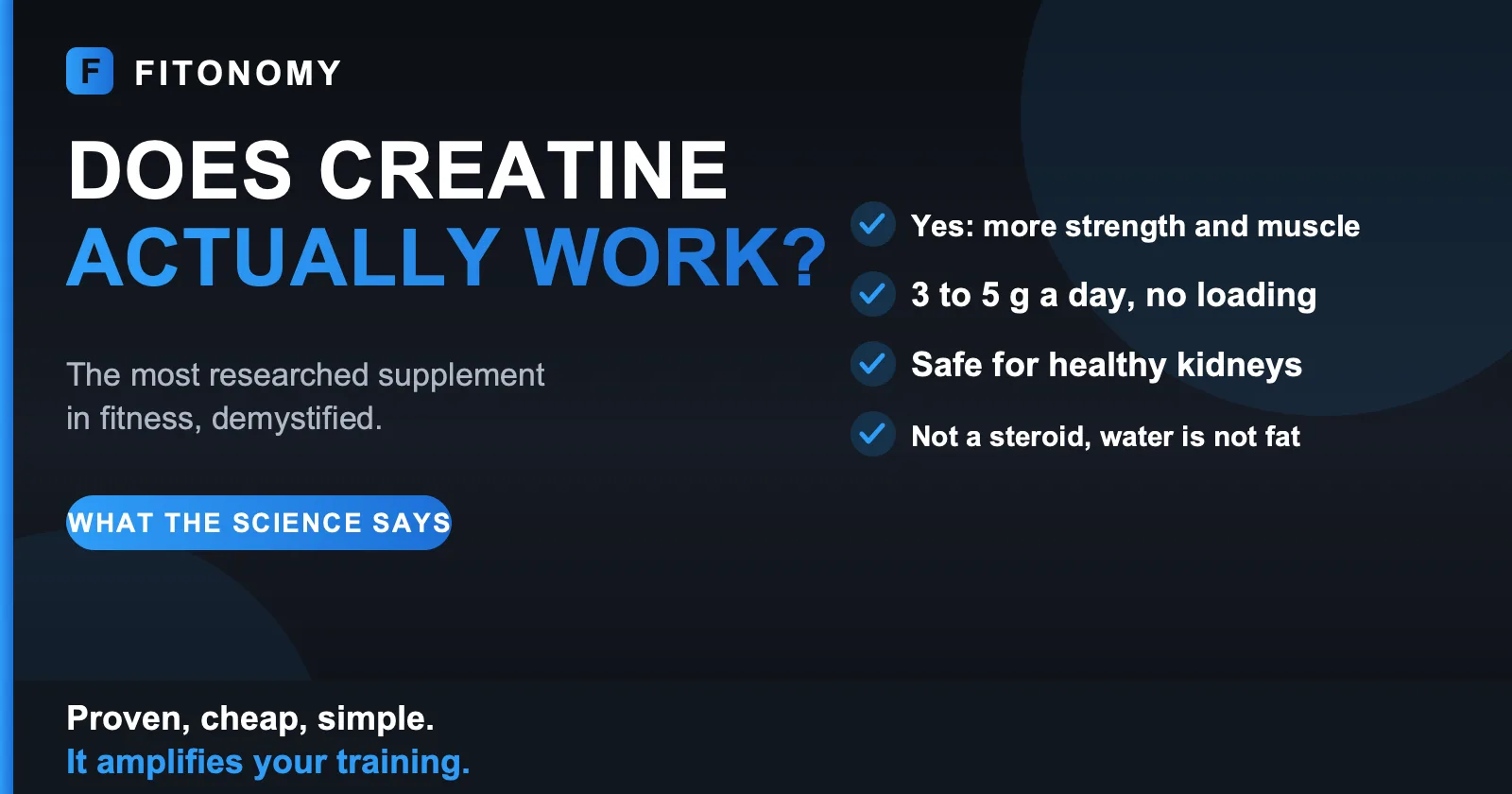
Creatine is the rare supplement that lives up to the hype. It is the most studied sports supplement in existence, with hundreds of trials behind it, and the evidence is remarkably consistent: it works. It is also wrapped in more myths than almost any other, from "it is basically a steroid" to "it wrecks your kidneys" to elaborate loading rituals. Most of that is wrong.
Here is what creatine actually does, how to take it in the simplest effective way, whether it is safe, and which of the scary stories you can ignore.
What creatine is and what it does
Creatine is a compound your body already makes and stores in muscle, where it exists mostly as phosphocreatine. Its job is to rapidly regenerate ATP, the fuel for short, hard efforts. Supplementing tops up those stores, so you can squeeze out an extra rep or two and produce a bit more force in high-intensity work. Over weeks and months, that small per-session boost adds up to more total training stimulus, which is where the muscle and strength come from.
The International Society of Sports Nutrition's position stand (Kreider and colleagues, 2017) is blunt about it: creatine monohydrate is the most effective ergogenic nutritional supplement available for increasing high-intensity exercise capacity and lean body mass during training.
Takeaway: Creatine refuels your muscles for hard efforts so you can do a little more each session. That extra work, repeated over time, is what drives the results.
Does it actually build muscle and strength?
Yes, when paired with resistance training. The effect is modest but real and well replicated.
For strength, a meta-analysis by Lanhers and colleagues found creatine combined with training improved upper-body strength, with roughly 5 to 10 percent greater 1-rep-max gains than training alone. For muscle size, a 2023 meta-analysis by Burke and colleagues using direct imaging confirmed that creatine plus resistance training augments muscle growth beyond training alone. And in older adults, where muscle matters most, Chilibeck and colleagues (2017) found creatine plus resistance training added about 1.37 kg more lean tissue mass than training with a placebo, plus greater upper- and lower-body strength.
The key word is "combined." Creatine does not build muscle while you sit on the couch. It amplifies the training you are already doing, which is why it pairs with a solid program like the one in our strength training after 30 and build muscle at home guides.
Takeaway: With training, creatine adds roughly 5 to 10 percent more strength and meaningfully more lean mass than training alone. Without training, it does little.
How to take it (it is simpler than the internet says)
The protocol is almost boringly simple.
- Take 3 to 5 grams of creatine monohydrate per day, every day. That is it.
- Timing does not matter. Pre, post, morning, night, all work. Consistency matters, not the clock.
- You do not need to load. A loading phase (around 20 grams a day for 5 to 7 days) just saturates your muscles faster, within a week instead of three to four. It is optional and can cause stomach upset. Skipping it reaches the same place.
- You do not need to cycle on and off. Take it daily, ongoing.
- Use plain creatine monohydrate. It is the most studied, most effective, and cheapest form. The fancy "advanced" versions are not better and usually cost more.
Takeaway: 3 to 5 grams of plain creatine monohydrate daily, any time of day, no loading and no cycling required. Simplicity is the protocol.
What about the water weight?
You may gain 1 to 2 kg in the first couple of weeks. This is not fat. As Antonio and colleagues (2021) explain, that early weight is intracellular water drawn into the muscle, which is part of how creatine works, not bloat sitting under your skin. For most people it makes muscles look slightly fuller, not puffy. It is a sign the supplement is doing its job.
Takeaway: The initial 1 to 2 kg is water inside the muscle, not fat. It is harmless and expected, not a reason to worry.
Is creatine safe?
For healthy people, yes, and this is one of the best-studied safety questions in sports nutrition. Reviews including Antonio and colleagues (2021) and the ISSN position stand conclude that creatine at recommended doses does not damage the kidneys or liver in healthy individuals, and it has been used safely in studies at up to much higher intakes. Decades of research back this up.
Two honest caveats. If you have existing kidney disease or another medical condition, check with your doctor first. And the persistent "creatine causes hair loss" claim traces back to a single small study that found a rise in DHT (a hormone linked to hair loss), not actual hair loss itself, and it has not been replicated. There is no direct evidence creatine causes baldness.
Takeaway: Creatine is safe for healthy people at normal doses, with no kidney or liver harm shown. Check with a doctor if you have kidney issues. The hair-loss claim is not supported by direct evidence.
Myth versus reality
- It is a steroid. What the research shows: False. It is a natural compound found in food and made by your body. Not a hormone..
- You must do a loading phase. What the research shows: Optional. 3 to 5 g daily reaches full effect in a few weeks without it..
- It damages your kidneys. What the research shows: No evidence of harm in healthy people at recommended doses..
- The weight gain is fat. What the research shows: It is intracellular water in the muscle, not fat..
- You need to cycle it. What the research shows: No. Daily ongoing use is fine..
- Fancy forms work better. What the research shows: Plain monohydrate is the most proven and cheapest..
Takeaway: Almost every scary or complicated creatine claim is a myth. The reality is simpler and more reassuring than the marketing.
Who benefits most?
Anyone doing resistance training will get more from their sessions. Older adults stand to gain a lot, since creatine plus training helps counter age-related muscle loss. Vegetarians and vegans often see a larger effect because they start with lower muscle creatine (it comes mainly from meat). And while the muscle benefits are the headline, research into creatine and cognition is promising, though that is a topic for another day.
Takeaway: Lifters, older adults, and plant-based eaters benefit most. If you train and want one supplement worth taking, this is it.
How Fitonomy fits
Supplements are the last 5 percent, not the foundation. Creatine amplifies a good program; it cannot replace one. Fitonomy's AI Workout Planner builds and progresses the resistance training that creatine makes more productive, and pairing it with enough protein (see how much protein to build muscle) covers the nutrition basics that matter far more than any pill. Get the training and protein right first, then add creatine as a cheap, proven bonus.
The bottom line
Creatine works, it is safe for healthy people, and it is simple: 3 to 5 grams of plain monohydrate every day, with no loading, cycling, or fancy versions needed. Paired with resistance training it adds a meaningful slice of extra strength and muscle, and the scary myths (steroid, kidney damage, hair loss) do not hold up. It is the most evidence-backed supplement in fitness, and one of the cheapest. Just remember it amplifies good training rather than replacing it.
Sources
- Kreider, R.B., et al. (2017). International Society of Sports Nutrition position stand: safety and efficacy of creatine supplementation in exercise, sport, and medicine. Journal of the International Society of Sports Nutrition. https://pmc.ncbi.nlm.nih.gov/articles/PMC5469049/
- Antonio, J., et al. (2021). Common questions and misconceptions about creatine supplementation: what does the scientific evidence really show? Journal of the International Society of Sports Nutrition. https://pmc.ncbi.nlm.nih.gov/articles/PMC7871530/
- Lanhers, C., et al. (2017). Creatine Supplementation and Upper Limb Strength Performance: A Systematic Review and Meta-Analysis. Sports Medicine. https://link.springer.com/article/10.1007/s40279-016-0571-4
- Burke, R., et al. (2023). The Effects of Creatine Supplementation Combined with Resistance Training on Regional Measures of Muscle Hypertrophy: A Systematic Review with Meta-Analysis. https://pmc.ncbi.nlm.nih.gov/articles/PMC10180745/
- Chilibeck, P.D., et al. (2017). Effect of creatine supplementation during resistance training on lean tissue mass and muscular strength in older adults: a meta-analysis. Open Access Journal of Sports Medicine. https://pmc.ncbi.nlm.nih.gov/articles/PMC5679696/
Frequently asked questions
Does creatine actually work? Yes, when combined with resistance training. Creatine is the most researched sports supplement and the evidence is consistent. Meta-analyses show it adds roughly 5 to 10 percent more strength than training alone and meaningfully more lean mass, including about 1.37 kg extra lean tissue in older adults. It works by helping your muscles refuel for hard efforts so you can do slightly more each session.
How much creatine should I take per day? Take 3 to 5 grams of creatine monohydrate every day. Timing does not matter, so take it whenever is convenient. The only thing that matters is taking it consistently. Plain creatine monohydrate is the most studied, most effective, and cheapest form, so there is no need for fancier or more expensive versions.
Do I need to do a creatine loading phase? No. A loading phase (about 20 grams a day for 5 to 7 days) only saturates your muscles faster, within a week instead of three to four. Taking 3 to 5 grams a day reaches the exact same end point without the higher dose, and loading can cause stomach upset. Loading is optional, not required.
Is creatine safe for your kidneys? For healthy people, yes. Reviews including the ISSN position stand conclude that creatine at recommended doses does not damage the kidneys or liver in healthy individuals, and it is one of the best-studied safety questions in sports nutrition. If you have existing kidney disease or another medical condition, check with your doctor before starting.
Does creatine make you fat or bloated? No. You may gain 1 to 2 kg in the first couple of weeks, but that is water drawn into the muscle cells, not fat and not under-the-skin bloat. For most people it makes muscles look slightly fuller. The water weight is part of how creatine works and is harmless.
Does creatine cause hair loss? There is no direct evidence that it does. The claim traces back to a single small study that found an increase in DHT, a hormone associated with hair loss, but it did not measure actual hair loss, and the finding has not been replicated. No study has shown creatine directly causes hair loss.