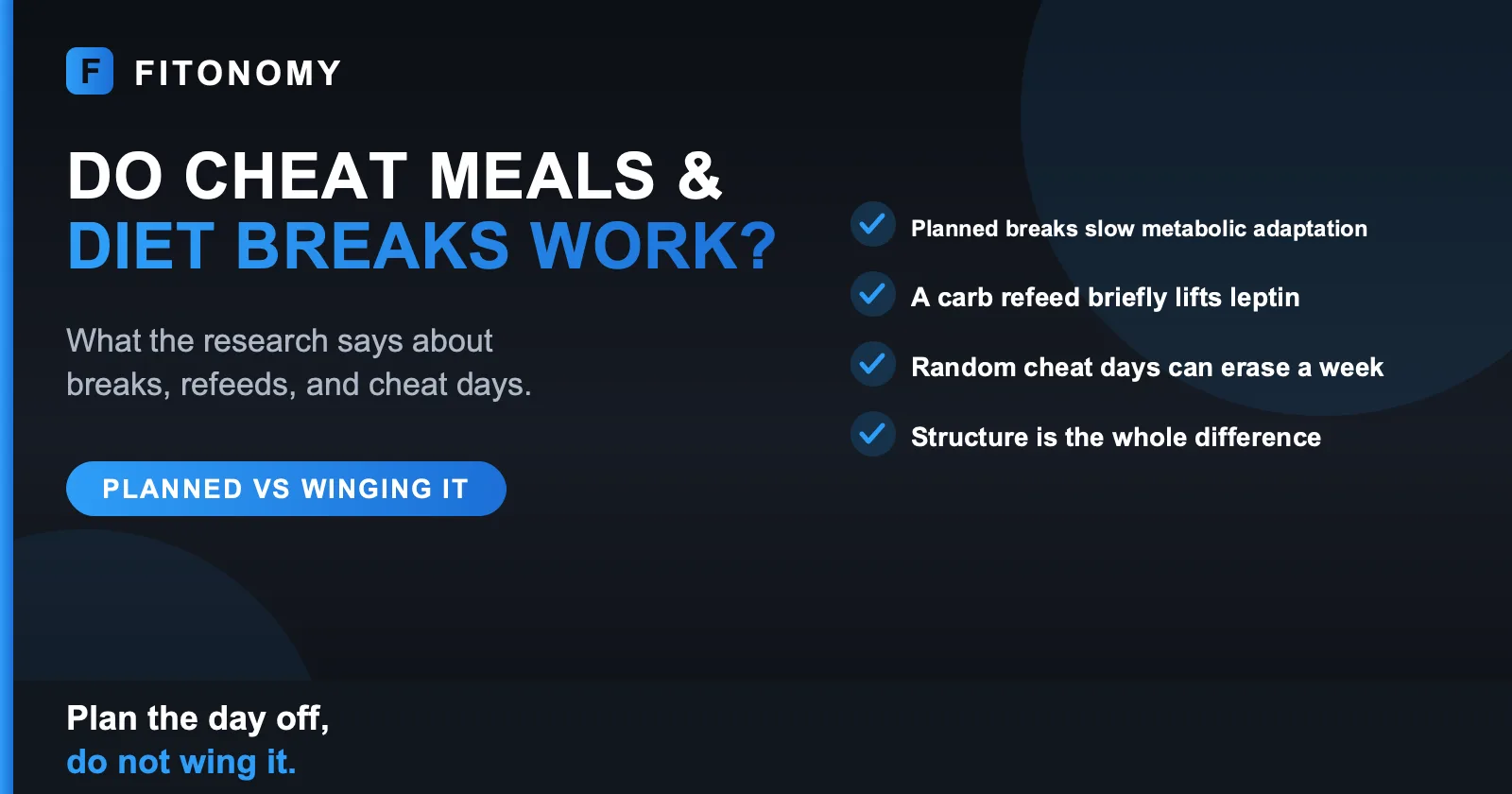
Every dieter reaches the point where they want a night off. The question is whether that night off is a smart strategy or just self-sabotage with a nicer name. The internet is no help here, with influencers promising that a weekly cheat day "resets your metabolism" on one side and hardliners saying any deviation ruins everything on the other.
The research lands in a more useful place, and the key is a distinction most people miss. Planned diet breaks and refeeds have genuine science behind them. Random, unplanned cheat days mostly do not, and can actively backfire. The difference between a tool and a trap is whether you planned it. Here is what the studies actually show and how to use a break without derailing your diet.
First, three different things people lump together
Cheat meal, refeed, and diet break get used interchangeably, but they are not the same, and the evidence treats them very differently.
A cheat meal is a single unplanned or loosely planned meal where you eat whatever you want, often well past full. A refeed is a planned, controlled increase in calories, usually from carbohydrates, for a day or two. A diet break is a longer planned pause, typically one to two weeks, where you eat at maintenance calories (not a deficit, but not a binge either) before resuming your diet. The more structured and planned it is, the more the research supports it.
Takeaway: A cheat meal is an unplanned splurge, a refeed is a planned 1 to 2 day calorie bump (mostly carbs), and a diet break is a planned 1 to 2 week pause at maintenance. Planning and control are what separate the strategies that work from the ones that do not.
Why planned breaks can genuinely help
The strongest case for diet breaks is fighting metabolic adaptation. When you diet, your metabolism slows by more than your smaller body alone would explain, a phenomenon called adaptive thermogenesis. A famous 2016 study by Fothergill and colleagues tracking Biggest Loser contestants found their resting metabolism ran roughly 300 to 500 calories per day below what their body size predicted, and it stayed suppressed for years. That slowdown fights your fat loss and drives regain.
Planned breaks appear to blunt this. A 2018 study by Byrne and colleagues, the MATADOR trial, had men with obesity diet either continuously for 16 weeks or in alternating 2-week blocks of dieting and eating at maintenance. The intermittent group lost more fat, held onto more muscle, had a smaller drop in resting metabolism, and kept the weight off better six months later. Interrupting the deficit gave their metabolism periodic rest, and it paid off. There is a hormonal angle too: dieting lowers leptin, the hormone that manages hunger and metabolic rate, and a 2000 study by Dirlewanger and colleagues found a short carbohydrate refeed raised leptin by 28 percent and energy expenditure by 7 percent, temporarily countering the diet's downshift.
Takeaway: Long diets slow your metabolism by roughly 300 to 500 calories a day. Planned diet breaks reduced that slowdown and produced more fat loss and better weight maintenance in the MATADOR trial, and a carb refeed briefly lifts leptin and energy expenditure. The metabolic case for planned breaks is real.
The catch: it depends who you are
Before you schedule a diet break, an honest caveat. The big benefits show up mostly in people with a lot of fat to lose on longer diets. For already-lean people, the metabolic payoff is smaller. A 2021 randomized trial by Peos and colleagues, the ICECAP study, put resistance-trained (already lean) adults through continuous versus intermittent dieting and found no meaningful difference in fat loss, muscle retention, or metabolic rate between the two, though the diet-break group did show better muscle endurance. So diet breaks are not magic. They help most when the diet is long and there is significant fat to lose, and matter less if you are lean and dieting for a short stretch.
Takeaway: Diet breaks help most for people with more fat to lose on longer diets. For already-lean people on a short cut, they make little metabolic difference. Match the strategy to your situation rather than assuming everyone needs one.
Cheat meals vs refeeds vs diet breaks
- Cheat meal. What it is: Unplanned, eat anything, often overeat. Evidence: Weak, easy to overshoot the whole week. Best for: Rarely the best choice.
- Refeed. What it is: Planned 1 to 2 day carb increase. Evidence: Raises leptin and energy expenditure short term. Best for: Breaking a stall, a hard training block.
- Diet break. What it is: Planned 1 to 2 week maintenance pause. Evidence: Less metabolic slowdown, better retention (MATADOR). Best for: Long diets, lots of fat to lose.
Where cheat meals go wrong
Unplanned cheat meals are where things unravel, and the problem is as much psychological as physical. A 2025 scoping review in Nutrition Reviews found that the physiological benefits of cheat meals are real but small and short-lived, nowhere near the "metabolism reset" hype. More importantly, it found that how you frame the meal matters enormously. When people treat it as a planned, goal-directed part of their approach, outcomes are positive. When they treat it as "cheating" or rule-breaking, it is linked to guilt, shame, and disordered eating patterns, and unplanned deviations can trigger cycles of overeating followed by restriction.
The math is unforgiving too. A single cheat meal can easily hit 2,000 to 3,000 extra calories, which can erase most of a week's carefully built deficit in one sitting. One planned refeed inside your calorie budget is a strategy. An unplanned free-for-all is often just a week's progress deleted.
Takeaway: Unplanned cheat meals offer little physiological benefit and real psychological risk, from guilt to disordered eating, and one blowout can wipe out a week's deficit. The framing matters: planned and goal-directed helps, "cheating" hurts.
How to use breaks and refeeds without derailing
Do it the way the evidence rewards, which means planning it. Schedule refeeds and breaks in advance rather than reaching for them in a moment of weakness. Keep a refeed controlled, a bump to maintenance calories mostly from carbs, not an all-you-can-eat pass. On a long fat-loss phase, build in a 1 to 2 week diet break at maintenance every 6 to 12 weeks to give your metabolism and your willpower a rest. Keep protein high throughout to protect muscle (see how much protein you need), and track it so a break stays a controlled maintenance phase, not a slide back into a surplus (this is exactly where tracking your intake earns its keep). And remember the whole thing still runs on the calorie deficit over time, so a planned pause is fine, an unplanned spiral is not.
Takeaway: Plan it in advance, keep refeeds controlled and carb-focused, schedule a 1 to 2 week diet break every 6 to 12 weeks on long diets, keep protein high, and track it so a break stays at maintenance. Structure is the entire difference.
The Fitonomy angle: plan the break, do not wing it
The research verdict is unusually clean: the version of a break that works is the planned one, and the version that backfires is the unplanned one. That makes this a planning problem, which is what a good app solves. Fitonomy's meal planner lets you set your calorie and protein targets and plan a refeed day or a maintenance-calorie diet break inside them, so a break becomes a deliberate part of your strategy with numbers attached, rather than an impulsive night that quietly erases the week. It is the difference between eating at maintenance on purpose and bingeing by accident. You can plan your targets and your break in the Fitonomy app and take your day off without losing the week (and the strategy pairs naturally with intermittent fasting or any other approach you use).
Takeaway: The winning move is a planned break, and planning is a tracking problem. Fitonomy's meal planner lets you schedule a refeed or maintenance break inside your targets, turning a day off into a strategy instead of a slip.
The bottom line
Cheat meals and diet breaks can work, but only the planned versions, and only for the right situation. Structured diet breaks genuinely reduce the metabolic slowdown of dieting and improve long-term results for people with significant fat to lose, and a controlled carb refeed can briefly restore leptin and energy. Random cheat days deliver little benefit, carry real psychological risk, and can wipe out a week of progress in one sitting. So do not ban the night off, plan it. A maintenance week scheduled on purpose is a smart tool. A blowout you reach for in a weak moment is just a stalled diet with extra steps.
Frequently asked questions
Do cheat meals actually work? Barely, and only when planned. A 2025 review found the physiological benefits of cheat meals are small and short-lived, far from the "metabolism reset" claims, while unplanned cheat meals framed as rule-breaking are linked to guilt and disordered eating. A single cheat meal can also add 2,000 to 3,000 calories and erase a week's deficit. A planned refeed is a much better tool than a random cheat day.
Do diet breaks help you lose fat? For the right person, yes. The MATADOR trial found that men with obesity who dieted in alternating 2-week blocks with maintenance breaks lost more fat, kept more muscle, had less metabolic slowdown, and maintained better than continuous dieters. The benefit is largest on long diets with significant fat to lose, and smaller for already-lean people on short cuts.
What is the difference between a refeed and a cheat meal? A refeed is a planned, controlled 1 to 2 day increase in calories, mostly from carbohydrates, kept within reason. A cheat meal is usually a single unplanned meal where you eat whatever you want, often past full. The refeed is a deliberate strategy that can raise leptin and energy expenditure briefly, while the cheat meal is easy to overshoot and offers little real benefit.
How often should you take a diet break? On a long fat-loss phase, a common evidence-based approach is a 1 to 2 week diet break at maintenance calories every 6 to 12 weeks. This gives your metabolism and your discipline a rest without abandoning the diet. Shorter or leaner cuts may not need one at all. The break should be at maintenance, not a surplus.
Will a cheat meal ruin my progress? One controlled, planned meal will not. The danger is an unplanned blowout: a single large cheat meal can add 2,000 to 3,000 calories and cancel most of a week's deficit, and treating it as "cheating" can trigger guilt and overeating cycles. Plan it, keep it reasonable, and get back on plan the next day, and it will not derail you.