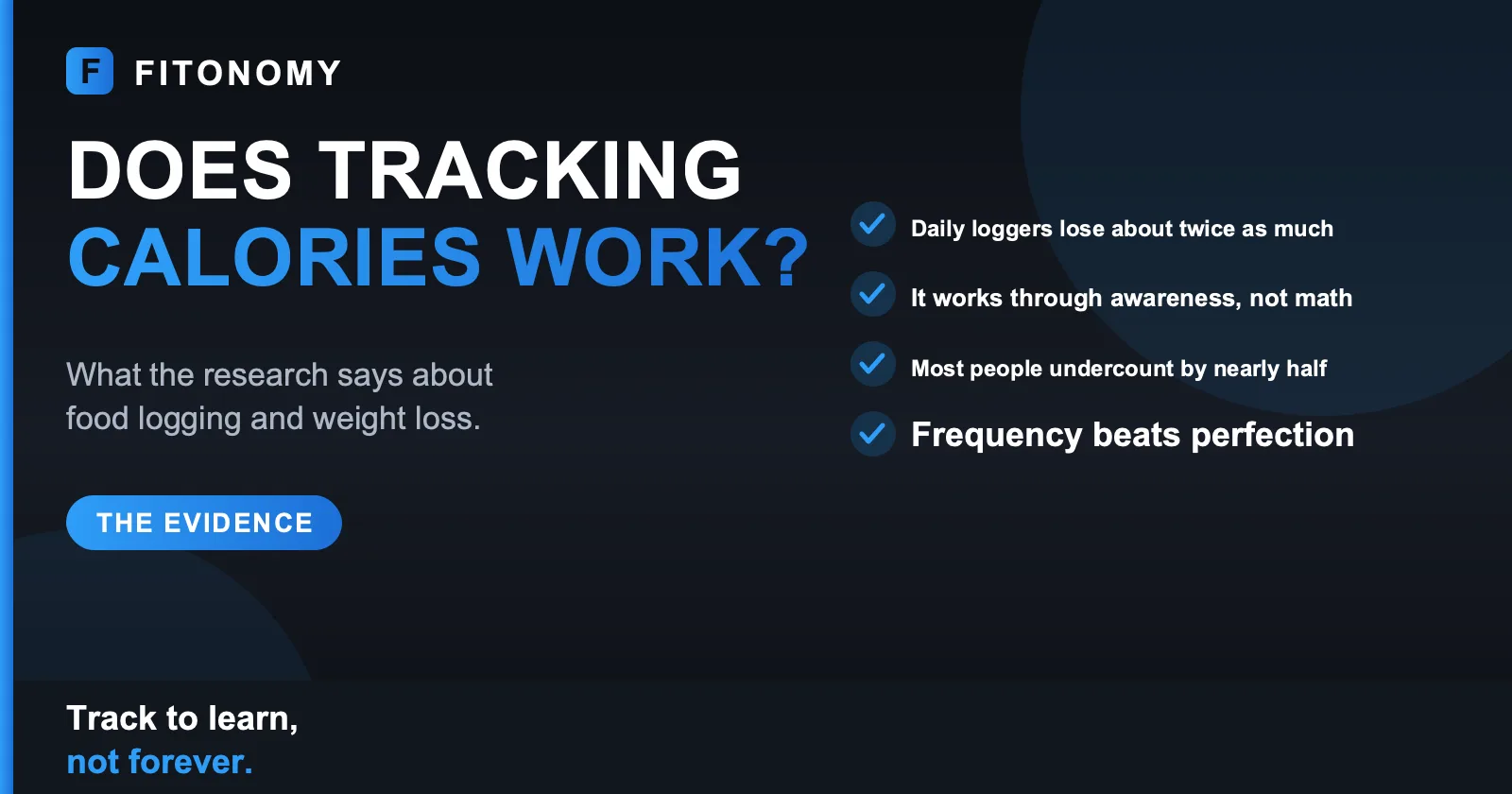
Logging every bite you eat sounds tedious, and plenty of people quietly suspect it is diet-culture busywork. So it is worth knowing that food tracking is not just popular, it is one of the most consistently effective weight-loss behaviors ever studied. The research on it is old, large, and remarkably one-directional: people who track lose more weight than people who do not.
But there is nuance that decides whether it works for you. Tracking is powerful because of what it does to your awareness, not because of the exact numbers, which are often wrong anyway. And you almost certainly do not need to do it forever. Here is what the science actually shows, why your calorie estimates are less accurate than you think, and how to track in a way you will keep up.
Does tracking calories actually work?
Yes, and the effect is large for a free behavior. A landmark 2008 study by Hollis and colleagues followed 1,685 dieters and found that those who kept daily food records lost about twice as much weight as those who kept none, roughly 18 pounds versus 8 pounds over six months, on the same program. Same diet advice, double the result, with food logging as the difference.
That is not a one-off. A 2011 systematic review by Burke and colleagues examined the evidence across 15 studies and concluded that dietary self-monitoring was significantly associated with weight loss, and that people who logged more consistently and completely lost more. More recently, a 2021 review by Patel and colleagues pooled 39 trials of digital tracking and found that 74 percent of the measured links between tracking and weight loss were positive. Across decades and methods, the answer keeps coming back the same.
Takeaway: Food tracking is one of the best-supported weight-loss behaviors there is. In a 1,685-person trial, daily loggers lost about twice as much weight. It reliably works, and it is free.
Why does it work?
Not because of the precise calorie math, but because tracking forces awareness. Most overeating is invisible: the handful of nuts, the oil in the pan, the bites while cooking, the second helping you did not really register. Writing food down (or logging it) makes those hidden calories visible, and once they are visible, you naturally cut back on some of them. This is the same self-monitoring principle behind why activity data helps (see our guide on whether fitness trackers actually work). The act of measuring a behavior changes it. Tracking also teaches you the calorie and protein content of the foods you actually eat, which is a skill that keeps paying off long after you stop logging.
Takeaway: Tracking works by making hidden calories visible and building awareness, not by perfect arithmetic. Once you can see what you are eating, you eat less of the stuff that was slipping through unnoticed.
How much do you actually need to track?
Less perfectly than you fear, but more consistently than you would like. A 2019 study by Harvey and colleagues, aptly titled "Log Often, Lose More," found that frequency mattered more than perfection: the people who lost 10 percent or more of their body weight logged about 2.7 times per day, versus 1.7 for those who lost less. And it did not take long. Successful trackers spent around 15 minutes a day total, and the most efficient logged a meal in under 60 seconds.
So the winning pattern is not obsessive precision, it is showing up. Log most meals, most days, quickly. A fast, slightly rough entry you actually make beats a perfect entry you skip. Consistency is the active ingredient, which is the same lesson behind staying consistent with exercise.
Takeaway: Frequency beats perfection. Aim to log most meals most days (successful losers averaged under 3 quick entries a day, about 15 minutes total). A rough log you keep up beats a perfect one you abandon.
The catch: you are probably worse at estimating than you think
Here is the humbling part. People are strikingly bad at eyeballing what they eat. A classic 1992 study by Lichtman and colleagues in the New England Journal of Medicine studied people who swore they could not lose weight on a low-calorie diet, and found they underreported their actual food intake by an average of 47 percent while overreporting their exercise by 51 percent. Not through lying, through honest human error: forgotten bites, underestimated portions, and invisible add-ons like oil, dressing, and drinks.
This is why tracking can quietly fail. If you log 1,500 calories but actually ate 2,200, the scale will not move and you will blame your metabolism. The fix is not to track forever, it is to track accurately for a while so your estimates get calibrated. This is also the honest limit of any calorie number, including the ones your devices show you, and why a deficit has to be managed with a real target, not a guess (see our calorie deficit guide).
Takeaway: People routinely underestimate intake by around half without realizing it. Most stalled diets are undercounting, not slow metabolism. Track accurately for a while to calibrate your eye, especially portions, oils, and drinks.
Do you have to track forever?
No, and you should not have to. Think of tracking as a learning tool with a job to do: teach you what portions and foods fit your goal. Once you have internalized that, most people can maintain on awareness alone, tracking again only when progress stalls or they want to lean out. Many use it in phases, log tightly during a fat-loss push, then loosen off during maintenance. The knowledge sticks even when the logging stops.
Takeaway: Tracking is a temporary teacher, not a life sentence. Log to learn your portions and food values, then coast on that awareness, returning to it in phases when you need to dial things in.
How to track in a way that actually sticks
Do it in the way the research rewards. Log immediately rather than trying to remember at night, when foods get forgotten. Weigh or measure portions early on, especially calorie-dense things like oils, nut butters, and grains, until your eye is trained. Do not skip the easy-to-forget stuff: drinks, sauces, cooking oil, and bites while cooking are where the hidden calories hide. Prioritize consistency over precision, a quick estimate logged beats a perfect entry skipped. And set a clear calorie and protein target so the numbers mean something (our protein guide covers the protein side).
Ways to track compared
- App with a food database. Accuracy: Good, fast once set up. Effort: Low to medium. Best for: Most people, daily use.
- Food scale plus an app. Accuracy: Highest. Effort: Medium. Best for: Calibrating your eye, plateaus.
- Photo journal. Accuracy: Rough. Effort: Very low. Best for: Awareness without numbers.
- Paper diary. Accuracy: Depends on you. Effort: Medium. Best for: People who dislike apps.
Takeaway: Log immediately, weigh calorie-dense foods early, never skip drinks and oils, and value consistency over precision. Pick the method you will actually keep using, and set a real calorie and protein target.
The Fitonomy angle: make logging low-friction
The research is clear on both halves of this: tracking works, and people quit it because of friction and inaccurate estimates. So the entire game is making logging fast, consistent, and tied to a clear goal. That is what a good tool does. Fitonomy's meal planner lets you set a realistic calorie and protein target and log your food against it, so the number on the screen actually means something and each entry takes seconds rather than minutes. Lower friction means you log more often, and logging more often is exactly what the studies tie to more weight loss. You can set your targets and track in the Fitonomy app and lean on the consistency the evidence rewards, instead of a paper diary you will abandon by Friday.
Takeaway: Tracking works when it is easy and goal-anchored. Fitonomy's meal planner sets a calorie and protein target and makes logging quick, which supports the frequent, consistent tracking the research links to more weight loss.
The bottom line
Tracking your food genuinely works, about doubling weight loss in the research, because it makes hidden calories visible and builds lasting awareness. It does not require obsessive precision, just consistent logging of most meals, most days, done quickly. Watch out for the universal blind spot of underestimating portions, calibrate your eye with a scale early on, and treat tracking as a temporary teacher you can set down once the lessons stick. Used that way, it is one of the highest-return habits in all of weight loss.
Frequently asked questions
Does tracking calories actually work for weight loss? Yes, strongly. A 1,685-person study found people who kept daily food records lost about twice as much weight as those who kept none, and a review of 15 studies confirmed dietary self-monitoring is significantly associated with weight loss. It works by making hidden calories visible and building awareness, not by perfect math.
Do you have to count calories to lose weight? No, but it is one of the most effective tools. Weight loss ultimately requires a calorie deficit, and tracking is simply the most reliable way to know whether you are in one. Some people achieve a deficit through habits alone, but tracking dramatically increases the odds, especially when progress stalls.
How accurate is calorie counting? Less accurate than most people assume. A classic study found people underreported their food intake by about 47 percent on average, usually through forgotten bites, underestimated portions, and invisible extras like oil and drinks. Weighing calorie-dense foods early on and logging immediately fixes most of this.
How long should you track calories? Not forever. Tracking is best used as a temporary learning tool to calibrate your sense of portions and food values. Once that awareness sticks, most people maintain without daily logging, returning to it in phases when progress stalls or they want to lean out.
What is the best way to track calories? Log immediately rather than from memory, weigh calorie-dense foods like oils and grains until your eye is trained, never skip drinks and sauces, and value consistency over precision. Successful trackers in research logged under three quick entries a day, about 15 minutes total, using an app with a food database.