You strap on a watch, it counts your steps, and somehow you are supposed to get fit. It sounds a little too easy to be true, and plenty of people buy a tracker in January only to leave it in a drawer by March. So the fair question is whether these devices actually do anything, or whether they just quantify a workout you were going to do anyway.
The research has a clear and useful answer. Fitness trackers genuinely work, in the sense that people who use them move more and lose a bit more weight than people who do not. But the effect is modest, some of the numbers they show you are unreliable, and a tracker on its own is far weaker than a tracker used the right way. Here is what the studies show and, more importantly, how to actually get results from yours.
Do fitness trackers actually increase activity?
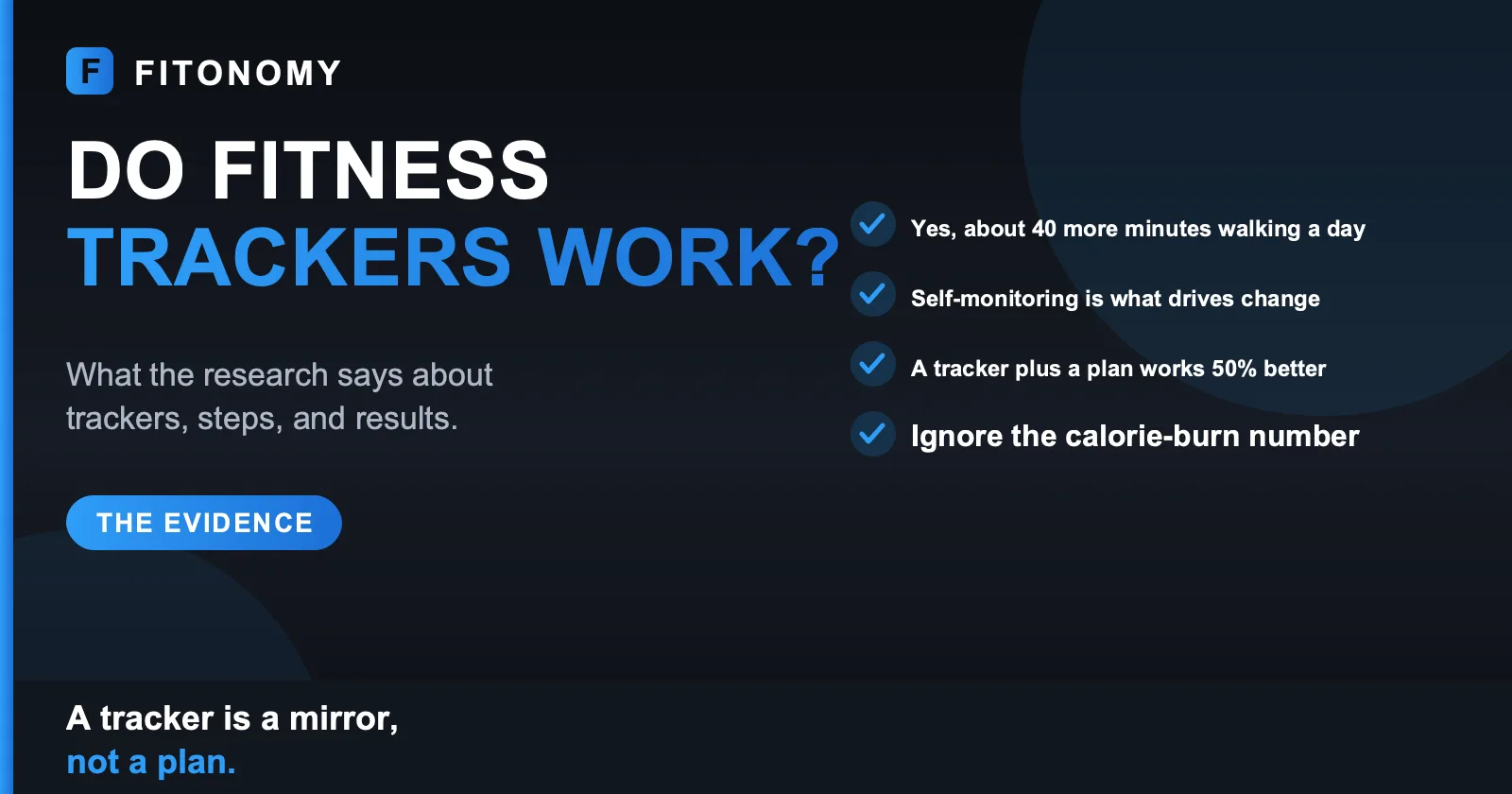
Yes, measurably. The strongest evidence is a 2022 umbrella review by Ferguson and colleagues in The Lancet Digital Health, which pooled 39 systematic reviews and meta-analyses. It found that wearing an activity tracker increased daily walking by about 40 minutes and was associated with roughly 1 kilogram (about 2 pounds) of weight loss, with the benefit holding across age groups and lasting over time. Of the analyses reviewed, 79 percent favored trackers and none favored going without one.
A 2019 meta-analysis by Brickwood and colleagues put a number on the activity boost: consumer trackers produced a small but significant increase in daily steps and in moderate-to-vigorous physical activity (effect sizes around 0.24 and 0.27). Small, but real, and consistent across studies. So the device is not a placebo. It nudges genuine behavior.
Takeaway: Fitness trackers reliably increase activity, adding around 40 minutes of daily walking and modest weight loss in the research. The effect is small but real and durable, not a placebo.
Why do they work?
Not because of the technology, but because of a well-established psychological principle: self-monitoring changes behavior. The simple act of measuring something makes you pay attention to it and adjust. A 2016 meta-analysis by Harkin and colleagues in Psychological Bulletin pooled 138 studies covering nearly 20,000 people and found that prompting people to monitor their progress toward a goal reliably increased goal attainment (effect size 0.40). Seeing the number is what does the work.
This is also why a tracker can backfire into motivation. Watch your step count climb toward a target and you will find yourself taking the stairs or walking the long way to close the ring. The device turns an invisible behavior into a visible, trackable one, which is the same reason we push logging your sessions in how to track your workouts and building a streak in how to stay consistent with exercise.
Takeaway: Trackers work through self-monitoring, not magic. Measuring a behavior makes you act on it, and monitoring progress toward a goal reliably improves goal attainment (effect size 0.40). The visible number is the active ingredient.
The catch: a tracker on its own is not enough
Here is the finding most tracker ads leave out. The device alone is the weakest version of the intervention. In the Brickwood meta-analysis, programs that combined a tracker with other elements like goal-setting, coaching, or a structured plan produced effects roughly 50 percent larger than the tracker used by itself. And a landmark 2009 meta-analysis by Michie and colleagues found that self-monitoring was most effective when paired with at least one other self-regulation technique, especially goal-setting.
In plain terms: a tracker tells you what you did, but it does not tell you what to do. Bolt it onto a clear goal and an actual plan and it becomes powerful. Wear it with no target and no program and it becomes a fancy pedometer you will eventually ignore.
Takeaway: A tracker by itself is the weakest setup. Pair it with goals and a structured plan and it works about 50 percent better. The device measures, but you still need something telling you what to do.
What trackers get right, and what they get wrong
Trust your tracker for some things and not others. A 2017 Stanford study tested seven popular devices and found they measure heart rate well, with six of seven within 5 percent error and the best within 2 percent. But energy expenditure was a different story: not one device measured calories burned accurately, and even the best was off by about 27 percent, with some far worse. Steps and heart rate are solid. The calorie-burn number is closer to a rough guess.
This matters most for weight loss, because people often eat back the calories their watch claims they burned, then wonder why the scale will not move. Do not do that. If your goal is fat loss, treat the calorie-burn figure as loose motivation, not a budget, and manage intake with a proper target instead (see our calorie deficit guide).
What to trust on your tracker
- Steps. Accuracy: Good. How to use it: Trust it, useful daily target.
- Heart rate. Accuracy: Good, within 2 to 5% error. How to use it: Trust it, handy for effort zones.
- Calories burned. Accuracy: Poor, off by 27% or more. How to use it: Treat as a rough trend, never eat it back.
- Sleep stages. Accuracy: Rough. How to use it: Watch the trend, not the nightly detail.
- Distance. Accuracy: Decent. How to use it: Fine for general tracking.
Takeaway: Steps and heart rate are accurate enough to trust. Calorie-burn estimates are unreliable and often too high, so never eat those calories back. Use the numbers you can trust and treat the rest as loose signals.
Do they actually help you lose weight?
A little, on their own. The Ferguson review found that tracker use was linked to about 1 kilogram of weight loss on average, which is real but modest. A tracker is not a weight-loss program. What it is good at is the behavior side: keeping you moving, making activity visible, and holding you accountable day to day. Weight loss still comes down to a sustained calorie deficit, and the tracker is a supporting tool for the activity half of that equation, not the whole solution.
Takeaway: Trackers produce modest weight loss (around 1 kg) by themselves. They support fat loss by boosting activity and accountability, but the result still depends on a calorie deficit. Treat the tracker as a helper, not the plan.
How to actually get results from a tracker
Use it the way the research says works. Set a specific, realistic goal rather than just wearing the device (a daily step target, a weekly workout count). Pair it with an actual plan so you know what to do, not just what you did. Trust steps and heart rate, and ignore the calorie-burn number for anything that matters. Watch trends over weeks rather than obsessing over any single day, since day-to-day readings are noisy. And use the accountability: a visible streak or a ring to close is often the nudge that gets you off the couch. The device is a mirror. It works when you act on what you see.
Takeaway: Set a specific goal, pair the tracker with a plan, trust steps and heart rate, ignore the calorie number, and follow the weekly trend. The tracker only works if you respond to it.
The Fitonomy angle: the tracker plus the plan
The clearest lesson from the research is that a tracker works best when it is one part of a bigger system: self-monitoring combined with goals and a structured plan, the multifaceted approach that outperformed a bare tracker by about 50 percent. That is precisely how Fitonomy is built. It logs your workouts and keeps a streak so the self-monitoring loop that drives behavior is always on, and it pairs that with structured plans and clear goals so you are never just staring at numbers wondering what to do next. The tracking tells you where you are, and the plan tells you where to go. You can track your workouts and follow a plan in the Fitonomy app and get the combination the evidence actually supports, instead of a lonely step count.
Takeaway: The evidence favors tracking plus a plan, not tracking alone. Fitonomy pairs workout logging and streaks with structured goals and plans, which is the combination the research shows works roughly 50 percent better than a tracker on its own.
The bottom line
Fitness trackers do work. They increase activity, support modest weight loss, and drive behavior through the simple power of self-monitoring. But the effect is small on its own, the calorie numbers are unreliable, and a tracker worn without a goal or a plan is the weakest way to use one. Set a clear target, pair the device with a real program, trust the steps and not the calorie count, and follow the trend. Used that way, a tracker earns its place. Left in a drawer, or worn without a plan, it is just jewelry that counts.
Frequently asked questions
Do fitness trackers actually work? Yes, modestly. A 2022 umbrella review in The Lancet Digital Health found wearing an activity tracker increased daily walking by about 40 minutes and was linked to roughly 1 kilogram of weight loss across age groups. The effect is small but real and lasting, driven by the behavior-change power of self-monitoring.
Are fitness tracker calorie counts accurate? No. A 2017 Stanford study found that popular trackers measure heart rate well (within 2 to 5 percent error) but estimate calories burned poorly, with even the best device off by about 27 percent. Never eat back the calories your tracker says you burned, especially if you are trying to lose weight.
Do fitness trackers help you lose weight? A little on their own, around 1 kilogram on average in the research. They help mainly by increasing activity and accountability, but weight loss still depends on a sustained calorie deficit. A tracker is a useful supporting tool, not a complete weight-loss program.
Why do fitness trackers work? Because of self-monitoring. Seeing a number makes you act on it. A 2016 meta-analysis of 138 studies found that monitoring progress toward a goal reliably improved goal attainment (effect size 0.40). The visible feedback, like a step count or a streak, is what nudges behavior.
What is the best way to use a fitness tracker? Do not just wear it. Set a specific goal, pair it with a structured plan, trust steps and heart rate but ignore the calorie-burn number, and follow weekly trends rather than daily noise. Research shows a tracker combined with goals and a plan works about 50 percent better than a tracker alone.