Search "home workout app" and you get thousands of options, all with glossy screenshots, five-star ratings, and a promise to transform you in 30 days. Most people pick one by its rating, use it hard for two weeks, and quietly stop. The app was probably not the problem. The fit was.
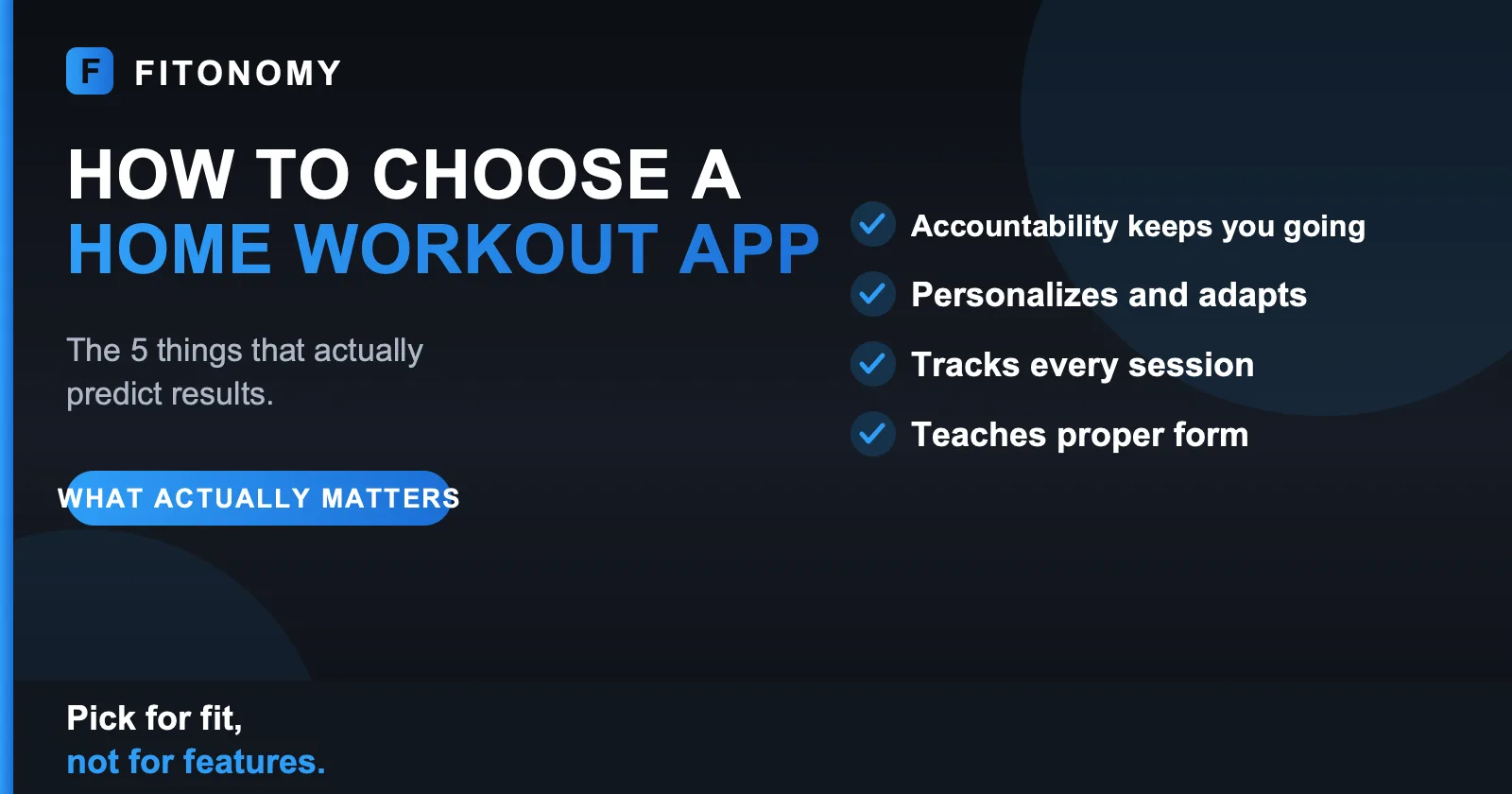
The features that actually predict whether an app works for you are mostly not the ones in the app store screenshots. They are the boring ones that keep you training and progressing month after month. Here is what the research says to look for, the red flags that waste your money, and the honest cases where you do not need an app at all.
First, the only metric that really matters: do you keep using it
An app can only help you if you keep opening it, and the evidence on fitness apps is humbling here. A 2019 systematic review by Romeo and colleagues found smartphone apps produced only a modest, non-significant increase in physical activity (about 477 extra steps per day, 95 percent CI -230 to 1183), and the effect was clearest in the short term, under three months. Apps nudge behavior, but the nudge fades fast if nothing keeps you engaged.
The flip side is the useful part. A 2022 meta-analysis of app-based interventions found small-to-moderate effects on body weight and body fat, and the apps that worked best shared specific features: reminders, self-reporting, and coaching. In other words, the app does not need to be magic. It needs to be built to keep you coming back. Every criterion below is really a proxy for that one question: will this app still be in your routine in six months?
Takeaway: Results come from consistency, and most apps fail on engagement, not exercise science. Judge an app by how well it keeps you training, not by its exercise count.
Criterion 1: Does it keep you accountable?
This is the feature set the research keeps singling out. The 2022 app meta-analysis found reminders, self-monitoring, and coaching were the difference between apps that worked and apps that did not. Behavior science agrees: Michie and colleagues (2009), reviewing 122 interventions across nearly 45,000 people, found self-monitoring was the single most effective behavior change technique, and pairing it with goal review and feedback raised effectiveness from 0.26 to 0.42.
Look for reminders you can schedule, streaks or progress visuals, and some form of check-in. Avoid apps that are just a silent video library you have to motivate yourself to open.
Takeaway: Prioritize apps with reminders, progress visuals, and check-ins. Accountability features are the most evidence-backed part of any fitness app.
Criterion 2: Does it personalize and adapt?
A static plan that never changes is a PDF with a subscription fee. The better apps adjust to your goal, level, and progress over time, a principle called autoregulation. A 2021 meta-analysis in Frontiers in Physiology found autoregulated training, which adjusts based on your recent performance, beat fixed programs for strength with a moderate effect (standardized mean difference 0.64).
A good app should ask your goal, experience, schedule, and equipment up front, then change the plan as you log workouts. If week eight looks identical to week one no matter how you performed, it is not really personalizing.
Takeaway: Choose an app that builds around your inputs and adapts to your logged performance, not one that hands everyone the same fixed plan.
Criterion 3: Does it track your progress?
Tracking is what turns training into progressive overload. Monitoring progress toward a goal reliably improves the odds of reaching it: a 2016 meta-analysis in Psychological Bulletin (138 studies, nearly 20,000 people) found a moderate effect (d = 0.40), and it was stronger when progress was physically recorded rather than kept in your head. An app that logs your sets, reps, weight, and effort, and shows last session's numbers, makes beating them easy. We go deeper on this in our guide to tracking your workouts.
Takeaway: Pick an app that records your sets, reps, weight, and effort and surfaces your history. Tracking is the mechanism behind almost all progress.
Criterion 4: Does it teach form?
At home there is no one to correct you, so the app has to. Clear demonstration videos that show setup, the working range, and common mistakes are the difference between an exercise that builds you and one that hurts you. This matters more for home training than gym training, precisely because no coach is watching. A searchable exercise library with real video guidance is a green flag.
Takeaway: Demand clear form videos, not just exercise names. At home, the app is your only coach.
Criterion 5: Does it fit your space, equipment, and level?
A home workout app is useless if it programs barbell back squats and you own two dumbbells and a mat. The best apps let you specify your equipment and adjust accordingly, scale to your level, and fit sessions into the time you actually have. If you train with minimal gear, our guide to building muscle at home without weights shows how much is possible with bodyweight alone, and the right app should program around exactly that.
Takeaway: The plan must match your equipment, space, level, and schedule. Personalization to your reality beats a generic "home" label.
The types of home workout app, compared
Not all workout apps are the same kind of thing. Knowing the category helps you match the tool to what you need.
- Guided program. What it does: Fixed multi-week plans you follow. Adherence support: Medium. Best for: Beginners who want a set path.
- AI planner. What it does: Builds and adapts a plan to your data. Adherence support: High. Best for: Most people who want structure that adapts.
- Exercise library. What it does: Searchable catalog of movements with videos. Adherence support: Low. Best for: Self-directed lifters who program themselves.
- Tracker only. What it does: Logs your workouts, no programming. Adherence support: Medium. Best for: People who already have a plan.
- Live coaching. What it does: Real coach via the app. Adherence support: Highest. Best for: Those who need real accountability and can pay.
The pattern: pure exercise libraries and trackers give you tools but leave the structure to you, guided and AI apps do the thinking, and live coaching adds a human at a higher price. Match the category to how much guidance and accountability you actually need.
Takeaway: Decide how much the app should think for you. AI planners suit most people; libraries and trackers suit those who can self-program; coaching suits those who need a person.
Red flags to avoid
- A single plan for everyone, with no questions about your goal, level, or equipment.
- No progression. The plan never gets harder as you do.
- No form guidance, just a list of exercise names.
- Locked behind a paywall before you can see whether it fits you.
- Outlandish promises ("shredded in 14 days") with no mention of consistency.
Takeaway: Walk away from one-size plans, no progression, and no form guidance. Those are the apps people abandon.
When you do not need an app at all
Honesty matters more than a sale here. If you already have a plan you follow and a way to track it, a notebook and a free exercise video are enough. If you are rehabbing an injury or managing a medical condition, a qualified professional beats any app. Apps earn their keep when they remove friction and keep you consistent, not when they replace knowledge you already have.
Takeaway: If you already train consistently and track it, you may not need an app. Apps are for removing friction, not for buying motivation you can build for free.
How Fitonomy maps to the checklist
For a worked example, Fitonomy lines up with the five criteria: its AI Workout Planner personalizes a plan to your goal, level, schedule, and equipment and adapts it from your logged performance; its Exercise Library provides video form guidance for each movement; and its Workout Logger tracks sets, reps, weight, and effort so the plan progresses off real data. Whether or not Fitonomy is your pick, run any app you are considering through the same five questions. We also covered the specific question of whether AI workout planners actually work if that is the category you are weighing.
The bottom line
The best home workout app is the one you will still be using in six months, and that comes down to fit, not features on a list. Judge it on five things: does it keep you accountable, does it personalize and adapt, does it track progress, does it teach form, and does it match your space and equipment. Run any app through those questions, watch for the red flags, and remember that if you already train and track consistently, you might not need one at all.
Sources
- Romeo, A., et al. (2019). Can Smartphone Apps Increase Physical Activity? Systematic Review and Meta-Analysis. Journal of Medical Internet Research. https://www.jmir.org/2019/3/e12053/
- Wang, Y., et al. (2022). Smartphone app-based interventions targeting physical activity for weight management: A meta-analysis of randomized controlled trials. International Journal of Nursing Studies. https://pubmed.ncbi.nlm.nih.gov/36379104/
- Michie, S., et al. (2009). Effective Techniques in Healthy Eating and Physical Activity Interventions: A Meta-Regression. Health Psychology. https://pubmed.ncbi.nlm.nih.gov/19916637/
- Zhang, B., et al. (2021). Effects of Autoregulation on Strength: A Systematic Review and Meta-Analysis. Frontiers in Physiology. https://www.ncbi.nlm.nih.gov/pmc/articles/PMC7994759/
- Harkin, B., et al. (2016). Does Monitoring Goal Progress Promote Goal Attainment? A Meta-Analysis. Psychological Bulletin. https://pubmed.ncbi.nlm.nih.gov/26854092/
Frequently asked questions
Are home workout apps worth it? They can be, if they keep you consistent. Research shows fitness apps produce modest effects on physical activity that fade after a few months, but the apps that work best include reminders, self-monitoring, and coaching. An app is worth it when it removes friction and keeps you training. It is not worth it if it is just a video library you have to motivate yourself to open.
What should I look for in a home workout app? Five things: accountability features (reminders, progress visuals, check-ins), real personalization that adapts to your logged performance, progress tracking for sets, reps, weight, and effort, clear form videos since no coach is watching at home, and programming that fits your equipment, space, level, and schedule. These predict results far better than the exercise count or the app store rating.
Are free workout apps any good? Some are, but free apps often skip the features that drive results. Behavior research links goal setting, self-monitoring, feedback, and reminders to better outcomes, and many free apps lack them. A free app that genuinely adapts and helps you stay consistent can work well. One that only shows a fixed list of exercises with no progression is effectively a static template.
Can a home workout app replace a gym or a personal trainer? For structure, progression, and low-cost convenience, a good app covers most needs for healthy beginners and intermediates training at home. It cannot watch your form in real time, manage an injury, or provide the accountability of a person expecting you. For rehab, medical conditions, or specialized goals, a qualified professional is the safer choice.
Do home workout apps actually build muscle? Indirectly, yes. The app does not build muscle, your training does, but a good app enables the things that do: a progressive plan, tracking so you can apply progressive overload, and the consistency to keep going. An app that personalizes, adapts, and tracks gives you the structure to build muscle at home, provided you follow it.
Which home workout app is best for beginners? For beginners, the best app is one with strong form guidance and a guided or adaptive plan, so you are not left to design your own routine. Prioritize clear demonstration videos, a plan that matches your equipment and level, and reminders to keep you consistent. The specific brand matters less than whether it scores well on those criteria.