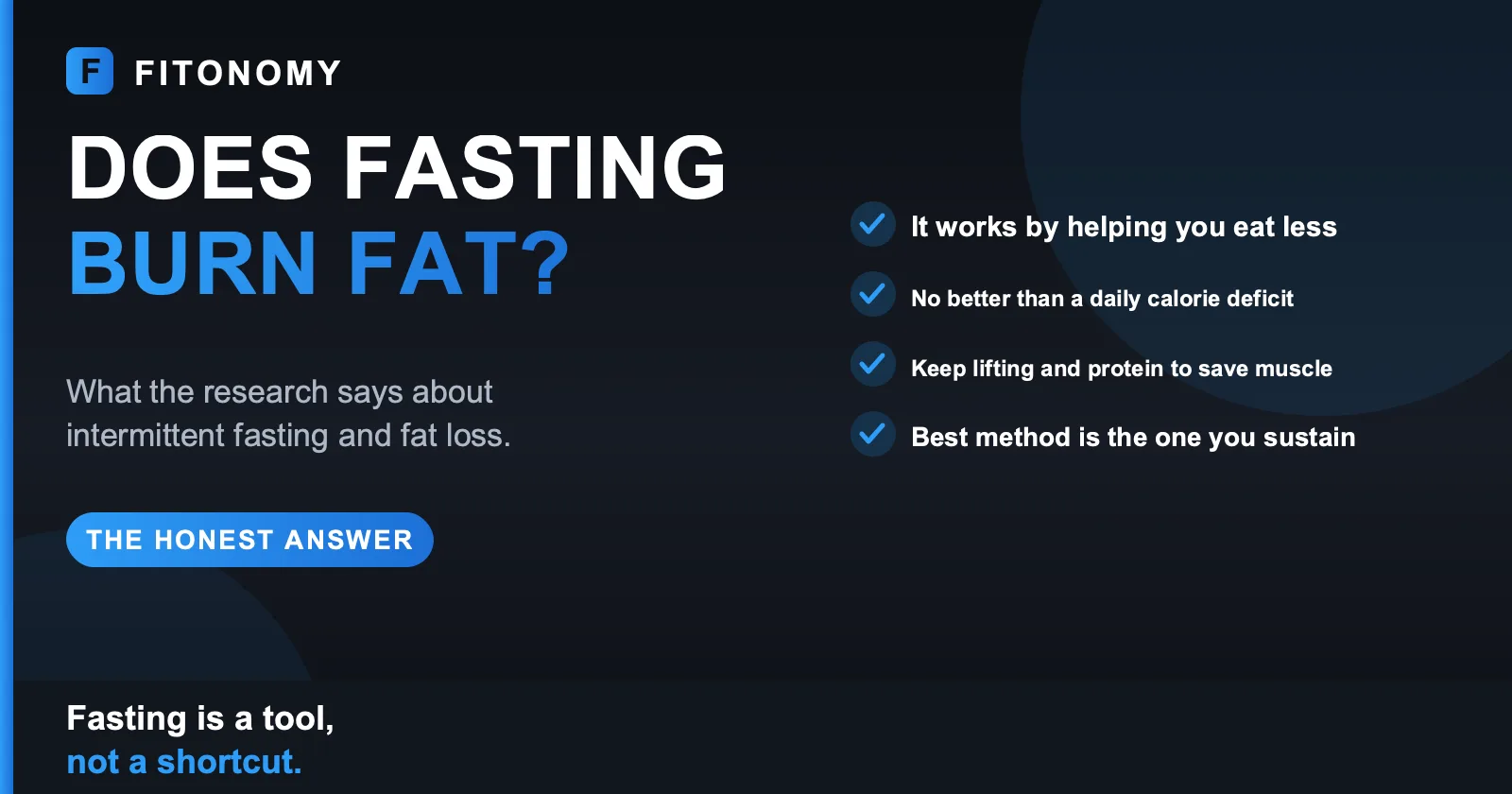
Intermittent fasting is one of the most popular diets in the world, and one of the most misunderstood. Fans swear it melts fat, flips a metabolic switch, and does things ordinary dieting cannot. Skeptics call it a fad. The research lands somewhere more useful than either camp: fasting genuinely works for fat loss, but almost certainly not for the reason you have been told.
Here is the honest summary before the details. Intermittent fasting helps people lose fat mainly because it is a convenient way to eat fewer calories, not because the timing itself is magic. That sounds like a letdown, but it is actually good news, because it means fasting is a legitimate tool you can choose based on whether it fits your life, not a rule you have to obey. Let me show you what the studies actually found.
Does intermittent fasting actually work?
Yes, for many people it does lead to fat loss. When you compress your eating into a shorter window (say 8 hours) or cut intake on certain days, most people naturally end up eating less overall. Fewer hours to eat means fewer calories, and a calorie deficit is what drives fat loss (we break that mechanism down in our calorie deficit guide). So the weight loss is real. The question is whether fasting does anything special beyond that, and that is where it gets interesting.
Takeaway: Intermittent fasting does produce fat loss for many people, because shrinking your eating window usually means eating fewer calories. The fat loss is real, but the mechanism is a calorie deficit, not the fasting itself.
Is it actually better than just eating less?
This is the key question, and the research answer is remarkably consistent: no, not meaningfully. Multiple systematic reviews and meta-analyses have compared intermittent fasting head to head against plain continuous calorie restriction (eating a bit less every day), and they find roughly equivalent results for weight loss, with no significant advantage for fasting once calories are accounted for.
The individual trials tell the same story. A 2020 randomized trial by Lowe and colleagues in JAMA Internal Medicine (the TREAT study) put people on 16:8 time-restricted eating and found it produced no more weight loss than eating across a normal day. A 2017 trial by Trepanowski and colleagues followed 100 people for a full year and found alternate-day fasting was no better than daily calorie restriction for weight loss, and it actually had a higher dropout rate (38 percent quit the fasting group versus 29 percent for daily restriction). Fasting was not superior, and for some people it was harder to stick with.
Takeaway: In head to head trials, intermittent fasting is not better than simply eating fewer calories every day. Weight loss comes out about the same, and some people find fasting harder to sustain. Pick it because it suits you, not because it beats calorie counting.
Then why does it work for so many people?
Because for the right person, a rule like "do not eat before noon" is simply an easier way to control calories than counting every bite. Cutting out late-night snacking or skipping breakfast removes a big chunk of daily intake without any tracking. That is a real, practical benefit. Fasting is not a metabolic hack, it is an appetite and behavior tool, and behavior is what most diets fail on. If a shorter eating window helps you eat less without feeling deprived, it is doing its job.
Takeaway: Fasting works when it makes eating less feel easier, by cutting a meal or a snacking window you did not need. It is a behavior strategy, not a metabolic one. The best diet is the one you can actually stick to.
Do you lose muscle when fasting?
You can, and this is the real risk to take seriously. Any time you lose weight in a calorie deficit, some of it can come from muscle, and the TREAT trial noted a concerning amount of lean-mass loss in the fasting group. But it is very preventable. A 2016 study by Moro and colleagues had resistance-trained men do 16:8 fasting while lifting, and they lost fat while maintaining their muscle. The difference was two things: they kept training, and they still ate enough protein.
So the rule is simple. If you fast, protect your muscle by lifting weights and hitting a solid protein target (see how much protein you actually need). A shorter eating window makes protein a little harder to fit in, so it takes intention, but it is entirely doable.
Takeaway: Muscle loss is a real risk on any diet, including fasting, but resistance training plus enough protein prevents it. Do not fast and skip the weights, that is how you end up smaller but not leaner.
Are there benefits beyond weight loss?
Possibly, and this is where fasting might have a genuine edge, though the evidence is younger. A 2018 crossover trial by Sutton and colleagues in Cell Metabolism fed men with prediabetes the exact same food, just in an early time-restricted window (finishing dinner by mid-afternoon), and it improved insulin sensitivity, blood pressure, and oxidative stress even though nobody lost weight. That suggests when you eat, especially eating earlier in the day, may carry some metabolic benefit independent of calories.
The honest caveat: that was a small, short study, and eating dinner in the early afternoon is impractical for most people. So treat this as a promising bonus for some, not the main reason to fast. The weight-loss story is still fundamentally about calories.
Takeaway: Early time-restricted eating showed some metabolic benefits (better insulin sensitivity and blood pressure) even without weight loss, hinting timing matters a little. But the evidence is early and the schedule is impractical for most, so do not count on it.
Which fasting method is best, and who should skip it?
The best method is the one you can hold for months without misery. Here is how the common approaches compare.
Common intermittent fasting methods
- 16:8 (time-restricted). How it works: Eat within an 8-hour window daily. Evidence and notes: Most popular and sustainable. No better than normal eating in TREAT, but easy to maintain.
- 5:2. How it works: Eat normally 5 days, very low calories 2 days. Evidence and notes: Works via weekly calorie reduction. Fasting days can be tough.
- Alternate-day fasting. How it works: Alternate normal and very-low-calorie days. Evidence and notes: Effective but highest dropout (38% in Trepanowski). Hard to sustain.
- Early time-restricted. How it works: Eat early, finish by mid-afternoon. Evidence and notes: Possible metabolic edge (Sutton), but impractical for most schedules.
A real safety note: intermittent fasting is not for everyone. If you are pregnant or breastfeeding, have a history of disordered eating, are underweight, or have diabetes or take medication that affects blood sugar, do not start fasting without talking to your doctor first. For those groups, the risks can outweigh any convenience benefit.
Takeaway: Pick the least painful method you can sustain, and 16:8 is the easiest for most. If you are pregnant, have a history of eating disorders, or manage blood sugar with medication, talk to a doctor before fasting.
How to do intermittent fasting well
If you try it, do it in a way that actually works. Do not treat the eating window as a license to binge, that erases the calorie deficit that makes it work in the first place. Keep resistance training and hit your protein target to hold onto muscle. Stay hydrated during the fast, and remember that black coffee and water are fine (our caffeine guide covers timing). And do not obsess over the exact hour, meal timing matters far less than total intake, as we cover in does nutrient timing matter. Above all, judge it on one question after a few weeks: is it helping you eat less without making you miserable? If yes, keep it. If no, a simple daily deficit works just as well.
Takeaway: Do not binge in your window, keep lifting, hit your protein, stay hydrated, and do not fuss over exact timing. If fasting makes eating less easier, it is working. If it makes you miserable, it is the wrong tool for you.
The Fitonomy angle: the levers that actually matter
The science points to a clear conclusion: fasting only works if it helps you eat fewer calories while keeping your muscle, which means the real levers are a calorie target, a protein target, and resistance training, not the clock on your eating window. That is worth building your effort around. Fitonomy's meal planner helps you set and hit a realistic calorie and protein goal, whether or not you use an eating window, and its structured workout plans keep you training hard enough to protect muscle while you lose fat. Fasting can be the delivery method, but these are the things that decide the result. You can set your targets and plan in the Fitonomy app and use fasting, or not, as simply the schedule that fits your day.
Takeaway: Fasting is just a schedule. The results come from calories, protein, and training. Use tools that manage those levers, and treat the eating window as an optional convenience, not the main event.
The bottom line
Intermittent fasting works for fat loss, but because it helps you eat less, not because of any metabolic magic. In fair comparisons it matches ordinary calorie restriction, no better and no worse, so choose it only if a shorter eating window genuinely makes eating less easier for you. Protect your muscle with weights and protein, do not binge in your window, and skip it entirely if you are pregnant, have a history of disordered eating, or manage blood sugar with medication. Fasting is a legitimate tool. It is just a tool, not a shortcut.
Frequently asked questions
Does intermittent fasting actually burn more fat than normal dieting? No. Multiple meta-analyses and head to head trials show intermittent fasting produces about the same weight and fat loss as continuous calorie restriction once calories are matched. It helps because a shorter eating window usually means eating fewer calories, not because fasting itself burns extra fat.
Is intermittent fasting better than counting calories? Not for results, only sometimes for convenience. In the year-long Trepanowski trial, alternate-day fasting was no more effective than daily calorie restriction and had a higher dropout rate. Fasting is worth choosing only if a set eating window makes it easier for you to eat less than tracking would.
Do you lose muscle with intermittent fasting? You can, as with any diet, and one trial found notable lean-mass loss on time-restricted eating. But it is preventable. A 2016 study found resistance-trained men doing 16:8 fasting lost fat while keeping muscle, because they kept lifting and ate enough protein. Train and hit your protein target and you can protect your muscle.
What is the best intermittent fasting method? The one you can sustain. 16:8 (an 8-hour daily eating window) is the most popular and easiest to maintain. 5:2 and alternate-day fasting also work through weekly calorie reduction, but alternate-day fasting has the highest dropout rate in studies. The best method is whichever helps you eat less without misery.
Who should not do intermittent fasting? Anyone who is pregnant or breastfeeding, has a history of disordered eating, is underweight, or has diabetes or takes medication that affects blood sugar should not start fasting without talking to a doctor first. For these groups the risks can outweigh the convenience.