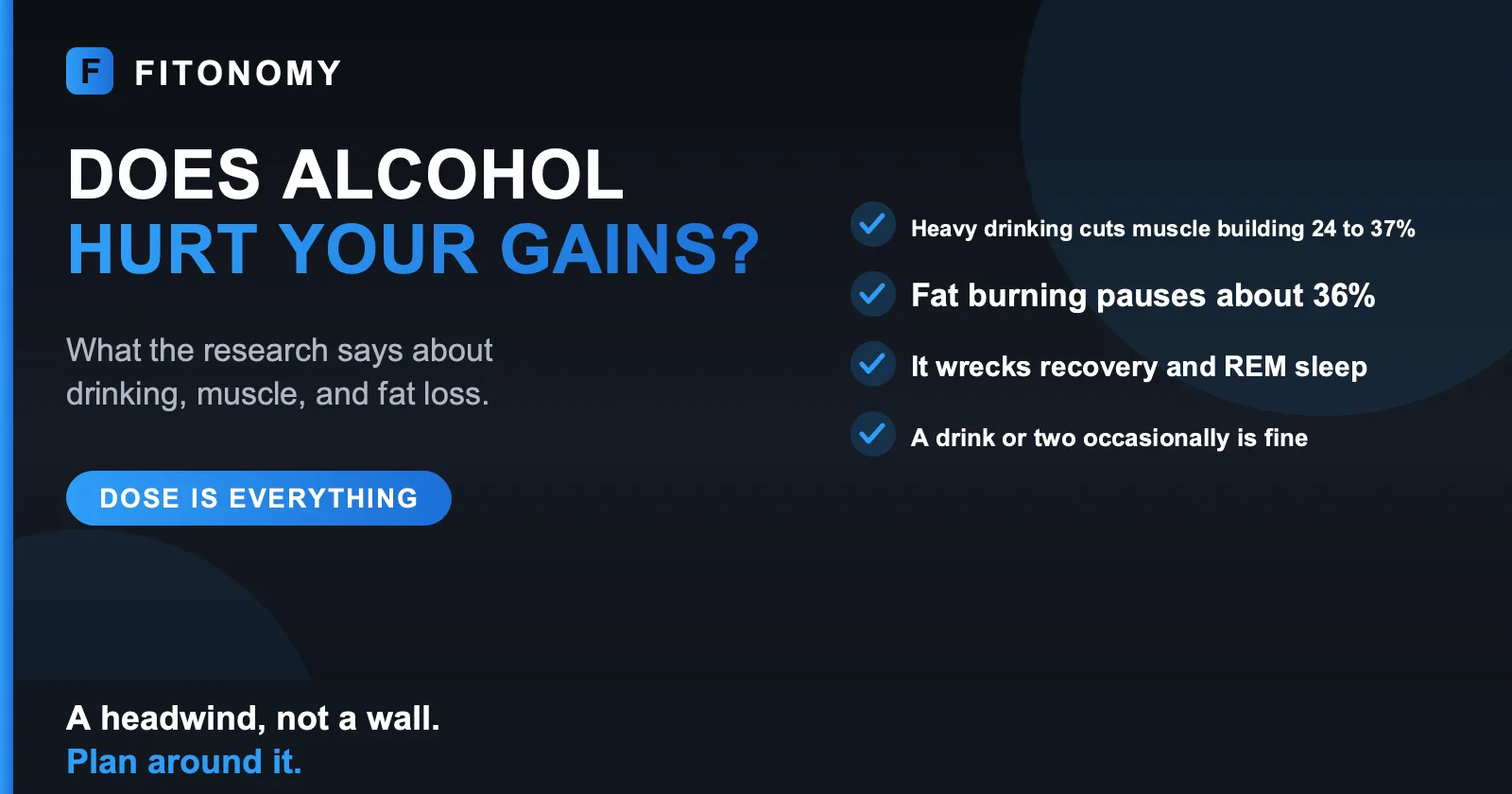
Few questions in fitness get answered with more guilt and less science than this one. One camp says a single beer erases a week of training. The other insists it makes no difference at all. As usual, the truth sits in the middle, and it is more useful than either extreme.
Here is the honest version. Alcohol genuinely works against building muscle and losing fat, through several mechanisms that are well documented. But the damage is strongly dose dependent, and an occasional drink or two is a very different thing from a weekly binge. You do not have to be sober to make progress. You do have to understand what alcohol actually does, so you can decide when it is worth it. Here is the science, and how to drink without wrecking your goals.
Does alcohol hurt muscle growth?
Yes, mainly by blunting the muscle-building signal after you train. Muscle grows through muscle protein synthesis (MPS), the process your body runs after a workout to repair and add tissue. A 2014 study by Parr and colleagues had trained men drink heavily (about 12 drinks worth) after a workout, and it suppressed muscle protein synthesis by 24 percent even when they ate protein alongside it, and by 37 percent with carbs. The muscle-building response was cut by roughly a third to a quarter, despite doing everything else right.
A 2019 systematic review by Lakićević and colleagues put this in context across 12 studies. The clearest harms showed up at higher doses: alcohol lowered testosterone, reduced plasma amino acids, cut muscle protein synthesis, and raised the stress hormone cortisol. Reassuringly, many measures like force and power were often unaffected at lower doses, which tells us dose is everything. Heavy drinking around training is what blunts growth. A moderate amount does far less.
Takeaway: Heavy drinking after training cut muscle protein synthesis by 24 to 37 percent in the research, even with protein, and lowers testosterone at high doses. The muscle-building damage is real but dose dependent, so it is binges that hurt, not a single drink.
Does alcohol stall fat loss?
In two ways, yes. First, alcohol is calorie dense at 7 calories per gram, nearly as much as pure fat, and those calories are easy to pour and easy to forget, which quietly blows a calorie deficit (the thing that actually drives fat loss, see our calorie deficit guide). Second, and less obvious, your body prioritizes burning alcohol over everything else because it cannot store it. A classic 1992 study by Suter and colleagues in the New England Journal of Medicine found that adding alcohol suppressed the body's fat burning (lipid oxidation) by about 36 percent. So while you are metabolizing the drinks, fat burning is essentially paused.
Add the well-known effect of alcohol lowering your inhibitions around food, which is how a few drinks turns into late-night takeaway, and it is easy to see why alcohol and fat loss fight each other. None of this makes fat loss impossible, but every drink is a headwind.
Takeaway: Alcohol stalls fat loss two ways: it adds easy-to-forget calories (7 per gram) that erode your deficit, and it pauses fat burning by about 36 percent while your body processes it. It also loosens food discipline. Fat loss is still possible, just slower.
What about recovery and sleep?
This is the underrated part. Alcohol degrades the two things your body needs to turn training into results: recovery and sleep. A 2010 study by Barnes and colleagues had people do damaging exercise and then drink, and found alcohol significantly magnified the loss of strength in the days afterward, meaning you recover slower and train weaker at your next session.
Sleep takes a hit too. Alcohol famously helps you fall asleep, but a 2013 review by Ebrahim and colleagues found it disrupts the second half of the night and reduces REM sleep at moderate to high doses. Since deep, quality sleep is when much of muscle repair and hormone regulation happens (our sleep guide covers this), a nightcap quietly undercuts the recovery you trained for. Poor recovery plus poor sleep is a bad combination for anyone chasing a physique goal.
Takeaway: Alcohol slows muscle recovery and worsens sleep quality, especially REM in the second half of the night, even though it helps you fall asleep. Since results are built during recovery, this is one of alcohol's most overlooked costs.
So how much is actually too much?
The research keeps pointing to the same answer: dose and frequency are what matter, not whether you ever drink. The clear harms to muscle protein synthesis, testosterone, fat burning, and recovery show up at high doses, the binge end of the scale. Light, occasional drinking has a much smaller footprint and will not undo consistent training and eating.
Alcohol and your goals, by amount
- 1 to 2 drinks, occasional. Muscle and hormones: Minimal measurable effect. Fat loss and recovery: A few extra calories, minor if it fits your day.
- Moderate, a few times a week. Muscle and hormones: Some blunting of recovery and sleep. Fat loss and recovery: Slows the deficit, adds up over a week.
- Heavy or binge (5+ in a sitting). Muscle and hormones: MPS cut 24 to 37%, testosterone down, cortisol up. Fat loss and recovery: Fat burning paused ~36%, sleep and recovery hit hard.
Takeaway: It is a dose curve, not an on-off switch. A drink or two occasionally barely registers, while regular heavy sessions clearly stall muscle, fat loss, and recovery. Match your drinking to how much your goals matter to you right now.
How to drink without derailing your goals
If you are going to drink, drink in a way that limits the damage. Keep it moderate, since the harms scale with the dose. Avoid heavy drinking right around your workouts, when muscle protein synthesis matters most, so a rest day is a better night to go out than the evening after a hard session. Count the calories honestly rather than pretending liquid calories do not exist, because they are the easiest ones to forget (this is exactly why we recommend tracking your intake). Prioritize protein that day so you still hit your target (see how much protein you need), hydrate between drinks, and protect your sleep where you can. And do not spiral: one night out is a rounding error over a month of consistency, so get back on plan the next day rather than writing off the week.
Takeaway: Keep it moderate, avoid heavy drinking around training, count the calories, hit your protein, hydrate, and protect sleep. One night will not undo a consistent month, so do not let it become an excuse to quit.
The Fitonomy angle: account for it, do not agonize over it
The science lands on a practical message: alcohol is a headwind, not a wall, and the smart response is to account for it rather than either ignore it or quit in guilt. That is a tracking and consistency problem, which is what an app is for. Fitonomy's meal planner lets you log alcohol calories against your calorie and protein target, so a night out is a planned choice that fits your day instead of an invisible deficit-killer, and its structured plans and streaks keep your training consistent so the occasional drink never turns into a derailment. Progress comes from the average, not from perfection. You can set your targets and keep training on track in the Fitonomy app and let the plan absorb the occasional night out.
Takeaway: Alcohol is a headwind you can plan around, not a reason to quit or feel guilty. Track the calories, keep training consistent, and let a steady weekly average carry you past the occasional drink.
The bottom line
Alcohol does affect muscle growth and fat loss. It blunts muscle protein synthesis by up to a third at high doses, pauses fat burning by around 36 percent, lowers testosterone, and degrades the recovery and sleep where results are actually built. But every one of those harms is dose dependent, and an occasional drink or two is a minor headwind, not a catastrophe. You do not need to be sober to build a great physique. You need to keep the heavy sessions rare, drink around your training rather than into it, count the calories, and stay consistent. Do that, and a night out costs you very little.
Frequently asked questions
Does alcohol affect muscle growth? Yes, mainly at higher doses. A 2014 study found heavy drinking after training suppressed muscle protein synthesis by 24 to 37 percent, even with protein, and reviews show high doses also lower testosterone and raise cortisol. But the effect is dose dependent, so an occasional drink or two has a minimal measurable impact on muscle.
Does alcohol stop fat loss? It slows it. Alcohol has 7 calories per gram that are easy to forget and erode your calorie deficit, and it pauses fat burning: a New England Journal of Medicine study found it suppressed fat oxidation by about 36 percent while being metabolized. It also loosens food discipline. Fat loss is still possible, just slower if you drink often.
Can you build muscle and still drink alcohol? Yes, in moderation. The clear harms to muscle appear at heavy, binge-level doses. Light, occasional drinking will not undo consistent training and eating. Keep drinking moderate, avoid heavy sessions right around workouts, hit your protein, and it can fit a muscle-building plan.
Does alcohol affect workout recovery? Yes. A 2010 study found alcohol significantly magnified strength loss in the days after damaging exercise, meaning slower recovery. It also disrupts the second half of your sleep and reduces REM, and since muscle repair and hormones depend on quality sleep, this is one of alcohol's most overlooked costs for anyone training.
How much alcohol is okay when working out? Dose and frequency are what matter. One or two drinks occasionally barely registers. The clear damage to muscle, fat loss, and recovery shows up with regular heavy or binge drinking (roughly 5 or more in a sitting). If you drink, keep it moderate, keep it away from training days, and count the calories.