How Long Does It Take to Build a Habit?
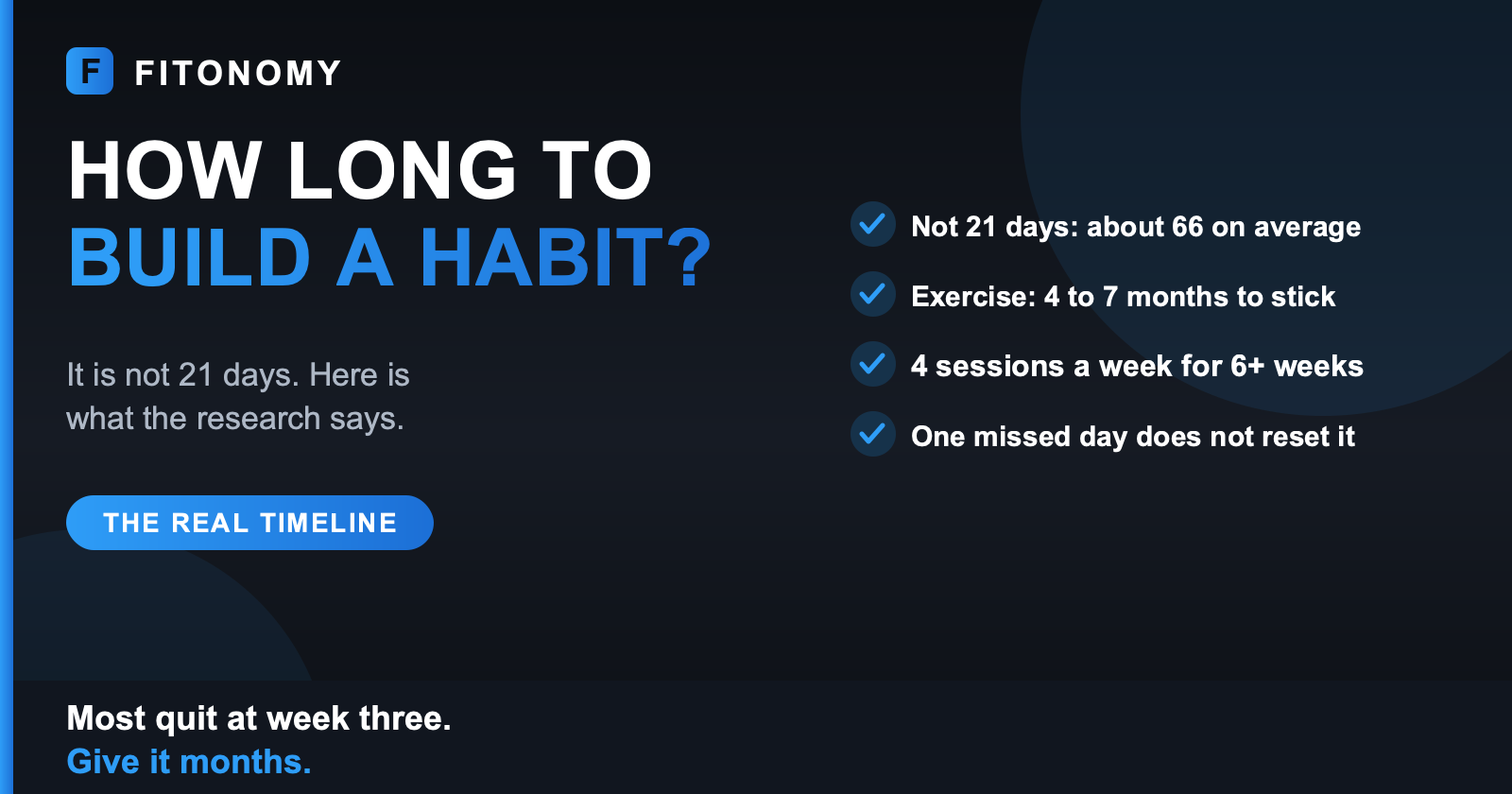
Not 21 days. The research says a habit takes about 66 days on average, and exercise can take four to seven months. Here is what actually decides the timeline and how to get to automatic without quitting in the gap.
Fitonomy Coach
July 14, 2026
You have heard it a hundred times: it takes 21 days to build a habit. It is clean, it is motivating, and it is wrong. That number is why so many people start a routine, push through three weeks, notice it still feels like effort, and quit believing they failed. They did not fail. They just measured against a myth.
The real answer is longer, more variable, and far more useful once you know it. Habits form on their own timeline, driven by how often you repeat the behavior and how consistent the trigger is, not by a magic day count. Here is what the research actually shows about how long it takes, why exercise takes longer than most habits, and how to get to automatic without giving up in the gap.
Where the 21-day myth came from
The 21-day rule did not come from a study of habits. It came from a 1960 self-help book called Psycho-Cybernetics, written by a plastic surgeon named Maxwell Maltz. He noticed that his patients seemed to take about 21 days to get used to a new face after surgery, or to adjust to a lost limb. That was a clinical observation about adapting to a new self-image, not an experiment on forming behaviors. Over the decades the caveat got dropped, "about 21 days" hardened into "21 days," and a surgeon's aside became fitness gospel. There was never any real evidence behind it.
Takeaway: The 21-day rule traces to a 1960 book about plastic-surgery patients adjusting to a new appearance, not to any habit research. Treat it as a motivational slogan, not a deadline.
The real number: about 66 days, but it varies a lot
The first proper test came in 2010, when Phillippa Lally and colleagues at University College London published a study in the European Journal of Social Psychology. They had 96 people pick one new daily behavior, a food, a drink, or an activity, and log every day for 84 days how automatic it felt. Fitting curves to each person's data, they found the median time to reach 95 percent of maximum automaticity was 66 days. That is roughly three times the myth.
The more important finding was the spread. Individual times ranged from 18 days to 254 days. Simpler behaviors, like drinking a glass of water after breakfast, became automatic fastest, while more demanding ones, like doing 50 situps or running before dinner, took much longer. So there is no single number. How long it takes depends heavily on what you are trying to make automatic and how consistently you do it.
Takeaway: In the landmark study, the average habit took about 66 days to feel automatic, with a huge range of 18 to 254 days. Simple behaviors locked in fast, harder ones took months.
What the newer evidence says: two to five months
The 2010 study was one experiment. A 2024 systematic review and meta-analysis in the journal Healthcare, led by Ben Singh and colleagues, pooled the research on health-behavior habit formation and reached a similar but broader conclusion: durable habits generally take from two to five months to consolidate. Across the studies that reported a specific figure, median times to form a habit landed around 59 to 66 days, while averages ran higher, 106 to 154 days, with individuals ranging anywhere from 4 to 335 days.
The review also flagged what speeds things up. Doing the behavior in the morning, choosing it yourself rather than being told to, and repeating it frequently all produced stronger, faster habits. In other words, the timeline is not fixed. You can shorten it by stacking the odds in your favor.
Takeaway: The best current evidence says most health habits take two to five months to stick, with a median near 60 days. Morning timing, self-chosen behaviors, and high frequency all speed it up.
Why exercise takes longer than most habits
Here is the part that matters for fitness specifically: working out is one of the slower habits to build, because it is effortful, it competes with everything else in your day, and the "reward" is often delayed. The research bears this out. A study of new gym members by Kaushal and Rhodes, published in the Journal of Behavioral Medicine, tracked 111 people over 12 weeks and found the minimum recipe for an exercise habit was roughly four sessions a week for at least six weeks. Below that frequency, the habit did not take hold. Their analysis showed consistency was the strongest driver, followed by keeping the behavior simple, having a stable environment or cue, and actually enjoying it.
Real-world data pushes the timeline even further. A large study in PNAS analyzed more than 12 million gym check-ins from over 60,000 members and found that gym-going became automatic far more slowly than lab habits, with the typical member taking somewhere in the range of four to seven months to reach near-full automaticity. So if the gym still feels like a decision after two months, that is not weakness. That is the normal curve for exercise.
Takeaway: Exercise is a slow habit. Expect roughly four sessions a week for six weeks as a minimum, and up to four to seven months of steady training before it feels truly automatic.
What actually decides how long it takes
- Consistency (same cue, same time). Effect on how long it takes: Speeds it up the most. Evidence: The single strongest predictor of habit strength in new exercisers.
- Behavior complexity. Effect on how long it takes: Simpler habits form faster. Evidence: Water after breakfast became automatic far sooner than a daily run.
- Frequency. Effect on how long it takes: The more often, the sooner. Evidence: About 4 sessions a week for 6 plus weeks was the minimum for an exercise habit.
- Missing an occasional day. Effect on how long it takes: Almost no effect. Evidence: Missing a single day did not break the automaticity curve.
- The 21-day rule. Effect on how long it takes: No effect, and sets a false deadline. Evidence: Comes from a 1960 book on surgery patients, not from habit research.
Takeaway: Speed comes from consistency, simplicity, and frequency, not from willpower or a countdown. Anchor the behavior to the same daily cue, keep it small, and repeat it often.
The trap: quitting in the gap
Put the numbers together and the real problem becomes obvious. People expect a habit at 21 days. The science says a health habit takes 60 days on average, and exercise can take four to seven months. That means most people quit right in the middle of the gap, at three or four weeks, exactly when the behavior still feels hard because it is supposed to. They read the effort as failure instead of as the normal middle of the curve.
The fix is not more motivation, which fades. It is to change what you expect and to protect consistency while the habit slowly builds. A missed day is fine, the research is clear that one lapse does not reset your progress, but a missed cue, a workout with no set time and no trigger, is what stalls habits. If you want the tactics for staying power, see our guides on how to stay consistent with exercise and on whether streaks and challenges work, and on the best time of day to train so your cue is fixed.
Takeaway: Most people quit at three weeks because they expected a habit by then. Reset the expectation to two to five months, protect your daily cue, and forgive the occasional missed day.
The Fitonomy angle: built to carry you across the gap
If the science says a habit takes two to five months and exercise can take longer, then the real job is not a burst of motivation, it is surviving the long middle where the behavior is still effort. That is exactly what a good app is for, and what Fitonomy is built around. Reminders keep your workout tied to a consistent cue and time, which the research names as the strongest driver of how fast a habit forms. Streaks and challenges reward the daily repetition that automaticity is made of. A personalized, guided plan keeps each session simple and already decided, so you clear the low-complexity bar the studies point to. And progress tracking makes the slow build visible, so week five does not feel like nothing is happening. Our own data echoes the science: users who complete around four workouts in their first two weeks convert and stick at dramatically higher rates, which lines up almost exactly with the four-sessions-a-week finding. You can start a guided plan with built-in reminders and streaks in the Fitonomy app and let the structure hold your consistency while the habit forms, and pair it with tracking your workouts so the progress is visible.
Takeaway: Fitonomy is built for the two-to-five-month reality: fixed cues through reminders, repetition through streaks, simplicity through a guided plan, and visible progress through tracking. That is the machinery that gets you to automatic.
The bottom line
Forget 21 days. A habit takes about 66 days on average, anywhere from a couple of weeks to most of a year depending on the behavior, and exercise specifically tends to need four sessions a week for six weeks to start and four to seven months to feel automatic. The number itself is less important than what it tells you: the effort you feel at week three is not a sign you are failing, it is the normal middle of a longer curve. Keep the behavior small, tie it to the same cue every day, repeat it often, do not let one missed day derail you, and give it months, not weeks. Do that and the day arrives when you stop deciding to work out and simply do it. That is what built actually feels like.
Frequently asked questions
How long does it really take to build a habit? On average about 66 days, according to the landmark 2010 study, with individuals ranging from 18 to 254 days. A 2024 review of health habits put the typical range at two to five months. There is no single magic number, it depends on the behavior and how consistently you repeat it.
Is the 21-day rule true? No. It comes from a 1960 self-help book by a plastic surgeon who noticed patients took about 21 days to adjust to a new appearance, which is not the same as forming a behavior. No habit research supports 21 days, and the real average is roughly three times longer.
How long does it take to make working out a habit? Longer than most habits. Research on new gym members found you need about four sessions a week for at least six weeks as a minimum, and a large study of over 12 million gym visits found it can take four to seven months to become truly automatic. Expect months of steady training, not weeks.
Does missing a day ruin my progress? No. The 2010 study found that missing a single day did not measurably break the habit-formation curve. What stalls a habit is not the occasional lapse, it is losing the consistent cue, a workout with no set time or trigger. Miss a day, then get back to your cue tomorrow.
How can I build a habit faster? Keep it simple and small, tie it to the same cue and time each day (mornings tend to work well), do it frequently, choose it yourself rather than forcing it, and make it something you can tolerate or enjoy. Consistency of the trigger is the single biggest lever the research identifies.