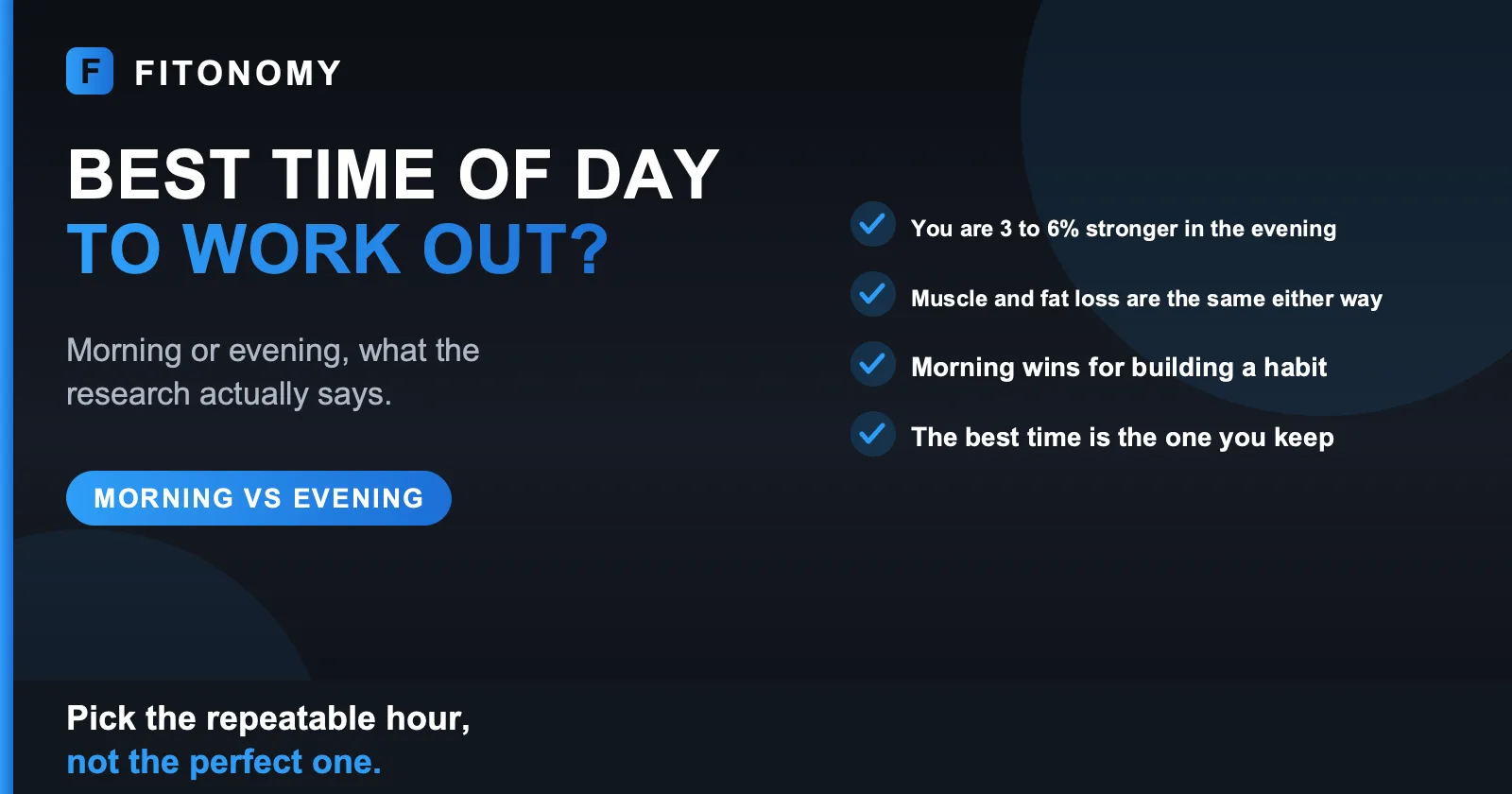
Ask ten people when to train and you will get ten confident answers. Morning people swear it sets up the day. Night owls insist they are useless before noon. The fitness internet layers on claims about fasted fat burning and testosterone windows. So what does the research actually say about the best time to work out?
The honest answer has two parts. Your body is genuinely a little stronger and more capable in the late afternoon and evening. But the long-term results, the muscle you build and the fat you lose, come out nearly identical no matter when you train, and morning workouts tend to be easier to turn into a lasting habit. So the best time is not a fixed hour on a clock. It is whenever you will actually show up, week after week. Here is the science behind that.
Are you really stronger at a certain time of day?
Yes, and it is measurable. Your body runs on a circadian rhythm, and one of its outputs is core body temperature, which bottoms out in the early morning and peaks in the late afternoon and early evening. Warmer muscles contract more forcefully, joints move more freely, and your nervous system fires faster. The result is a real performance bump: strength and power tend to peak in the late afternoon to early evening, with research showing roughly a 3 to 6 percent advantage in measures like grip strength compared to the morning. The rule of thumb is that a 1 degree Celsius rise in muscle temperature translates to a 2 to 5 percent performance gain.
So if you want to hit a personal record or push your hardest session, late afternoon is your body's natural peak. The flip side is that morning training starts from a colder, stiffer baseline, which is worth remembering.
Takeaway: You are genuinely strongest in the late afternoon and early evening, by roughly 3 to 6 percent, because core body temperature peaks then. For a max-effort session or a PR attempt, evening is your body's natural sweet spot.
Then why do so many people swear by morning workouts?
Because performance is not the same as results, and results depend on showing up. Morning exercise has a consistency advantage: it happens before the day's meetings, tiredness, and social plans can derail it. Research on people who successfully keep weight off finds that a large share, over 47 percent in one analysis, are morning exercisers, and studies suggest training earlier helps maintain a regular routine. When you train first thing, nothing has had the chance to bump your workout yet.
There is a mood and energy bonus too. A morning session can lift your energy and focus for hours (we cover the paradox of exercise creating energy in does exercise give you energy). For a lot of people, the small performance edge of evening is not worth the higher chance the evening workout simply does not happen.
Takeaway: Morning workouts win on consistency, not performance. They happen before life can cancel them, which is why so many long-term exercisers train early. A slightly weaker session you actually do beats a stronger one you skip.
Does the time of day change your muscle or fat-loss results?
Barely, and this is the part that settles the debate. For muscle, a 2019 meta-analysis by Grgic and colleagues found that hypertrophy gains were similar whether people trained in the morning or evening, and concluded the timing should come down to personal preference. A 24-week training study by Kuusmaa and colleagues backed this up: both morning and evening groups built muscle and strength (cross-sectional area rose 12 to 20 percent), with only a slightly larger hypertrophy edge to evening training late in the study.
For fat loss, it is the same story. A 2023 randomized controlled trial by Brooker and colleagues had 100 adults do the same weekly exercise in either the morning or evening, and both groups lost a similar amount of fat. Time of day is a rounding error next to the things that actually drive results: total training volume, a calorie deficit for fat loss (see our calorie deficit guide), enough protein, and consistency over months. Interestingly, one notable adaptation is that your body partly tunes itself to whenever you train, so your regular time becomes your best-performing time.
Takeaway: Over months, muscle growth and fat loss are nearly identical morning or evening. Volume, diet, and consistency dwarf timing. Your body even adapts to perform best at whatever time you train regularly, so the clock is almost a non-issue for results.
Morning vs evening at a glance
- Peak strength and power. Morning: Lower (cold start). Evening: Higher, about 3 to 6% stronger.
- Consistency and adherence. Morning: Usually better, before life interferes. Evening: Easier to skip after a long day.
- Muscle and fat-loss results. Morning: Excellent. Evening: Excellent, tiny hypertrophy edge.
- Sleep impact. Morning: No downside. Evening: Late intense sessions can disrupt sleep.
- Best for. Morning: Building a reliable habit. Evening: Hitting PRs and hard sessions.
What about your chronotype and your schedule?
Genetics play a role. Some people are true morning larks and others are night owls, and forcing yourself to train hard at your worst time of day can measurably reduce performance. If you feel subhuman before 10 am, do not fight it, train later. If you are wired at 6 am and dead by 8 pm, train early. Your natural rhythm is useful information, not something to override.
One practical caution: intense training too close to bedtime can disrupt sleep for some people by raising body temperature and adrenaline, and sleep is where results are built (see our sleep guide). If you train late and struggle to wind down, shift earlier or keep the last session lighter. And because morning muscles are cold, a proper warm-up matters more before an early session.
Takeaway: Work with your chronotype, not against it, since training at your worst hour hurts performance. Just avoid intense sessions right before bed if they wreck your sleep, and warm up thoroughly for cold morning workouts.
How to actually choose your time
Stop optimizing for the perfect hour and optimize for the repeatable one. Pick the time you are most likely to protect every day, which for most people is the one with the fewest competing demands (often the morning). Anchor it to a fixed slot so it becomes automatic, the same principle behind building any exercise habit (see how to stay consistent with exercise). If you have a specific performance goal like a heavy lifting PR, schedule those hard sessions for late afternoon when you are strongest. Otherwise, choose the time you will not talk yourself out of, and let consistency do the heavy lifting.
Takeaway: Choose the time you can repeat, not the one that is theoretically optimal. Anchor it to a fixed daily slot. Save your hardest sessions for late afternoon if performance matters, and otherwise just pick the time you will reliably keep.
The Fitonomy angle: lock in a time you will keep
Since the research says the winning move is a time you will repeat, the whole game is turning your chosen slot into an automatic habit rather than a daily decision. That is a scheduling problem, and it is what an app is built for. Fitonomy lets you schedule your workouts and set reminders, so your chosen time becomes a consistent cue that prompts you before the day gets in the way, exactly the consistency the evidence rewards. Whether you are a 6 am lark or a 6 pm lifter, the app helps make that time stick. You can schedule your sessions in the Fitonomy app and let a fixed, reminded slot carry the habit.
Takeaway: The best time only works if you keep it, so the practical win is automating it. Fitonomy's scheduling and reminders turn your chosen time into a daily cue, which is what makes any workout time actually stick.
The bottom line
There is no magic hour. You are modestly stronger in the late afternoon thanks to your body clock, so save your hardest sessions for then if you can. But muscle growth and fat loss come out nearly the same regardless of when you train, morning workouts tend to build a more durable habit, and your body adapts to whatever time you make routine. So stop searching for the optimal time and pick the repeatable one. The best time to work out is simply the time you will actually do it, consistently, for months.
Frequently asked questions
What is the best time of day to work out? The one you will do consistently. You are measurably stronger in the late afternoon (by about 3 to 6 percent, because body temperature peaks then), but long-term muscle and fat-loss results are nearly identical morning or evening. Morning training tends to build a more reliable habit, so consistency matters far more than the specific hour.
Is it better to work out in the morning or at night for building muscle? Both work almost equally. A 2019 meta-analysis found muscle growth was similar regardless of training time, and a 24-week study saw both morning and evening groups gain muscle (cross-sectional area up 12 to 20 percent), with only a slight late-study edge to evening. Choose based on preference and consistency, not muscle-building potential.
Does the time of day affect weight loss? Barely. A 2023 randomized trial had people do the same weekly exercise in the morning or evening and both groups lost a similar amount of fat. Fat loss is driven by a calorie deficit, total activity, and consistency, not the clock. Some observational data hints morning may help slightly, but the effect is minor next to those basics.
When are you strongest during the day? Late afternoon to early evening, roughly 4 to 8 pm, when core body temperature peaks. Warmer muscles contract more forcefully, giving about a 3 to 6 percent strength and power advantage over the morning. That makes late afternoon the natural time to attempt a personal record or your hardest session.
Is a morning or evening workout better for sleep? Morning and most evening workouts are fine, but intense training very close to bedtime can disrupt sleep for some people by raising body temperature and adrenaline. If you train late and struggle to wind down, shift earlier or keep the final session lighter, since quality sleep is where your results are actually built.