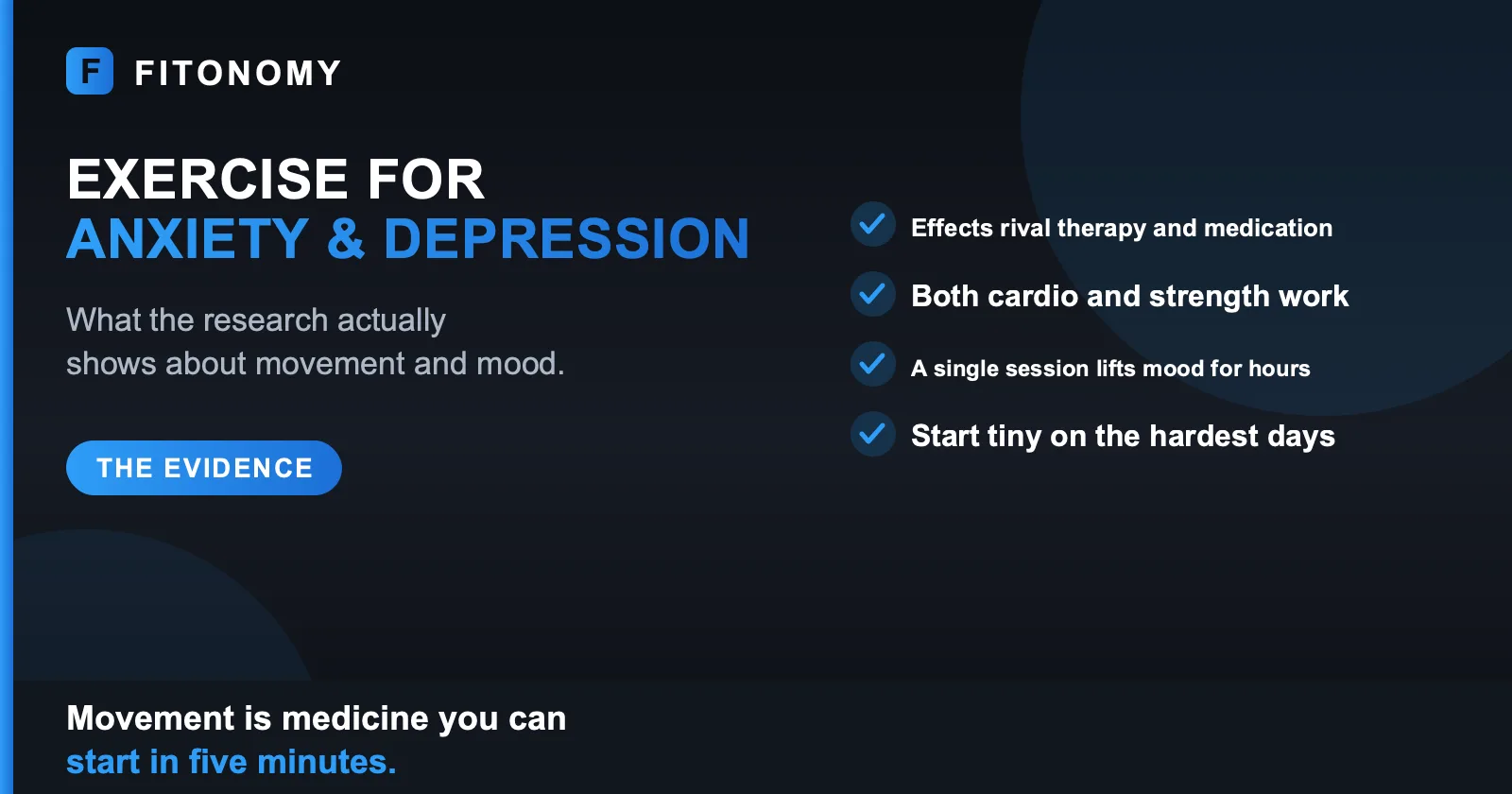
Most people have heard that exercise is good for your mood. What most people do not realize is how strong the evidence actually is. This is not a soft wellness talking point. It is one of the most consistently supported findings in mental-health research, with effects on depression and anxiety that hold up in large reviews and, in some studies, rival therapy and medication.
That said, let me be clear up front about what this article is and is not. Exercise is a powerful, evidence-based tool for mood, and for many people it is genuinely life-changing. It is not a cure, and it is not a replacement for professional care if you are struggling. If your symptoms are moderate or severe, please treat this as a complement to seeing a doctor or therapist, not a substitute. With that said, here is what the research actually shows.
Does exercise really help, or is that just something people say?
It really helps, and the evidence is large. A 2023 umbrella review by Singh and colleagues in the British Journal of Sports Medicine pooled 97 systematic reviews covering more than 128,000 people and found that physical activity produced medium reductions in depression (effect size around minus 0.43), anxiety (around minus 0.42), and psychological distress (around minus 0.60) compared with usual care. The authors concluded these effects are comparable to, or slightly greater than, what is typically seen from talk therapy and medication.
A 2016 meta-analysis by Schuch and colleagues went further on depression specifically. After statistically correcting for publication bias across 25 controlled trials, they found a large effect for exercise (standardized mean difference around 1.11), and noted that the true effect had likely been underestimated in earlier work, not overstated. In plain terms: the more carefully researchers look, the better exercise performs.
Takeaway: Across more than a hundred reviews and tens of thousands of people, exercise produces real, medium-to-large reductions in depression and anxiety. This is one of the best-supported findings in the field, not wishful thinking.
Is it as good as medication?
For some people, close to it. The most famous test is the SMILE trial by Blumenthal and colleagues, which randomly assigned 202 adults with major depression to supervised exercise, home-based exercise, the antidepressant sertraline, or a placebo. After four months, the exercise groups improved about as much as the medication group, and roughly 46 percent of participants were in full remission.
The honest nuance: medication tended to work a bit faster, and exercise is not a guaranteed swap for everyone, especially in severe cases. But as a treatment with comparable medium-term results, minimal cost, and side effects that are all positive (better sleep, fitness, and heart health rather than nausea or fatigue), it is remarkable. Many clinicians now use it alongside standard treatment rather than instead of it.
Takeaway: In head-to-head research, exercise matched antidepressant medication for many people with depression over a few months, with side effects that help rather than harm. It is best viewed as a strong complement to care, not a replacement for it.
Which type of exercise helps most, cardio or strength?
Both work, and you do not have to choose. The research supports aerobic exercise and resistance training for mental health, through somewhat different bodies of evidence.
Aerobic exercise (walking, running, cycling) has the longest track record for depression, and the Singh umbrella review found higher-intensity activity tended to produce larger mood benefits. Resistance training has its own strong evidence: a 2018 meta-analysis by Gordon and colleagues in JAMA Psychiatry pooled 33 trials and found lifting significantly reduced depressive symptoms (effect size 0.66), and notably, the benefit did not depend on people actually getting stronger, which suggests the act of training itself is doing the work. For anxiety, a separate 2017 meta-analysis by Gordon found resistance training reduced anxiety symptoms (effect size 0.31).
So the best type is largely the one you will keep doing. If you like lifting, our guide to strength training after 30 shows how little it takes. If cardio is more your speed, walking is a seriously underrated option, and you can compare intensities in our HIIT vs steady state guide.
What the research shows, by exercise type
- Any physical activity vs usual care. Mental-health finding: Reduces depression (Singh 2023). Effect size: around minus 0.43.
- Any physical activity vs usual care. Mental-health finding: Reduces anxiety (Singh 2023). Effect size: around minus 0.42.
- Aerobic exercise for depression. Mental-health finding: Large effect, bias-adjusted (Schuch 2016). Effect size: around 1.11.
- Resistance training for depression. Mental-health finding: Significant reduction (Gordon 2018). Effect size: 0.66.
- Resistance training for anxiety. Mental-health finding: Significant reduction (Gordon 2017). Effect size: 0.31.
Takeaway: Both cardio and strength training measurably improve mood, and resistance training helps even when you do not get stronger. The best kind is whatever you will actually stick with.
How much do you need?
Less than you might fear. The mood benefits show up at modest doses, and more is not always better. The Singh review found that shorter programs and higher-intensity sessions often delivered larger effects, and general guidance from the World Health Organization (150 minutes of moderate activity per week, roughly 20 to 30 minutes most days) is a reasonable target that also happens to match what the mental-health research supports.
Two encouraging points. First, even a single workout can lift your mood for hours afterward, so you get a same-day return, not just a long-term one. Second, something always beats nothing: the largest jump in benefit is going from no activity to a little, so a 10-minute walk on a bad day is genuinely worth doing. You do not need to train like an athlete to feel better.
Takeaway: Aim for roughly 150 minutes a week, but do not let that number stop you. A short session helps the same day, and going from nothing to a little gives the biggest return of all.
Why does exercise work on your brain?
There is no single magic mechanism, which is part of why it is so robust. Several effects stack together. Exercise triggers the release of mood-related brain chemicals including endorphins and endocannabinoids (the real source of the runner's high). Over time it raises brain-derived neurotrophic factor, a protein that supports the growth and resilience of brain cells, and it lowers chronic inflammation, which is increasingly linked to depression. It also improves sleep, and poor sleep both feeds and worsens low mood (see our guide on sleep and recovery). Finally there is a psychological layer: finishing a workout you did not feel like doing builds a sense of agency and self-efficacy that directly counters the helplessness of depression and anxiety.
Takeaway: Exercise helps through several routes at once, brain chemistry, reduced inflammation, better sleep, and a real sense of accomplishment. That redundancy is exactly why the effect is so reliable.
The hard part: starting when you least feel like it
Here is the cruel irony of exercise for mental health. The times you need it most, when you are anxious or low, are exactly the times you have the least motivation to do it. Depression saps energy and interest, so telling someone to just go work out can feel useless. This is real, and it is not a character flaw.
The way through is to shrink the task until it is almost too easy to skip. Do not commit to an hour at the gym. Commit to putting on your shoes and walking to the end of the street, or doing five minutes of bodyweight movement at home. The goal on a bad day is not a great workout, it is simply to not break the chain. Because consistency matters far more than intensity here, the systems that keep you showing up (a fixed time, a low bar, a plan you do not have to think about) matter more than which exercise you pick. We cover those in depth in how to stay consistent with exercise, and if you are brand new, the beginner gym guide removes the guesswork.
Takeaway: Motivation is lowest exactly when you need movement most, so make the task tiny. On hard days, a five-minute walk counts as a win. Consistency beats intensity for mood.
An important note on getting help
Exercise is a genuinely powerful tool, but it is not a cure-all, and it does not replace professional treatment. If you are dealing with persistent low mood, severe anxiety, or any thoughts of harming yourself, please reach out to a doctor, a therapist, or a crisis line in your country. The strongest results in the research often come when exercise is combined with therapy or medication, not used as a lonely alternative to them. Think of movement as one reliable pillar of your mental health, alongside professional care, sleep, and connection, not the whole roof.
Takeaway: Use exercise as a complement to professional support, not a substitute. If you are seriously struggling, reach out to a doctor, therapist, or crisis line. The best outcomes usually combine approaches.
The Fitonomy angle: make the first step small
The evidence is unambiguous that movement helps mood, and that the benefit comes from what you actually keep doing. So the entire game is lowering the barrier to starting on the days it feels hardest. That is what a good app can do. Fitonomy gives you short guided workouts you can do at home with no equipment, so there is no gym trip to talk yourself out of, and scheduled reminders that turn the decision into a simple prompt to follow. On a low day, opening a five-minute session is a much smaller ask than planning a workout from scratch. You can start with a short session in the Fitonomy app and let an easy first step do the heavy lifting.
Takeaway: Because mood benefits come from consistency, the app's job is to make starting easy: short no-equipment home workouts and reminders shrink the first step on the days that matter most.
The bottom line
Exercise is one of the most reliable, best-evidenced things you can do for anxiety and depression, with effects that hold up across huge reviews and, for many people, rival therapy or medication. Both cardio and strength work, modest doses are enough, and a single session can lift your mood the same day. The catch is that it is hardest to start exactly when you need it most, so make the first step tiny and focus on consistency over intensity. And if you are struggling more than a workout can fix, use exercise alongside professional help, not instead of it.
Frequently asked questions
Does exercise really help with depression and anxiety? Yes. A 2023 umbrella review of 97 systematic reviews found physical activity produced medium reductions in depression (effect size around minus 0.43) and anxiety (around minus 0.42) compared with usual care, comparable to talk therapy and medication. A 2016 meta-analysis found a large effect for exercise on depression after adjusting for publication bias.
Is exercise as effective as antidepressants? For many people with depression, it comes close. In the SMILE randomized trial, four months of exercise improved symptoms about as much as the antidepressant sertraline, with roughly 46 percent reaching full remission. Medication may work faster, and exercise is best used alongside professional care rather than as a guaranteed replacement, especially for severe symptoms.
What type of exercise is best for mental health? Both aerobic exercise and resistance training work. Aerobic exercise has the longest track record for depression, and higher intensity tends to help more. Resistance training reduced depressive symptoms (effect size 0.66) and anxiety (0.31) in meta-analyses, and helped even when people did not get stronger. The best type is whatever you will consistently keep doing.
How much exercise do you need to feel better? Modest amounts help. Around 150 minutes of moderate activity per week (about 20 to 30 minutes most days) is a good target, and shorter, higher-intensity sessions can work too. A single workout can lift your mood for hours, and the biggest jump in benefit comes from going from no activity to a little.
How quickly does exercise improve mood? Partly the same day. A single session can boost mood for hours afterward through the release of endorphins and endocannabinoids. The larger, lasting reductions in depression and anxiety build over weeks of consistent activity, typically noticeable within a few weeks of a regular routine.