Open almost any fitness app and it will try to turn exercise into a game. Keep your streak alive. Close your rings. Beat last week. Join the 30-day challenge. It can feel a little manipulative, like being bribed with digital gold stars to do something you already know you should. So the fair question is whether these mechanics actually change behavior, or whether they are just sticky app design meant to keep you opening the app.
The research has a genuinely interesting answer. Gamification does work, and the effect is real enough to show up in controlled trials. But it comes with an important catch about durability and motivation that most apps will never tell you. Here is what the science shows, which game elements pull the most weight, and how to use streaks and challenges so they build a habit instead of a dependency.
Do fitness streaks and challenges actually work?
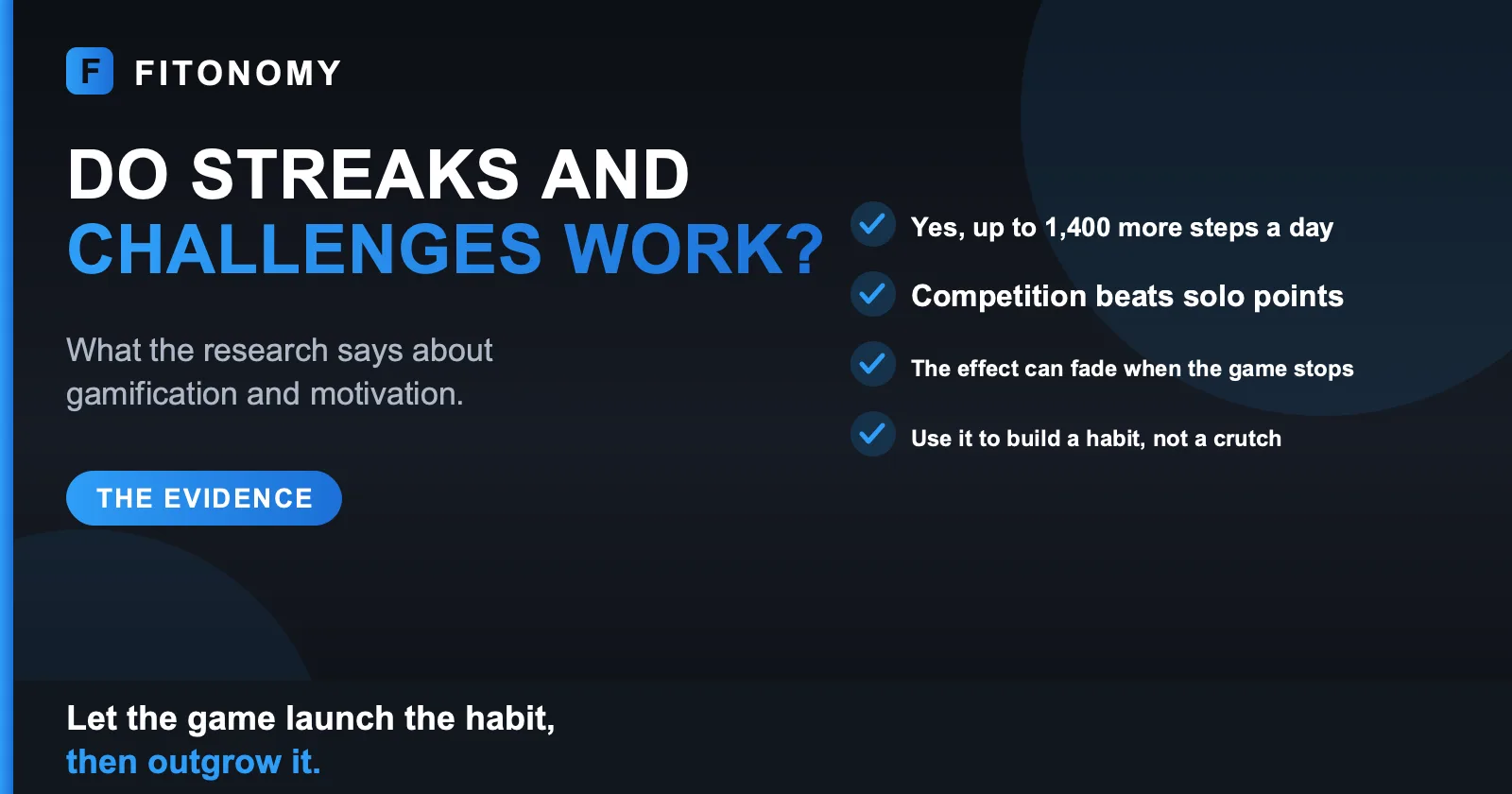
Yes, measurably. The best summary is a 2022 meta-analysis by Mazeas and colleagues in the Journal of Medical Internet Research, which pooled 15 randomized controlled trials covering more than 2,400 people. Gamified interventions increased physical activity by roughly 500 to 1,400 additional steps per day compared with control groups, a moderate effect (Hedges g between 0.33 and 0.48). Crucially, the benefit persisted past the end of the studies, which suggests it is not just a short-lived novelty buzz.
Real trials back this up. A 2017 randomized trial by Patel and colleagues (the BE FIT study) found that families using a game-based intervention with social incentives significantly increased their steps and hit their step goals more often than a control group. A broader 2016 systematic review by Johnson and colleagues looked at 19 studies of gamification for health and found 59 percent reported clearly positive effects and the rest mixed, with none showing harm. The direction of the evidence is consistent: game mechanics get people moving more.
Takeaway: Gamification genuinely increases activity, adding roughly 500 to 1,400 steps a day in controlled trials, and the effect can outlast the program. Streaks and challenges are not just gimmicks, they move real behavior.
Why do they work?
Because they hijack a few well-understood levers of human motivation at once. A streak creates loss aversion: once you have a 20-day run going, skipping feels like losing something, and people work harder to avoid a loss than to chase an equal gain. A challenge sets a specific, time-bound goal, and specific goals reliably beat vague intentions. A visible progress bar or ring gives immediate feedback, which is satisfying and tells you exactly where you stand. And competition or teamwork adds social pressure and accountability, which is a powerful motivator on its own. None of this is about the exercise being more fun. It is about the design making the next session feel more urgent and more rewarding.
Takeaway: Streaks work through loss aversion, challenges through specific goals, rings through instant feedback, and competition through social accountability. Gamification stacks several motivation levers, which is why the effect is reliable.
Which elements work best?
Not all game mechanics are equal, and the social ones tend to punch hardest. The largest test is the 2019 STEP UP trial by Patel and colleagues in JAMA Internal Medicine, which randomized about 600 overweight and obese adults to a control group or one of three gamification designs: support (from family or friends), collaboration (working toward a shared team goal), or competition (a leaderboard against others). All three significantly increased daily steps during the 24-week program, and competition was the most effective of the three. The takeaway is that adding other people, whether cheering you on or racing you, amplifies the effect beyond solo points and badges.
How gamification elements compare
- Streaks. How it motivates: Loss aversion, do not break the chain. What the evidence shows: Drives daily consistency, strong habit cue.
- Challenges. How it motivates: A specific, time-bound goal. What the evidence shows: Specific goals beat vague intentions.
- Progress rings and feedback. How it motivates: Instant visible progress. What the evidence shows: Feedback enhances motivation (positive effect).
- Competition (leaderboard). How it motivates: Social pressure, status. What the evidence shows: Most effective element in STEP UP.
- Collaboration (team goal). How it motivates: Accountability, belonging. What the evidence shows: Significant, slightly behind competition.
Takeaway: Social mechanics work best. In the largest trial, competition beat collaboration and solo support, so a challenge with other people usually outperforms points earned alone. If you want the biggest boost, make it social.
The catch: the effect can fade, and rewards can backfire
Here is the part the app store never mentions. In that same STEP UP trial, activity dropped in every group once the intervention ended, so the gains were not fully self-sustaining. Gamification is good at starting behavior, but if the game is the only reason you are moving, the behavior can leave when the game does.
There is a deeper risk too. A landmark 1999 meta-analysis by Deci, Koestner, and Ryan pooled 128 experiments and found that tangible, expected rewards actually undermined people's intrinsic motivation to do a task (effect size around minus 0.36). In plain terms, if you only ever exercise for the points, you can end up enjoying it less on its own. The same review found the opposite for positive feedback, which enhanced intrinsic motivation (effect size 0.33). So the distinction that matters is feedback and progress versus pure external rewards. Progress bars and encouragement build lasting motivation. Chasing points for their own sake can quietly erode it.
Takeaway: Gamification can fade when the game stops, and rewarding yourself with points alone can dull your intrinsic enjoyment. Feedback and progress help long term, but do not let the game become the only reason you show up.
How to use gamification without becoming dependent on it
Use it as training wheels, not a crutch. Lean on streaks and challenges hardest at the start, when you most need momentum, and let them carry you through the first weeks until the behavior becomes a habit (the science of that transition is in how to stay consistent with exercise). Favor the elements the research rewards long term: visible progress, personal feedback, and the occasional social challenge over a fixation on points. And protect yourself from the biggest trap, which is quitting entirely after one missed day breaks a streak. A broken streak is not failure, it is a Tuesday. Restart it. The goal is to use the game to build a routine that eventually does not need the game at all, and the tracking habit behind it (see whether fitness trackers actually work and how to track your workouts) is what remains once the novelty fades.
Takeaway: Use streaks and challenges to launch the habit, favor progress and feedback over points, do not quit when a streak breaks, and aim to make the routine outlast the game. Gamification should bootstrap a habit, not replace one.
The Fitonomy angle: streaks that build a habit
The research points to a clear design principle: gamification works best when it provides progress and feedback and helps a habit take root, rather than dangling external rewards you become dependent on. That is how Fitonomy uses it. The app keeps a streak and shows your progress so the self-monitoring loop and the do-not-break-the-chain effect are working for you, and it pairs that with structured plans so the streak is attached to a real routine, not just a number to protect. The point is to get you through the first weeks until training is simply what you do, which is exactly the durable version of gamification the evidence supports. You can keep a streak and follow a plan in the Fitonomy app and let the momentum carry you until the habit stands on its own.
Takeaway: Fitonomy uses streaks and visible progress attached to a real plan, which is the durable form of gamification the research favors: momentum to build the habit, not points to chase forever.
The bottom line
Fitness streaks and challenges genuinely work. They add hundreds to over a thousand steps a day in controlled trials, they work by stacking loss aversion, goals, feedback, and social pressure, and the social versions like competition tend to work best. The catch is durability: the effect can fade when the game stops, and living only for the points can undercut your natural motivation. So use gamification the smart way, as momentum to launch a habit, leaning on progress and feedback, shrugging off broken streaks, and aiming for the day the routine no longer needs a game to keep it alive.
Frequently asked questions
Do fitness streaks and challenges actually work? Yes. A 2022 meta-analysis of 15 randomized trials found gamified interventions increased activity by about 500 to 1,400 steps per day versus control, a moderate effect that often persisted after the program ended. Streaks, challenges, and competition reliably get people moving more.
Which type of fitness gamification works best? Social mechanics tend to win. In the STEP UP trial of about 600 adults, support, collaboration, and competition all increased steps, and competition (a leaderboard against others) was the most effective. Adding other people, cheering or competing, amplifies the effect beyond solo points and badges.
Why do fitness apps use streaks? Because streaks trigger loss aversion. Once you have built a run of days, skipping feels like losing something, and people work harder to avoid a loss than to earn an equal gain. A streak turns an easy-to-skip workout into something you feel compelled to protect, which drives daily consistency.
Can gamification backfire? It can. In trials, activity often dropped once the game ended, so the effect is not always self-sustaining. A meta-analysis also found that tangible rewards can undermine intrinsic motivation (effect size around minus 0.36), meaning if you only exercise for points, you may enjoy it less on its own. Positive feedback and progress, however, enhance motivation.
How do I use fitness challenges without relying on them? Treat them as training wheels. Lean on streaks and challenges hardest early to build momentum, favor progress and feedback over chasing points, do not quit when a streak breaks, and aim to make the routine a habit that eventually does not need the game. Gamification should launch the behavior, not be the only reason for it.