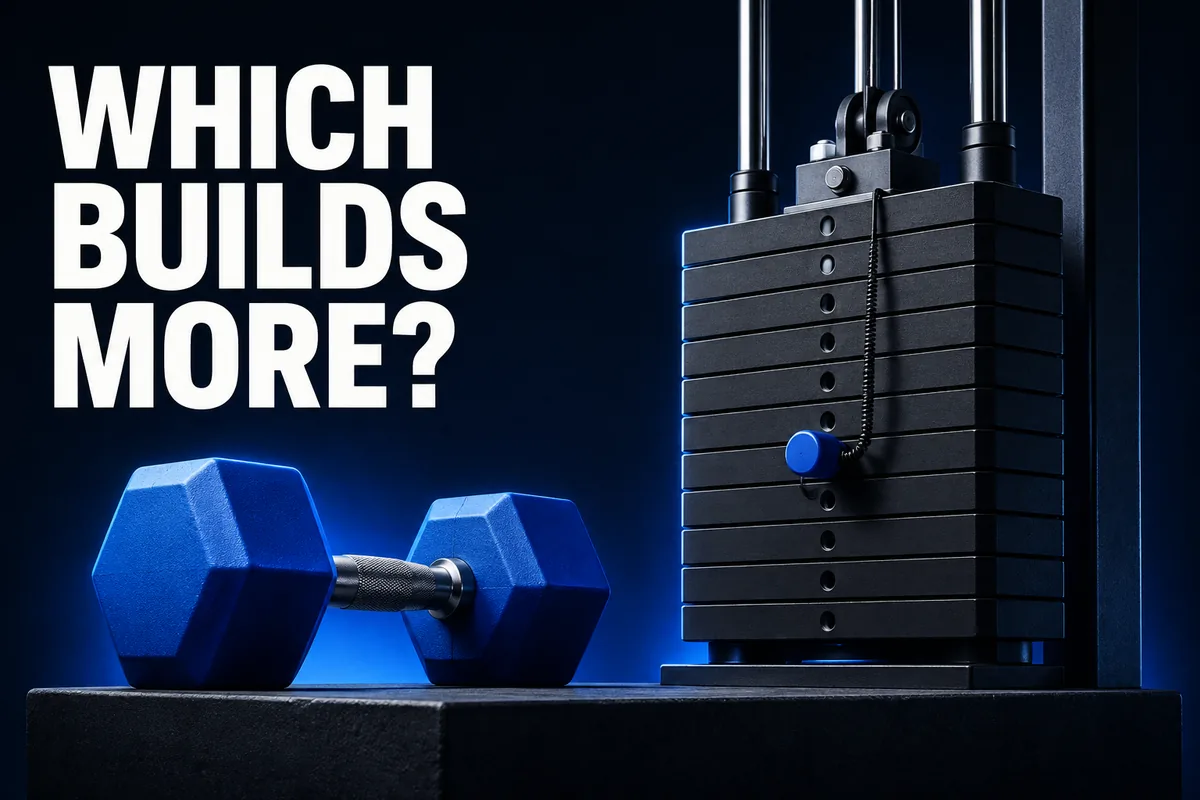
Machines and free weights can both belong in a beginner’s routine. Your first decision is practical: which option lets you learn the movement, adjust the load and return for another session? You do not have to graduate from machines before using dumbbells, or abandon machines once you gain experience.
To put your equipment choice into a complete session, start with our first gym workout guide.
Does one build more muscle?
A 2023 systematic review found no significant difference in muscle growth between the equipment types across the included studies. Strength gains were more specific to the equipment used and tested. Improving a machine press does not automatically tell you how much you can bench press with a barbell.
The ACSM guidance published in 2026 also emphasizes regular resistance training for healthy adults. Equipment choice did not consistently change outcomes in its evidence review. These findings support having options; they do not mean every exercise or program produces identical results.
When a machine is a useful choice
A machine with a guided path can make it easier to focus on the intended movement without balancing a separate weight. Before loading it, learn the seat adjustment, starting position and release mechanism. Ask gym staff to demonstrate any control you do not understand.
Check whether the handles and pads fit your body and whether the movement feels comfortable. A fixed path is not automatically suitable for everyone. If you cannot find a comfortable setup, choose another exercise instead of forcing the machine to fit.
If you choose a machine for pushing, the beginner chest press guide gives a concrete example of checking the seat and handles before adding load.
When free weights make sense
Dumbbells and barbells let you practice controlling the weight through a path you guide yourself. That is useful when learning a particular free weight lift is part of your goal, or when simple equipment is what you have available.
Start with a load you can position and put down under control. Learn the movement before increasing resistance. For lifts that need safeties or a spotter, learn the correct setup with a qualified trainer. Neither equipment category removes the need for good technique.
A simple way to choose for your next session
- Choose an exercise that matches the movement in your program. A chest press machine and a dumbbell press are possible options, not identical tests.
- Check that you understand the setup, have enough space and can move comfortably. Stop if the movement causes pain.
- Keep a manageable starting load and repeat the same option across sessions while you learn it. Mixing machines and free weights within a routine is also reasonable.
For the specific problem of occupied equipment, use the busy gym backup plan. Keep each substitute and its load in a separate training record.
Record progress on the same equipment
Write down the exercise, equipment, seat setting where relevant, load and repetitions. Treat a different machine or exercise as a new reference point. Pulley systems and machine designs vary, so kilograms on one stack are not directly comparable with a dumbbell or another machine.
When the movement stays controlled and your planned repetitions become manageable, use our guide to when to increase your weights. Consistent practice and sensible progression give your equipment choice a purpose.