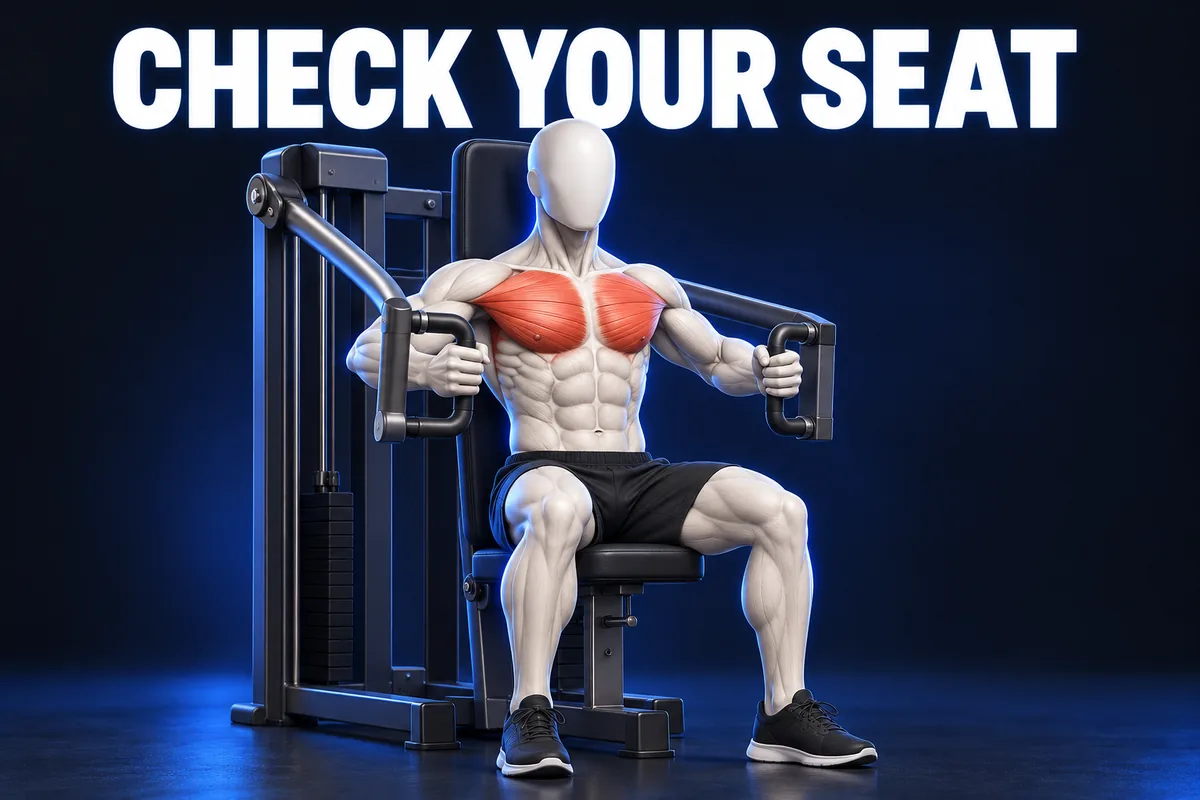
A chest press machine guides a pushing movement while a seat and backrest support you. The useful beginner skill is finding a setup you can repeat comfortably. More weight is not the first goal, and the machine’s fixed path does not suit every body.
This guide explains the machine press named in our first gym workout guide. Use it to learn one pushing option within a broader session, alongside leg work, pulling and trunk practice.
Adjust the machine before loading it
Ask gym staff to show you the seat, starting position controls and any release or assistance pedal. Designs differ, so use that machine’s instructions. Warm up first; Mayo Clinic recommends five to ten minutes of walking or similar activity before strength training.
Set the seat so the handles meet the middle of your chest. Choose a starting depth that does not pull the handles behind the front of your chest. If the available settings do not fit comfortably, ask about another machine or exercise.
- Keep your feet firmly on the floor or the intended foot supports. Rest your back against the pad with its natural curve, without increasing the arch as you push.
- Wrap your thumbs around the handles and keep your wrists aligned with your lower arms. Settle your shoulders away from your ears and against the backrest.
Press and return smoothly
Breathe out as you press forward. Extend your elbows without snapping them into a locked position. Keep your head aligned and shoulder blades supported. Breathe in as you bend your elbows and return slowly to the comfortable starting position.
The ACE seated chest press guide describes these setup and movement cues. Avoid adding the advanced variation of lifting away from the backrest while you are learning this supported version.
Choose a load for practice
Start light enough to rehearse a few controlled repetitions. Mayo Clinic gives twelve to fifteen comfortable repetitions as a starting weight selection example, not a test everyone must finish. End earlier if your position changes. Rest before trying again, and reduce the load if the return is hard to control.
Watch two common compensations
- If your shoulders roll forward or your back lifts from the pad, finish the set. Recheck the seat and reduce the load or movement depth rather than reaching farther.
- If your wrists bend back or you need to jerk the handles, stop and reset the grip with a lighter load. Pain is a reason to stop, not a cue to push harder.
Record a repeatable setup
Log the machine, seat setting, starting position, displayed load and repetitions. Numbers on different machines are not interchangeable. Our machines and free weights comparison explains why the equipment belongs in your record.
When a setup stays comfortable and controlled across sessions, use the progression guide to consider one small change. For a pulling option in the same programme, read the supported dumbbell row guide. The press alone is not a complete workout.
If you cannot adjust the machine confidently, get a qualified trainer to demonstrate it before continuing. A recent injury, persistent symptoms or a health condition affecting exercise calls for individual advice from a qualified clinician.