How Long Should You Rest Between Sets?
Resting longer between sets can build more muscle and strength, not less. Here is how long to rest by goal, backed by the research, and why cutting rest short quietly costs you gains.
Fitonomy Coach
August 5, 2026
Walk into any gym and you will see two camps. One rushes from set to set, barely catching their breath, convinced that keeping the heart pounding is what builds muscle. The other sits on the bench scrolling a phone for what looks like forever. It turns out the phone scrollers are closer to right. For years the standard advice was to rest only 30 to 60 seconds to grow muscle, and the research has quietly overturned that. Resting longer does not make you lazy. In several studies it built more muscle and more strength than short rest, because it let people keep the load and the reps that actually drive results.
This guide gives you the number to rest by goal, the evidence behind it, and the mistakes that quietly cost you gains. The short version: rest longer than the gym bros told you.
The short answer, by goal
Rest length is not one size fits all. It depends on what you are training for and how heavy you are lifting. Here is the evidence-based range for each goal.
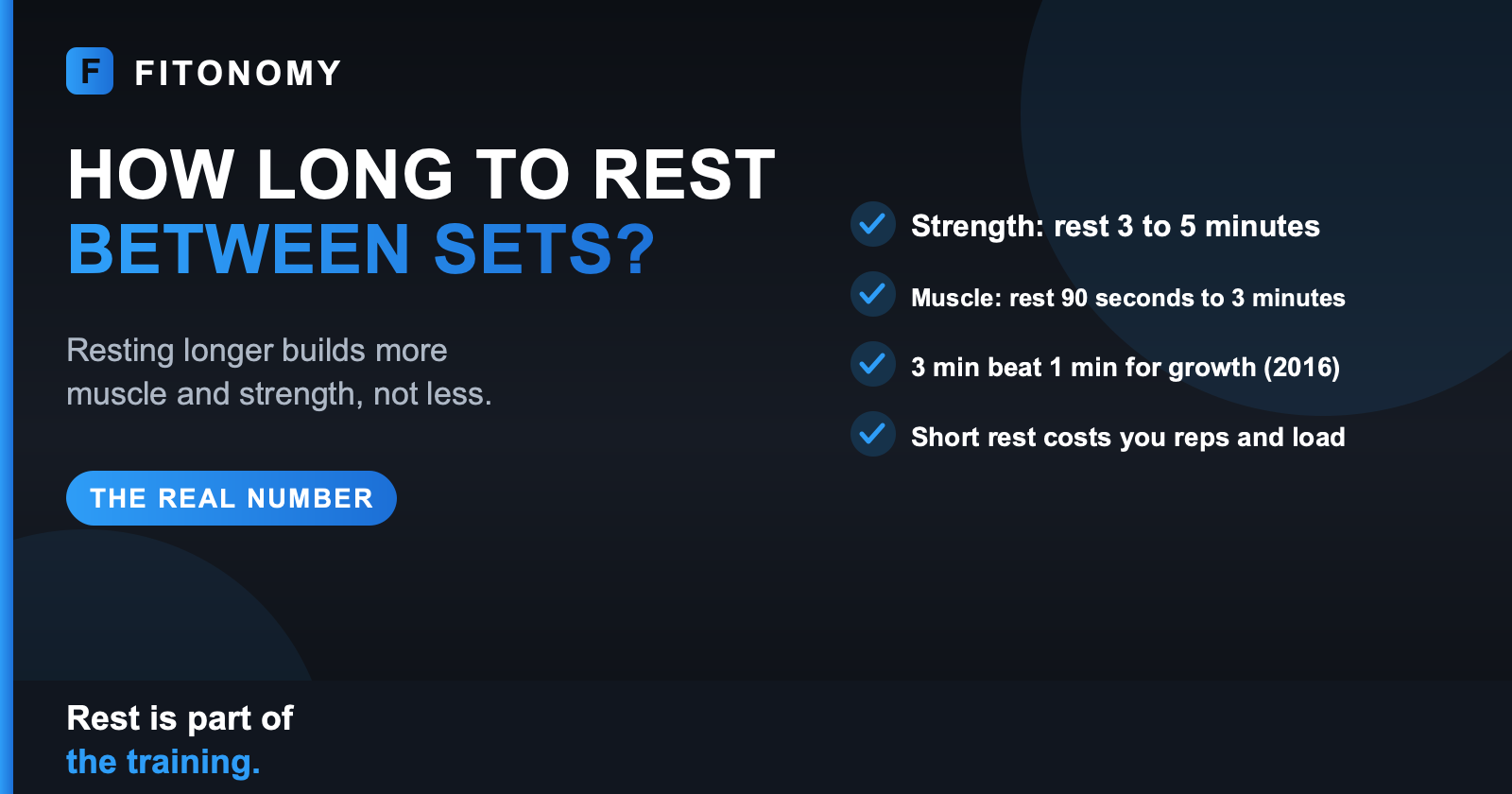
- Strength and power. Rest between sets: 3 to 5 minutes. Why it works: Full recovery lets you lift heavy again and complete more total reps, which drives strength.
- Muscle growth. Rest between sets: About 1.5 to 3 minutes, at least 60 to 90 seconds. Why it works: Longer rest preserves your load and reps, which protects the volume that builds muscle.
- Muscular endurance. Rest between sets: 30 to 60 seconds. Why it works: Short rest trains your muscles to resist fatigue.
- Circuit or conditioning. Rest between sets: 30 to 90 seconds. Why it works: Keeps your heart rate up and packs more work into less time.
Takeaway: For strength, rest 3 to 5 minutes. For muscle, rest at least 90 seconds and up to 3 minutes. Only drop below a minute when your specific goal is endurance or conditioning.
Why the old "short rest for muscle" advice was wrong
The idea that short rest builds more muscle came from a reasonable-sounding theory. Short rest raises the body's acute growth hormone response and creates more of the burn and pump lifters associate with a good session. For years position statements reflected this. The 2009 American College of Sports Medicine position stand (Ratamess and colleagues) recommended 1 to 2 minutes of rest for hypertrophy and 2 to 3 minutes for strength and power.
The problem is that the growth hormone spike from short rest does not translate into more muscle. When researchers actually measured muscle growth instead of hormones, the short-rest advantage disappeared. What matters far more for growth is the total quality work you do, and short rest quietly sabotages that.
Takeaway: The hormone theory behind short rest sounded good but did not hold up when researchers measured actual muscle. Chasing the burn is not the same as building the muscle.
What longer rest actually does
The mechanism is simple. Heavier sets fatigue your muscles and your nervous system, and both need time to recover before the next set. Cut the rest short and you cannot lift as much or complete as many reps, so your training volume drops. Since volume, meaning the total load you move across your sets, is one of the strongest drivers of both strength and size, protecting it protects your results.
De Salles and colleagues reviewed this in Sports Medicine in 2009 and found that when lifting between 50 and 90 percent of your one-rep max, resting 3 to 5 minutes let people complete more repetitions across their sets and produced greater increases in absolute strength than short rest. Power output was also higher when resting 3 or 5 minutes compared with only 1 minute. More recovery meant more quality work, which meant better adaptation.
Takeaway: Longer rest is not wasted time. It preserves the load and reps that make each set count, and volume is what drives strength and growth.
Rest for strength and power: 3 to 5 minutes
If your main goal is getting stronger on the big lifts, rest is not the place to save time. Heavy sets at 85 percent of your max or above draw down the energy your muscles use for short bursts, and that system needs a few minutes to refill. Rush it and your next set suffers.
The de Salles review is clear here: for heavy loads, 3 to 5 minutes between sets produced the greatest strength and power gains. Powerlifters and strength athletes have trained this way for decades, and the research backs the practice. If you are working up to a heavy triple on the squat or deadlift, taking 3 to 5 minutes is not indulgent, it is how you hit the numbers that make you stronger.
Takeaway: For heavy strength work, rest 3 to 5 minutes. Your next set, and your long-term strength, depend on it.
Rest for muscle growth: 1.5 to 3 minutes
This is where the biggest myth lived, and where the evidence has moved the most. In a well-known 2016 study in the Journal of Strength and Conditioning Research, Schoenfeld and colleagues put 21 resistance-trained men through 8 weeks of full-body training, three times a week, doing 3 sets of 8 to 12 reps. One group rested 1 minute between sets, the other rested 3 minutes. The 3-minute group gained significantly more strength on both squat and bench press, and greater muscle thickness in the quadriceps. Longer rest built more muscle, not less.
The bigger picture agrees. A 2024 Bayesian meta-analysis in Frontiers in Sports and Active Living pooled 19 measurements from 9 studies and found a small but real hypertrophy benefit to resting longer than 60 seconds, with the advantage leaning toward the arms and thighs. Importantly, it found no meaningful extra benefit to resting beyond about 90 seconds. An earlier 2017 systematic review by Grgic and colleagues reached a practical middle ground: both short and long rest can work for beginners, but trained lifters do better with longer rest, and around 90 seconds is a sensible balance between results and time.
Put together, the sweet spot for muscle is roughly 1.5 to 3 minutes. Take at least 60 to 90 seconds so you keep your reps up, and do not feel guilty about stretching it toward 2 or 3 minutes on hard compound lifts.
Takeaway: For muscle growth, rest at least 90 seconds and up to 3 minutes. The old 30-second rule was costing people the reps that build size.
Rest for endurance and conditioning: 30 to 90 seconds
Short rest is not useless, it is just for a different goal. If you are training muscular endurance, the ability to keep going under fatigue, deliberately short rest of 30 to 60 seconds is the right tool. It teaches your muscles to clear fatigue faster and keep performing when tired.
The same goes for circuits, conditioning, and fat-loss style sessions where the point is to keep your heart rate elevated and do more work in less time. Here, resting 30 to 90 seconds and moving between exercises is exactly what you want. Just be honest about the trade-off: you will not lift as heavy, so this is not the way to maximize pure strength or size.
Takeaway: Short rest of 30 to 90 seconds is the right choice for endurance and conditioning, not for maximum strength or muscle.
How to actually time your rest
Most people do not rest too long. They rest inconsistently, guessing, ending sets early because the clock feels awkward, or getting distracted and letting 5 minutes drift into 10. The fix is to actually time it rather than eyeball it. Use the same rest across your working sets so your sessions are comparable week to week, which is also the foundation of tracking progress. If you are new to structuring sessions, our guide on how many sets and reps to build muscle covers the volume side that rest is there to protect, and our take on training to failure explains how hard to push each set.
This is one of the quiet advantages of training with a structured app. Fitonomy runs a rest timer between your sets, counts your recovery, and cues you when it is time for the next set, so you take the full rest the research calls for instead of rushing or drifting. It sets that rest based on the kind of training you are doing, and it keeps your load and reps logged so the volume you are protecting is actually visible. If you want the sessions planned and timed for you, the guided workouts in the Fitonomy app handle the rest periods so you do not have to think about them.
Takeaway: Time your rest, do not guess it. Consistent rest keeps your sessions comparable and your volume honest, and a rest timer removes the guesswork.
Common rest mistakes
A few habits quietly cost people results. Rushing heavy sets to keep the burn going trades strength and muscle for a feeling. Resting so long you go cold, past about 5 minutes on most lifts, lets your muscles and focus drop off. Using the same 60 seconds for a heavy squat and a light cable curl ignores that heavy compounds need more recovery than small isolation moves. And changing your rest every week makes it impossible to tell whether your program is working, since you are changing two things at once.
For older lifters or anyone returning after time off, err toward the longer end. Recovery between sets tends to take a little more time with age, which is one of the themes in our guide on strength training after 30.
Takeaway: Match your rest to the lift, keep it consistent, and give heavy compounds more recovery than isolation work.
The bottom line
Rest between sets is not dead time, it is part of the training. For strength and power, rest 3 to 5 minutes so you can lift heavy again. For muscle growth, rest at least 90 seconds and up to 3 minutes, because longer rest protects the reps and load that actually build size, and the old 30-second rule was holding people back. Save short rest of 30 to 60 seconds for when endurance or conditioning is the real goal. Time it instead of guessing, match it to the lift, and keep it consistent so your progress is something you can actually measure.
Frequently asked questions
How long should I rest between sets to build muscle? Rest at least 60 to 90 seconds, and up to about 3 minutes, is best for muscle growth. Research by Schoenfeld and colleagues found that resting 3 minutes built more muscle and strength than resting 1 minute, and a 2024 meta-analysis found the benefit of resting past roughly 90 seconds is small. Aim for 1.5 to 3 minutes on your hard sets.
Is 30 seconds of rest enough between sets? Only if your goal is muscular endurance or conditioning. For building strength or muscle, 30 seconds is too short. You will not fully recover, so your reps and load drop, and that lost volume is what drives growth. Take at least 90 seconds for muscle and 3 to 5 minutes for heavy strength work.
Does resting longer between sets build more muscle? In trained lifters, yes, up to a point. Studies show longer rest of about 2 to 3 minutes builds at least as much muscle as short rest, and often more strength, because you keep your reps and load higher. Beyond roughly 3 minutes there is little added benefit for hypertrophy, so there is no need to rest 5 or 10 minutes for growth.
How long should powerlifters rest between heavy sets? For heavy strength and power work, 3 to 5 minutes is best. De Salles and colleagues found that this range let lifters complete more reps at high intensity and produced the greatest strength gains. On a top squat, bench, or deadlift set, taking the full 3 to 5 minutes is normal and helps you hit your numbers.
Should rest be the same for every exercise? No. Heavy compound lifts like squats, deadlifts, and presses fatigue you more and deserve longer rest, around 2 to 5 minutes depending on your goal. Smaller isolation moves like curls or lateral raises recover faster, so 1 to 2 minutes is fine. Match the rest to how demanding the exercise is.