Walk into any gym and you will hear confident, contradictory answers. Three sets of ten. Five by five. High reps for tone, low reps for size. Most of it is tradition dressed up as science. The good news is that muscle building has been studied heavily, and the real answer is simpler and more forgiving than the bro-science suggests.
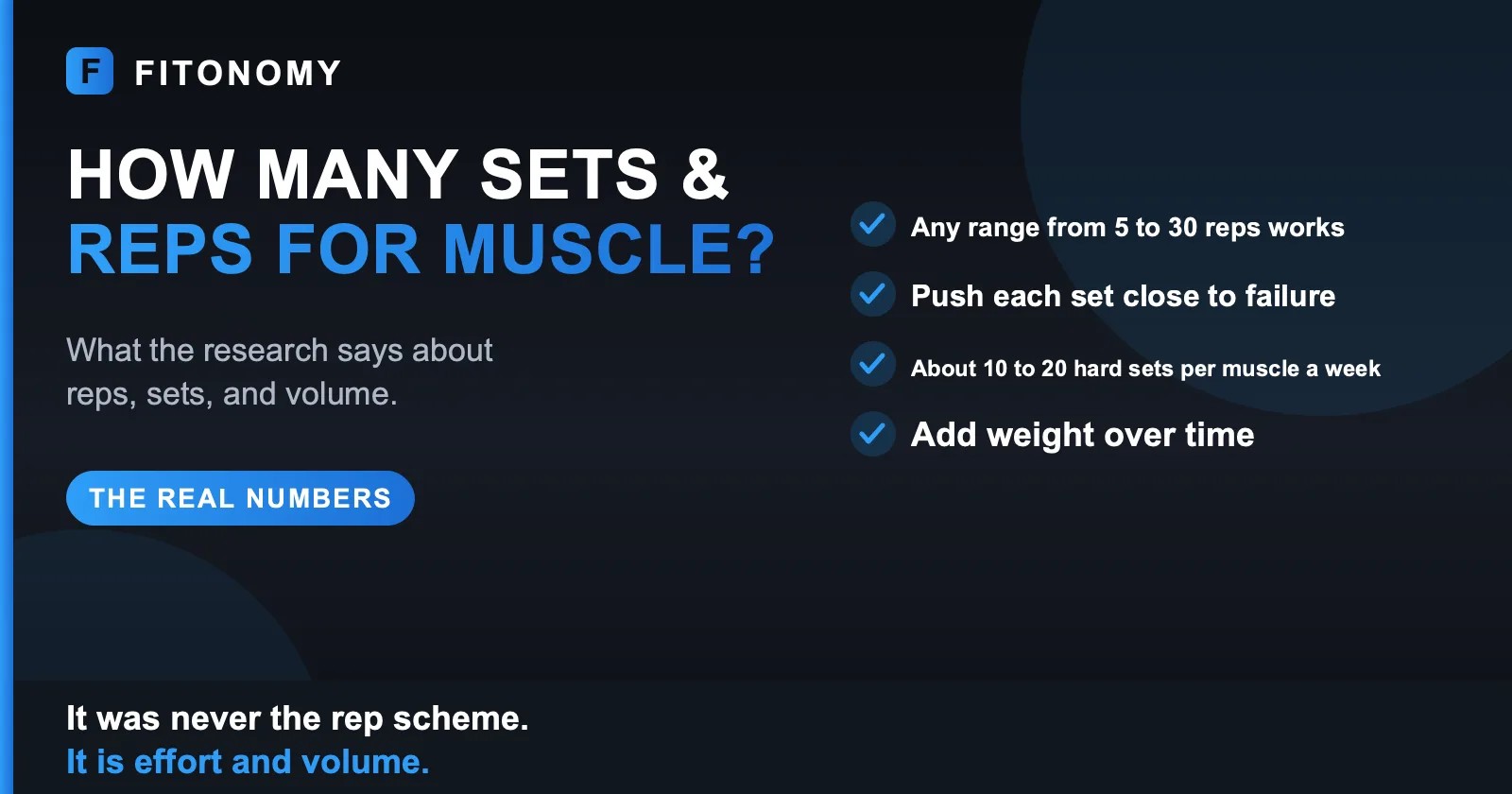
Here is the short version. You can build muscle across a wide range of reps, roughly 5 to 30, as long as you take your sets close to failure. What actually drives growth is not the exact rep number but your total weekly volume, the number of hard sets you do per muscle, plus progressively adding weight over time. Let me show you the numbers and turn them into a simple plan.
How many reps build muscle?
Almost any rep range you would realistically use. A 2017 meta-analysis by Schoenfeld and colleagues pooled 21 studies and found that when total volume is equated and sets are taken near failure, muscle growth is similar across the whole spectrum from about 5 to 35 reps. A randomized trial by Morton and colleagues in 2016 drove the point home: trained men who lifted heavy (around 80 percent of their max, roughly 8 to 12 reps) built the same amount of muscle as men who lifted light (around 30 percent, over 20 reps), as long as both groups trained to failure.
So the classic "8 to 12 reps for growth" is not wrong, it is just not the only option. That range is popular because it is efficient, letting you accumulate good volume without the joint stress of very heavy sets or the sheer discomfort of very high-rep sets. But if you prefer heavier fives or lighter twenties, your muscles will grow either way.
Takeaway: You can build muscle anywhere from about 5 to 30 reps if you take sets close to failure. The 8 to 12 range is popular because it is efficient, not because it is magic. Pick a range you can push hard in and progress.
How many sets? This is what actually matters
Reps are flexible, but weekly volume is the real dial. Volume means the number of hard sets you perform per muscle group per week, and it has a clear dose-response with growth: more sets, more muscle, up to a point of diminishing returns. A 2017 dose-response meta-analysis by Schoenfeld, Ogborn, and Krieger found that around 10 or more hard sets per muscle per week drove near-maximal hypertrophy, with higher-volume groups gaining meaningfully more than lower-volume ones. A 2023 network meta-analysis by Currier and colleagues confirmed the same direction: more volume, more growth.
For most people, that means aiming for roughly 10 to 20 hard sets per muscle group each week. A beginner can grow on the lower end, around 10, while more advanced lifters often need more to keep progressing. If you are doing 3 sets of a chest exercise twice a week, that is 6 sets, likely below the sweet spot. Nudging that toward 10 or more is one of the highest-impact changes most people can make.
Takeaway: Weekly volume is the main driver of muscle growth. Aim for about 10 to 20 hard sets per muscle group per week, starting near 10 as a beginner and adding sets over time. Many people simply do not do enough volume.
What about strength, and heavy vs light?
Here the answer splits. While muscle size grows across rep ranges, maximal strength is more load-dependent. The 2023 Currier network meta-analysis found that heavier loads, above about 80 percent of your one-rep max (roughly 5 reps or fewer), maximized strength gains specifically, even though all loads built similar muscle. Strength is partly a skill of producing force against heavy resistance, so you get better at it by practicing with heavy resistance.
The practical takeaway: if your goal is pure size, train mostly in the comfortable 6 to 15 range and chase volume. If you also want to get strong, include some heavier work in the 3 to 6 range on your main lifts. And whatever the rep range, how hard you push matters, which is why effort and proximity to failure deserve their own attention (see do you need to train to failure).
Takeaway: For size, any moderate rep range plus enough volume works. For maximal strength specifically, include heavy sets above 80 percent of your max (about 5 reps or fewer). Chase volume for muscle, chase heavy loads for strength.
Does how often you train each muscle matter?
Less than you would think, once volume is set. A 2019 meta-analysis by Schoenfeld and colleagues found that when weekly volume is held equal, training a muscle once, twice, or three times a week produces essentially the same growth. Frequency is a scheduling tool, not a separate growth lever.
That said, frequency is useful for a practical reason: it lets you spread your weekly sets into manageable sessions. Cramming 16 sets for your legs into one brutal weekly session is far harder and lower quality than splitting them across two sessions of 8. So most people do best training each muscle about twice a week, not because twice is magic, but because it makes hitting your weekly volume with good-quality sets far easier.
Takeaway: For a given weekly volume, training frequency does not change muscle growth. Aim to hit each muscle about twice a week anyway, because splitting your sets across two sessions makes the volume easier to do well.
The prescription, by goal
- Build muscle (size). Rep range: 6 to 15. Sets per muscle per week: 10 to 20. Load: Moderate, near failure.
- Maximal strength. Rep range: 3 to 6. Sets per muscle per week: 10 to 15. Load: Heavy (over 80% of max).
- Muscle endurance. Rep range: 15 to 30+. Sets per muscle per week: 8 to 15. Load: Light, high reps.
- General fitness. Rep range: 8 to 15. Sets per muscle per week: 8 to 12. Load: Moderate.
The two things that beat any rep scheme
Two principles matter more than the exact numbers. First, effort: your sets have to be genuinely hard, taken to within a couple of reps of failure, or the rep range is irrelevant. A comfortable set of ten does little. Second, progressive overload: over weeks you must add weight, reps, or sets, because your body only adapts to a demand it has not already met. Doing the same 3 sets of 10 with the same weight forever is the single most common reason people stop growing. Track your lifts so you can beat them (see how to track your workouts), and remember this all takes months to show, not days (see how long it takes to build muscle).
Takeaway: Effort and progressive overload beat any specific rep scheme. Take sets close to failure, and add weight or reps over time. A hard, progressing set of any reasonable rep count beats a comfortable, static one.
The Fitonomy angle: the numbers, handled for you
The research turns muscle building into a fairly mechanical checklist: hit around 10 to 20 hard sets per muscle each week, in any rep range you can push near failure, and add load over time. The hard part is not knowing this, it is programming and tracking it session after session. That is what a structured app does. Fitonomy prescribes your sets and reps, spreads your weekly volume across sessions so you actually hit the effective range, and progresses your loads over time so overload happens automatically instead of by accident. Its workout logging keeps a record so you are always trying to beat last week, which is the whole game. You can follow a structured, progressing plan in the Fitonomy app and let it manage the sets, reps, and progression while you focus on pushing hard. It even suits training with minimal gear (see building muscle at home).
Takeaway: The science is a simple volume-and-progression checklist, and the challenge is executing it consistently. Fitonomy prescribes your sets and reps, keeps your weekly volume in range, and progresses the load automatically, so the programming is handled and you just train.
The bottom line
Building muscle does not require a secret rep scheme. Pick a rep range you can push hard in, anywhere from about 5 to 30, take your sets close to failure, and accumulate roughly 10 to 20 hard sets per muscle each week, ideally split across two sessions. Add weight or reps over time. Go heavier, above 80 percent of your max, if you also want maximal strength. Do that consistently for months and you will grow, regardless of whether you favor fives, tens, or twenties. The magic was never in the numbers. It was in the effort and the progression.
Frequently asked questions
How many reps should you do to build muscle? Almost any range from about 5 to 30 reps builds muscle, as long as you take your sets close to failure. A 2017 meta-analysis found similar growth across that whole spectrum when volume was matched. The classic 8 to 12 range is popular because it is efficient, but heavier or lighter reps grow muscle just as well.
How many sets per muscle should you do each week? Aim for roughly 10 to 20 hard sets per muscle group per week. A dose-response meta-analysis found near-maximal muscle growth at around 10 or more weekly sets, with more volume producing more growth up to a point. Beginners can start near 10, and more advanced lifters usually need more to keep progressing.
Is 3 sets enough to build muscle? Three sets of one exercise, done once a week, is likely below the effective range. But 3 sets per session done twice a week gets you to 6, and adding another exercise pushes you toward the 10-plus weekly sets that drive good growth. Think in terms of total weekly sets per muscle, not sets per exercise.
Do you have to lift heavy to build muscle? No. Research shows light loads (around 30 percent of your max, over 20 reps) build the same muscle as heavy loads when both are taken to failure. Heavy lifting is necessary for maximal strength, not for size. For muscle, effort and total volume matter more than the load on the bar.
How often should you train each muscle to build it? For a given weekly volume, frequency does not change growth. Training a muscle once, twice, or three times a week produces similar results if the total sets are equal. Most people do best training each muscle about twice a week, simply because it makes hitting the weekly volume with quality sets easier than one brutal session.