How Many Steps a Day Do You Actually Need?
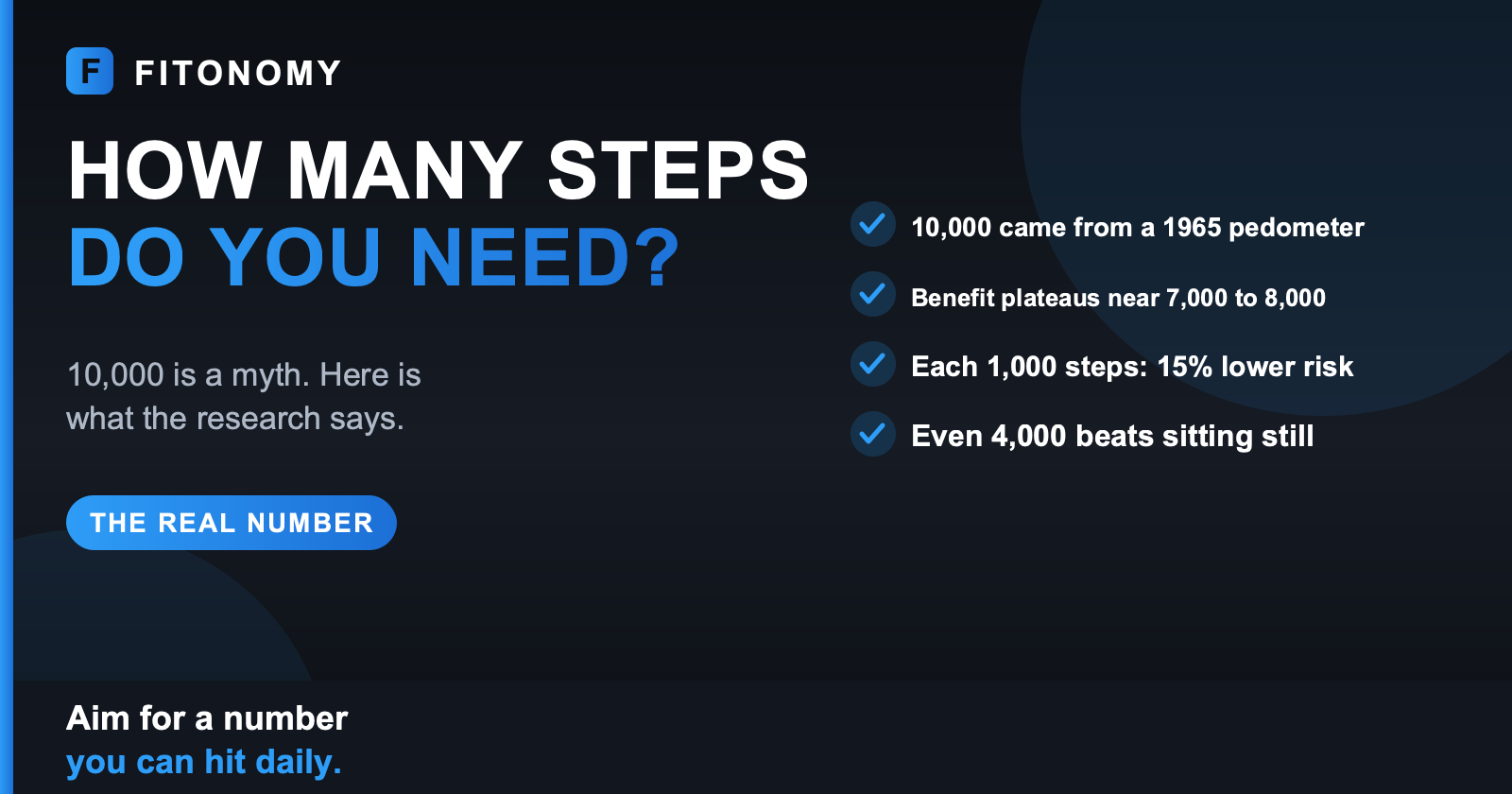
10,000 steps is a marketing number from a 1965 pedometer, not science. The research says the benefit plateaus around 7,000 to 8,000 for most adults, and even 4,000 beats sitting still. Here is the step target that fits you.
Fitonomy Coach
July 14, 2026
Ten thousand steps. It is on your watch, your phone, and your friend's smug status update. It feels official, like a number handed down by science. It was not. It came from a 1960s marketing campaign, and the actual research says most people need fewer steps than that to capture most of the health benefit. Here is where the number came from, what the studies really show, and the step target that fits you.
The short version: more steps do lower your risk of dying early, but the benefit climbs fast at the start and then flattens out, usually well before you hit 10,000. For most adults the sweet spot sits somewhere around 7,000 to 8,000, and even a few thousand steps beats sitting still. Here is the evidence, with numbers, plus how to think about steps as one piece of staying healthy rather than the whole thing.
Where 10,000 steps came from, and it was not science
In 1965, a Japanese company called Yamasa sold a pedometer named Manpo-kei, which literally means "10,000-steps meter." It was created by Dr. Yoshiro Hatano around the buzz of the 1964 Tokyo Olympics, when the country was leaning into fitness. The number 10,000 was chosen because it was round, catchy, and easy to sell, and the Japanese character for 10,000 even looks a little like a person walking. There was no trial, no cohort, no data behind it. As Harvard epidemiologist I-Min Lee, who has studied steps for years, has put it plainly, the 10,000 figure started as a marketing strategy, not a scientific one.
Takeaway: The 10,000-step target is a 1965 pedometer brand name, not a research finding. It is a fine round goal, but nothing magic happens at exactly 10,000.
What the research actually shows: more steps, lower risk, then a plateau
When scientists finally studied it, a clear pattern emerged. A 2019 study by Lee and colleagues in JAMA Internal Medicine tracked 16,741 older women and found that those averaging about 4,400 steps a day had a 41 percent lower risk of dying over the follow-up than the least active women at about 2,700 steps. Risk kept dropping as steps rose, but the benefit leveled off at around 7,500 steps a day. Notably, walking speed did not matter much once total volume was accounted for. It was the number of steps, not how fast, that tracked with living longer.
The dose-response holds up across huge samples. A 2023 meta-analysis by Banach and colleagues in the European Journal of Preventive Cardiology pooled 17 studies and 226,889 people and found that every extra 1,000 steps a day was linked to a 15 percent lower risk of dying from any cause. Crucially, benefits appeared even below 4,000 steps, so the biggest returns come from moving off the couch, not from chasing a five-figure target.
Takeaway: More steps genuinely lower your risk of early death, with each extra 1,000 steps tied to about 15 percent lower mortality, but the curve flattens around 7,500 steps for many adults. The first few thousand steps give the biggest payoff.
Your ideal number depends on your age
There is no single magic number because it shifts with age. A 2022 meta-analysis by Paluch and colleagues in the Lancet Public Health combined 15 cohorts and 47,471 adults and found that the mortality benefit plateaued at about 6,000 to 8,000 steps a day for adults 60 and older, but continued a bit further, to about 8,000 to 10,000 steps, for adults under 60. In other words, younger people keep gaining benefit further up the curve, while older adults reach most of the payoff sooner.
Takeaway: If you are under 60, aim for roughly 8,000 to 10,000 steps. If you are 60 or older, 6,000 to 8,000 captures most of the benefit. Neither group needs to obsess over hitting exactly 10,000.
Steps and your brain
Walking does not just help your heart and lifespan, it appears to protect your brain. A 2022 study by del Pozo Cruz and colleagues in JAMA Neurology followed 78,430 UK adults aged 40 to 79 wearing motion sensors and found that dementia risk fell as daily steps rose, bottoming out at around 9,800 steps a day, which was linked to a 51 percent lower risk of dementia. You did not need to hit that number to benefit, though. Half of the maximum benefit showed up at just about 3,800 steps a day, and walking at a faster cadence added a little extra protection on top.
Takeaway: For brain health, more steps helped up to about 9,800 a day, tied to roughly half the dementia risk, but you get half of that benefit at only 3,800 steps. Any walking beats none.
The comparison at a glance
- Under 60. Step target for most of the benefit: About 8,000 to 10,000. What the research shows: Mortality keeps dropping until roughly 8,000 to 10,000, then plateaus.
- 60 and over. Step target for most of the benefit: About 6,000 to 8,000. What the research shows: The benefit plateaus earlier, around 6,000 to 8,000.
- Just starting out. Step target for most of the benefit: Even 4,000 helps a lot. What the research shows: About 4,400 steps cut death risk 41 percent versus 2,700 in one study.
- Want brain benefits. Step target for most of the benefit: Around 9,800. What the research shows: Lowest dementia risk landed near 9,800 steps a day.
- Chasing exactly 10,000. Step target for most of the benefit: Fine, but not required. What the research shows: The number came from a 1965 pedometer name, not a study.
Takeaway: There is no universal number. Younger adults benefit up toward 8,000 to 10,000, older adults plateau around 6,000 to 8,000, and everyone gains something from as few as 4,000.
The catch: steps are a floor, not the whole gym
Steps are one of the best things you can do for longevity, your heart, your brain, and your mood, and they are the easiest activity to rack up because you do them while living your life. But walking does almost nothing to build muscle or strength, and muscle is what protects your metabolism, your bones, and your independence as you get older. Steps and resistance training do different jobs, and one does not replace the other. The healthiest setup is a solid daily step count plus a couple of strength sessions a week. If you want the case for lifting as you age, see our guide on strength training after 30, and for whether to walk or run, our take on walking versus running for fat loss.
Takeaway: Steps are a fantastic daily baseline but they build little strength or muscle. Pair your step count with resistance training, because they protect different parts of your health.
So what should you actually aim for?
Here is the practical version. If you are under 60, target roughly 8,000 to 10,000 steps a day. If you are 60 or older, 6,000 to 8,000 gets you most of the benefit. If you are starting from very little, do not fixate on 10,000, just add 1,000 to 2,000 steps to your current average, since the first extra thousands lower your risk the most, about 15 percent per additional 1,000 steps. The best target is one you can hit on most days, because consistency beats a perfect number you only reach twice a week. A tracker helps you see where you stand, our guide on whether fitness trackers work covers that, and the real skill is staying consistent long enough for it to become a habit.
Takeaway: Pick a step goal you can hit most days, roughly 8,000 to 10,000 if under 60 or 6,000 to 8,000 if older, and if you are sedentary just add 1,000 to 2,000 to your current average. Consistency matters more than the exact target.
The Fitonomy angle: steps are the base, training is the build
The research is clear that a solid baseline of daily movement is one of the highest-value things you can do, and steps are the easiest way to get it. But steps alone leave out the training that actually builds strength, shape, and the muscle that protects you as you age. That is exactly the part Fitonomy is built for. It gives you a structured, personalized workout plan that adds the strength work the evidence says to pair with your steps, plus reminders and streaks that keep the daily movement habit going and progress tracking so you can watch it build over months. Think of your daily steps as the floor and a guided plan in the Fitonomy app as the training that sits on top of it, so you cover both the longevity side and the strength side instead of only counting steps.
Takeaway: Steps are the daily baseline, but strength training is what they cannot give you. Fitonomy adds the structured workouts, reminders, and streaks that turn a step count into a complete, consistent fitness habit.
The bottom line
Ten thousand is a fine goal, but it is a marketing number, not a scientific one. The research says the benefit ramps up fast and flattens well before 10,000: roughly 7,000 to 8,000 steps a day captures most of the longevity benefit for most adults, younger people gain a little more up toward 8,000 to 10,000, and even 4,000 steps crushes being sedentary. Aim for a number you can hit most days, add strength training on top, and stop stressing about a target that was invented to sell pedometers.
Frequently asked questions
Do you really need 10,000 steps a day? No. The 10,000 figure came from a 1965 Japanese pedometer name, not from research. Studies show the health benefit rises quickly and then plateaus, usually around 7,000 to 8,000 steps for most adults. More is fine, but you capture most of the payoff before 10,000, and even about 4,000 steps beats being sedentary.
Is 7,000 steps enough? For most adults, yes. Around 7,000 to 8,000 steps a day captures most of the longevity benefit, and one large meta-analysis found each extra 1,000 steps lowered mortality risk about 15 percent, with the curve flattening near 7,500 for older adults. If you are under 60, pushing toward 8,000 to 10,000 adds a little more.
How many steps a day to lose weight? Steps add to the calorie-burn side of things, but weight loss is driven mostly by diet. A higher daily count, say 8,000 to 10,000, adds meaningful movement, but you will only lose fat if you are also in a calorie deficit. Use steps for health and daily activity, and control your food for the scale.
Do steps count as exercise? They count as physical activity, and daily steps genuinely lower your risk of early death, heart disease, and dementia. But walking builds little strength or muscle, so it is not a substitute for resistance training. Treat steps as your daily movement baseline and add a couple of strength sessions a week.
Does walking speed matter? For longevity, total steps matter more than speed. The 2019 older-women study found intensity had little effect once total volume was counted. For brain health, a faster cadence added a small extra benefit in one large study. So get the steps in first, and treat a brisker pace as a bonus.