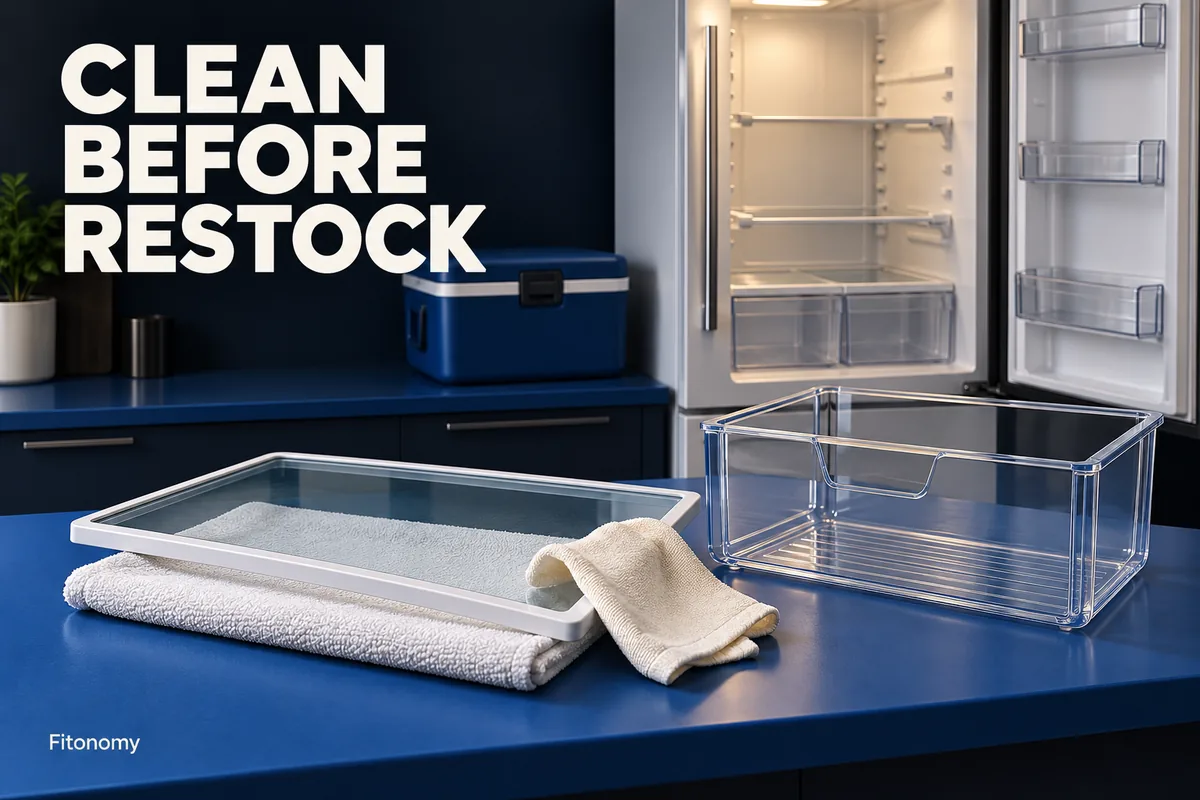
Keep food cold first
Before removing food, arrange another refrigerator or suitable cold storage at or below 4 degrees Celsius, also stated as 40 degrees Fahrenheit. The FDA storage guidance sets a room temperature limit of two hours, or one hour above 32 degrees Celsius, also stated as 90 degrees Fahrenheit. These are limits, not cleaning time targets. If cold storage is uncertain, postpone the job. The cold lunch guide covers transport separately.
Read the model instructions
Check which parts may be removed, how to support them and whether power isolation is required. Samsung care guidance shows why designs differ. Use your own model manual, without forcing clips or borrowing another fridge's removal sequence. Glass can be heavy. Prepare a protected place to set it down and use only permitted cleaning materials.
Protect cold glass while washing
Do not put cold glass straight into hot water. The CDC cleaning page says to let it reach room temperature first. That page concerns a food recall; here, use its glass handling caution alongside your manual. Hand wash permitted parts with an approved mild detergent and soft cloth. Do not assume dishwasher compatibility, mix chemicals or spray water into the appliance.
Rinse dry and restore
Rinse away soap and dry with a clean towel as the care instructions allow. Clean accessible interior surfaces by the approved method. Refit parts and restore operation according to the manual. Use the fridge thermometer guide to check cold storage before returning food. Cleaning does not correct earlier unsafe handling, and smell does not prove food safe.
Separate routine care from a recall
A recalled product needs the authority's specific disposal and cleaning directions, with compatible appliance advice. This routine is not a complete recall response or proof of sterility. Wipe spills promptly, then return to ordinary meal planning and leftover lunch planning. Fitonomy supports fitness planning, not food safety assessment.