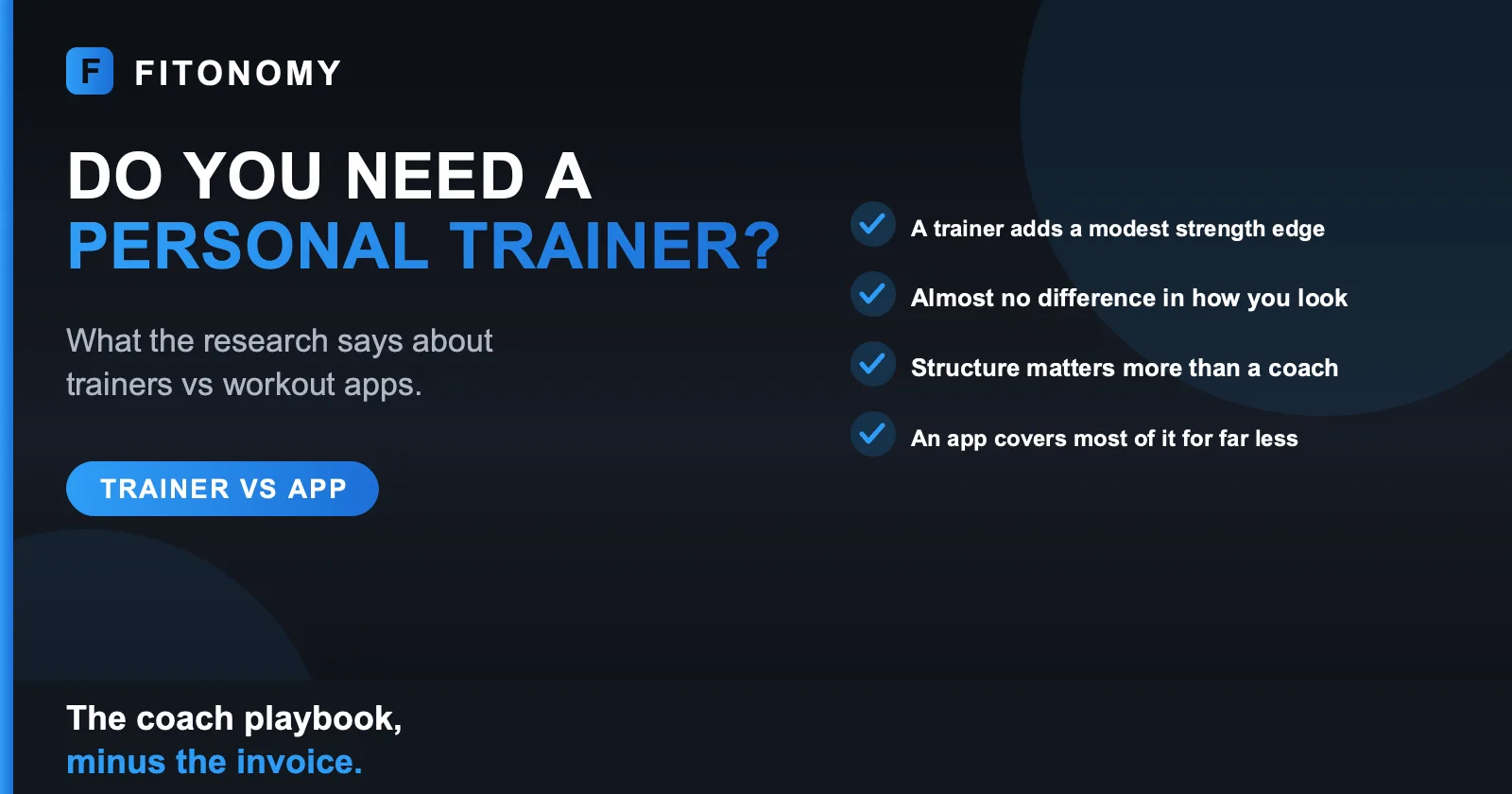
A personal trainer can cost more per month than rent in some cities, so it is a fair question whether you actually need one, or whether a good workout app does the same job for the price of a coffee. The honest answer is not the one either the fitness industry or the app stores want to give you. A trainer genuinely helps, but by less than you would expect, and for most people a well-built app closes most of the gap.
Here is what the research actually shows about training with a coach versus training with an app or on your own, what a trainer adds that matters, and when paying for one is genuinely worth it.
Does a personal trainer actually get you better results?
Yes, but the edge is modest. The best summary is a systematic review and meta-analysis of 12 studies comparing supervised training (a trainer watching you) against unsupervised training. It found a moderate advantage for supervision on strength (effect size 0.40), a small advantage on overall performance (0.28), and, tellingly, a trivial difference for body composition (0.07). In plain terms: a trainer helps you get stronger somewhat faster, but makes almost no difference to how you look.
A classic 2000 study by Mazzetti and colleagues showed the same. Men who trained under direct supervision got significantly stronger in the squat and bench than those who trained alone, and the reason was simple: the supervised group lifted heavier. A trainer's biggest effect is not secret knowledge, it is getting you to work harder than you would by yourself.
Takeaway: A trainer produces a moderate strength boost (effect size around 0.40) but a trivial difference in body composition (0.07). The main mechanism is that supervision pushes you to train harder, not that trainers hold hidden secrets.
What a trainer actually does that works
Strip away the mystique and a trainer adds value in four concrete ways. First, they push intensity. Left to ourselves, we lift too light: a 2008 study by Ratamess and colleagues found that people training without a trainer self-selected loads around 42 percent of their one-rep max, well below the intensity needed for good results, while those with a trainer went heavier. Second, programming: a coach structures your sessions and progresses them over time so you are not guessing. Third, accountability: a scheduled appointment with a person you are paying is hard to skip. Fourth, form: a good trainer corrects your technique in real time, which reduces injury risk and makes exercises more effective.
Notice that three of those four, intensity guidance, programming, and accountability, do not actually require a human standing next to you. Only hands-on, real-time form correction genuinely needs a person in the room.
Takeaway: A trainer helps by pushing intensity, programming your training, keeping you accountable, and fixing your form. Only the last one truly requires a human present. The other three can be delivered other ways, including by a good app.
Can an app really replace most of that?
For most people, yes, most of it. A 2024 randomized controlled trial compared in-person supervision, app-guided training, and self-guided training head to head. In-person supervision came out on top for strength and adherence, as expected, but app-guided training clearly beat going it alone, and delivered solid results. Other research backs this up: a mobile-app rehabilitation program improved strength and balance about as well as in-person therapy in older adults, and remote training has matched in-person training for body composition in several studies.
The pattern is consistent. The biggest drop-off in results is not app versus trainer, it is having structure versus winging it. A structured app that prescribes proper loads, progresses you automatically, and keeps you accountable captures most of a trainer's benefit. What it cannot fully replace is a skilled eye correcting your form in the moment, though exercise video demos narrow even that gap for common movements.
Takeaway: A good app clearly beats training with no plan and approaches supervised training for many outcomes. The real divide is structured versus unstructured, not app versus trainer. The one thing an app does less well is live form correction.
Trainer vs app vs going it alone
- Cost. Personal trainer: High (per session). Good workout app: Low (monthly). On your own: Free.
- Programming and progression. Personal trainer: Excellent, tailored. Good workout app: Very good, structured. On your own: Depends on your knowledge.
- Pushing intensity. Personal trainer: Strong, in person. Good workout app: Prescribed loads and targets. On your own: Often too light.
- Accountability. Personal trainer: Highest. Good workout app: Reminders and streaks. On your own: Willpower only.
- Real-time form feedback. Personal trainer: Best. Good workout app: Video demos, no live fix. On your own: None.
- Best for. Personal trainer: Rehab, beginners, big budget. Good workout app: Most people. On your own: Experienced, self-motivated.
When a personal trainer is genuinely worth it
There are real cases where paying for a trainer makes sense. If you are coming back from an injury or have a medical condition, hands-on professional guidance is worth it and sometimes necessary. If you are a total beginner who feels lost and anxious in a gym, a few sessions to learn the basic lifts safely can be money well spent. If you are training for something specific like a powerlifting meet or a physique competition, individualized coaching and live form work matter more. And if accountability is genuinely your weak point and money is not, a trainer is one of the most effective adherence tools there is.
For everyone else, the honest verdict is that a good app plus a bit of self-education covers the essentials at a tiny fraction of the cost.
Takeaway: A trainer is worth it for rehab or medical needs, nervous beginners learning the basics, sport-specific goals, or people who need maximum accountability and can afford it. Outside those cases, most people do not need one.
How to get a trainer's benefits from an app
If you go the app route, get the parts that matter. Use a structured plan that progresses your loads over time rather than random workouts (this is exactly what to look for in choosing a workout app, and why AI-built plans can work well). Actually push the prescribed weights rather than staying comfortable, since under-loading is the classic solo mistake. Lean on the accountability features, reminders and streaks, the same way you would dread skipping a paid appointment (more on that in staying consistent). And use the exercise demos to learn proper form, checking your technique on video (our exercise library guide covers this). Do those four things and you have reconstructed most of what a trainer provides.
Takeaway: To replace a trainer with an app, use a progressive structured plan, actually lift the prescribed loads, use the accountability features, and learn form from the demos. That covers programming, intensity, adherence, and most of form.
The Fitonomy angle: the trainer's job, minus the price tag
The research breaks a trainer's value into programming, intensity, accountability, and form, and shows that a structured app captures most of it. That is what Fitonomy is built to do. It gives you structured plans with progressive loads so your programming and intensity are handled, reminders and streaks so accountability is built in, and an exercise library with demonstrations so you can learn and check your form, all for a fraction of what a trainer costs. It will not put a hand on your shoulder to fix your squat, but it covers the parts of coaching that move the needle most for the average person. You can follow a structured plan in the Fitonomy app and get the coach's playbook without the coach's invoice.
Takeaway: Fitonomy delivers the replicable parts of coaching (programming, progressive intensity, accountability, form demos) at a fraction of a trainer's cost. It cannot fix your form by hand, but it covers what matters most for most people.
The bottom line
You probably do not need a personal trainer. The research says supervision gives a moderate strength edge and almost no body-composition advantage, and that its real magic is pushing intensity and accountability, things a structured app can largely deliver. A trainer is genuinely worth it for rehab, nervous beginners, sport-specific goals, or when accountability is your one weak link and budget is not an issue. For most people chasing general strength, muscle, and fat loss, a good app plus a willingness to push yourself gets you the large majority of the results at a tiny fraction of the price. The biggest mistake is not skipping the trainer. It is training with no plan at all.
Frequently asked questions
Do you need a personal trainer to get fit? Most people do not. A meta-analysis found supervised training gives a moderate strength edge (effect size 0.40) but a trivial body-composition difference (0.07) versus unsupervised training. A trainer helps mainly by pushing intensity and accountability, which a structured app can largely provide. A trainer is most valuable for rehab, nervous beginners, or sport-specific goals.
Is a workout app as good as a personal trainer? For most goals, close. A 2024 randomized trial found in-person supervision was best for strength and adherence, but app-guided training clearly beat training with no plan and delivered solid results. The big divide is structured versus unstructured training, not app versus trainer. An app cannot fully replace live form correction, but it covers programming, intensity, and accountability well.
Why does a personal trainer help you get stronger? Mostly by getting you to lift heavier. Studies show people training alone tend to pick loads around 42 percent of their max, too light for good results, while supervised trainees go heavier. A trainer also programs your sessions, keeps you accountable, and corrects form. The intensity and accountability effects are the biggest, and both can be replicated without a person present.
When is a personal trainer worth the money? When you are recovering from an injury or have a medical condition, when you are a beginner who feels lost and wants to learn the basic lifts safely, when you are training for a specific sport or competition, or when accountability is your main weakness and you can afford it. Outside those cases, a good app covers the essentials far more cheaply.
Can beginners build muscle without a trainer? Yes. Beginners make the fastest progress of anyone, and a structured app that prescribes proper exercises, loads, and progression covers what most beginners need. A few starter sessions with a trainer to learn form can help if the gym feels intimidating, but they are optional, not required, for building muscle.