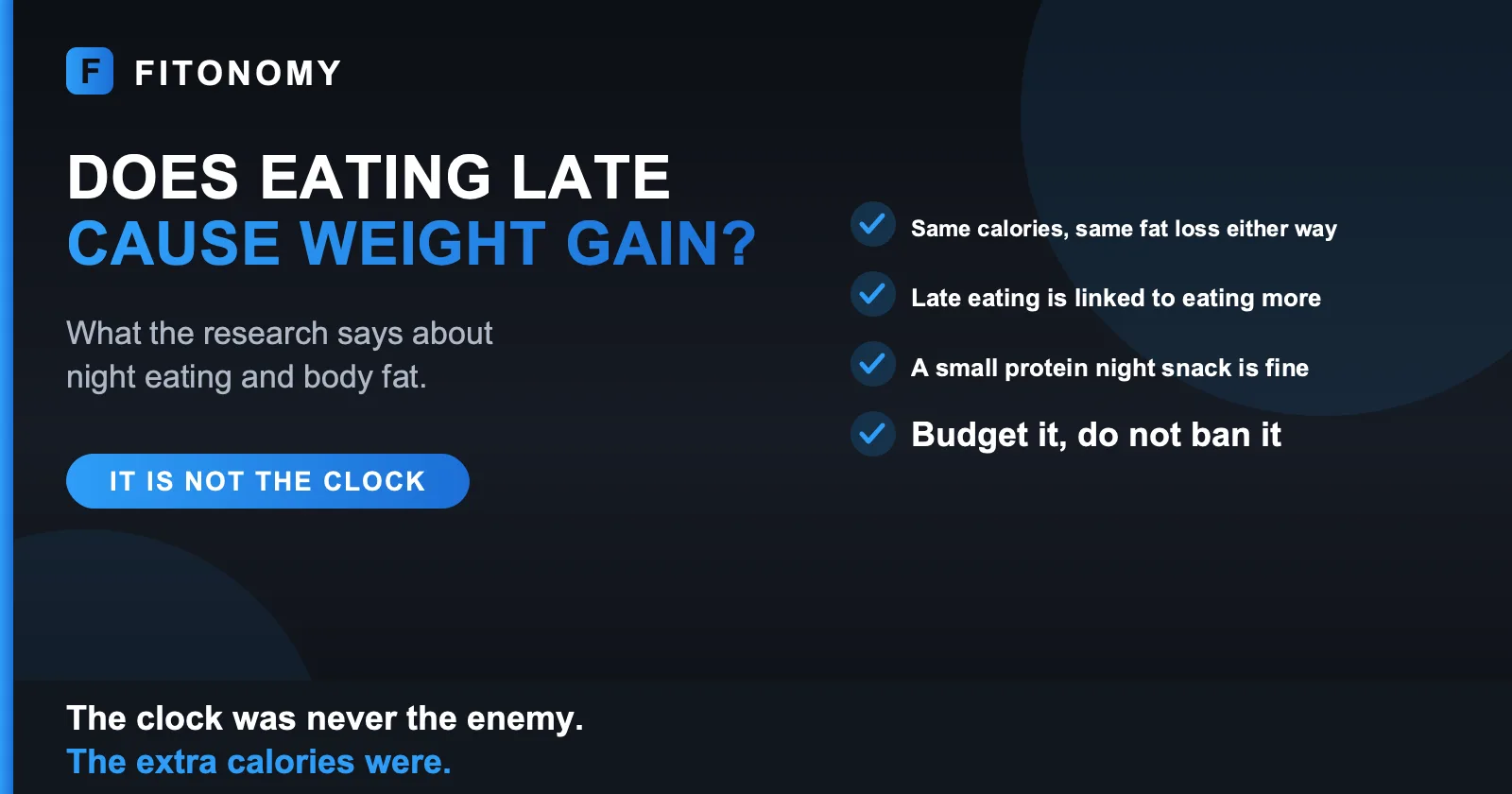
It is one of the most repeated rules in dieting: do not eat after 8pm, or the calories go straight to fat while you sleep. It sounds intuitive. Your body is winding down, not burning much, so surely late food gets stored. Plenty of people skip a genuinely hungry evening because of it.
The research tells a more nuanced and more useful story. The clock itself is not what makes you gain weight, calories are, and a calorie eaten at 10pm is not magically fattier than one eaten at noon. But eating earlier can still help you in the real world, and late-night eating really is linked to weight gain, just not for the reason you think. Here is what the science shows and how to have that evening snack without undoing your progress.
Does eating late actually cause fat gain?
Not by itself. The cleanest test came from a 2022 crossover trial by Ruddick-Collins and colleagues in Cell Metabolism. They fed people the exact same number of calories, either front-loaded in the morning or loaded in the evening, and measured everything carefully. The result: weight loss was identical, about 3.3 kg either way, and energy expenditure did not differ. When calories are held equal, when you eat them does not change how much fat you lose.
This lines up with what physiology predicts. Your body does not stop burning energy at night, and it does not have a rule that converts evening calories to fat. Total energy balance over days and weeks is what determines your weight, not the hour on the clock. So the strict "no eating after 8pm" rule is not based on a metabolic reality.
Takeaway: Eating late does not cause fat gain on its own. In a tightly controlled trial, eating the same calories in the evening versus the morning produced identical weight loss. The clock does not override calorie balance.
Then why do studies link late eating to weight gain?
Because in real life, people who eat late tend to eat more, and eat earlier tends to help you eat less. Two well-known studies show the pattern. A 2013 study by Garaulet and colleagues followed 420 dieters for 20 weeks and found that late eaters lost about 2.2 kg less than early eaters, despite similar reported calorie intake. And a 2013 trial by Jakubowicz and colleagues gave women the same 1,400 calories but front-loaded into a big breakfast or a big dinner, and the big-breakfast group lost more than twice as much, 17.8 pounds versus 7.3.
How does that square with the controlled study showing no difference? The key is that those real-world studies were not perfectly calorie-matched. Eating earlier helps mainly by controlling appetite. That same Cell Metabolism trial found the evening group was noticeably hungrier, even though they lost the same weight in the lab. In the real world, hungrier means eating more, and late-night hours are prime time for mindless, high-calorie snacking. So the link between late eating and weight gain is real, but it runs through eating more, not through the timing being fattening.
Takeaway: Late eating is linked to weight gain because it usually means eating more, not because night calories are special. Eating earlier curbs hunger, and studies where it was not calorie-matched show early eaters lose more. The extra evening snacking is the culprit, not the clock.
The small ways timing does matter
To be fair, timing is not completely neutral. Your body burns slightly more energy digesting food earlier in the day. A 2020 study by Richter and colleagues found that diet-induced thermogenesis, the calories you burn processing a meal, was about twice as high after breakfast as after the same meal eaten at dinner. It is a real effect, though small in absolute terms, a modest tilt in favor of eating earlier rather than a game changer.
There is also the appetite angle already mentioned, and one more practical point: eating a large, heavy meal very close to bedtime can disrupt your sleep, and poor sleep is genuinely bad for fat loss and hunger control (see our sleep guide). So there are legitimate reasons to lean earlier, they are just not the "calories turn to fat at night" myth.
Takeaway: Timing has small real effects: you burn about twice as much energy digesting a morning meal as an evening one, and eating earlier curbs appetite. Heavy meals right before bed can also hurt sleep. These favor eating earlier modestly, not a hard cutoff.
Is a bedtime snack bad?
No, and it can even help. A 2015 review by Kinsey and Ormsbee found that a small, nutrient-dense nighttime snack, around 150 calories of a single nutrient like protein, does not cause fat gain and may actually benefit muscle repair and metabolic health, especially in people who exercise. The problem was never a modest, sensible snack. It was large, mixed, high-calorie meals and mindless grazing.
So a scoop of Greek yogurt, some cottage cheese, or a protein shake before bed is not sabotaging you, and for people trying to build muscle it can be useful (our protein guide covers why). A bag of chips in front of the TV is a different story, not because of the hour, but because of the calories and the mindlessness.
Takeaway: A small, protein-focused bedtime snack does not cause fat gain and may help muscle and recovery. The danger is not eating at night, it is large mindless snacking. Choose the snack deliberately and it fits fine.
Myth vs what the research shows
- Calories at night turn to fat. Reality: No, total calories decide weight, not the hour (Ruddick-Collins).
- Never eat after 8pm. Reality: No metabolic basis, a rigid cutoff is unnecessary.
- Eating earlier is better. Reality: Modestly true, via appetite and slightly higher morning thermogenesis.
- A bedtime snack makes you fat. Reality: No, a small protein snack is fine, even helpful (Kinsey 2015).
- Late eating is linked to weight gain. Reality: True, but because of eating more, not the timing itself.
How to eat late without gaining weight
The fix is simple once you know the real cause. First, count the snack in your daily calories rather than treating it as free, since total intake is what matters (this is exactly where tracking your intake and knowing your calorie deficit pay off). Second, make it protein-focused and sensible, not a mindless bag of something in front of a screen. Third, if you find evenings are your danger zone for overeating, try shifting more of your calories earlier so you are less hungry at night, which the research says helps. And fourth, avoid a huge heavy meal right before bed so it does not wreck your sleep. Do that, and a late snack is not a problem at all. And note this is different from peri-workout timing, which we cover in does nutrient timing matter.
Takeaway: Fit the snack into your daily calories, keep it protein-focused and deliberate, shift more calories earlier if nights are your weak point, and avoid heavy meals right before bed. Manage the calories and the timing takes care of itself.
The Fitonomy angle: budget the snack, do not ban it
The science lands on a practical message: it is not the clock, it is whether that evening food is planned or piled on top. That makes it a budgeting problem, which is what a good app solves. Fitonomy's meal planner lets you set your daily calorie and protein target and plan an evening snack inside it, so a late bite is a deliberate choice that fits your day rather than an invisible extra that quietly blows your deficit. Instead of a rigid rule you will break anyway, you get a number that lets you eat at night and still hit your goal. You can set your targets and plan your day in the Fitonomy app and have the snack without the guilt.
Takeaway: The problem is unplanned extra calories, not the hour, so the fix is budgeting. Fitonomy's meal planner lets you fit an evening snack inside your calorie and protein target, turning mindless night eating into a planned choice that still fits your goal.
The bottom line
Eating late at night does not make you gain weight on its own. When calories are equal, the timing does not change your fat loss, and a small protein snack before bed is completely fine and can even help. Late-night eating is linked to weight gain because it usually means eating more, through hunger and mindless snacking, not because the calories are somehow different after dark. Eating earlier helps modestly, mostly by controlling appetite, so it is a reasonable lean, not a hard rule. Count your snack, keep it sensible, protect your sleep, and you can eat at night and still reach your goals. The clock was never the enemy. The extra calories were.
Frequently asked questions
Does eating late at night make you gain weight? Not by itself. In a tightly controlled 2022 trial, people who ate the same calories in the evening versus the morning lost identical amounts of weight. Total calories decide your weight, not the hour you eat them. Late eating is linked to weight gain mainly because it tends to mean eating more, not because night calories are different.
Is it bad to eat before bed? A small, sensible snack is fine. A 2015 review found that a modest nighttime snack, around 150 calories of protein, does not cause fat gain and may even help muscle repair and metabolic health, especially for people who exercise. The problem is large, mindless, high-calorie eating at night, not a deliberate small snack.
Should you stop eating after 8pm? There is no metabolic basis for a hard cutoff. Your body does not convert evening calories to fat any faster. A rigid "no eating after 8pm" rule is unnecessary. What matters is your total daily calories. If eating a bit earlier helps you control your appetite and avoid overeating at night, that is a reasonable personal strategy, not a rule everyone must follow.
Why do studies say eating earlier is better for weight loss? Because eating earlier helps control appetite, and in real-world studies that were not perfectly calorie-matched, early eaters ended up eating less and losing more. There is also a small metabolic tilt: you burn about twice as much energy digesting a morning meal as an evening one. But when calories are held equal, the difference in fat loss disappears.
How can I eat at night without gaining weight? Fit the snack into your daily calorie budget instead of adding it on top, make it protein-focused rather than mindless junk, shift more of your calories earlier if evenings are when you overeat, and avoid a heavy meal right before bed so it does not disrupt your sleep. Manage total calories and a late snack is not a problem.