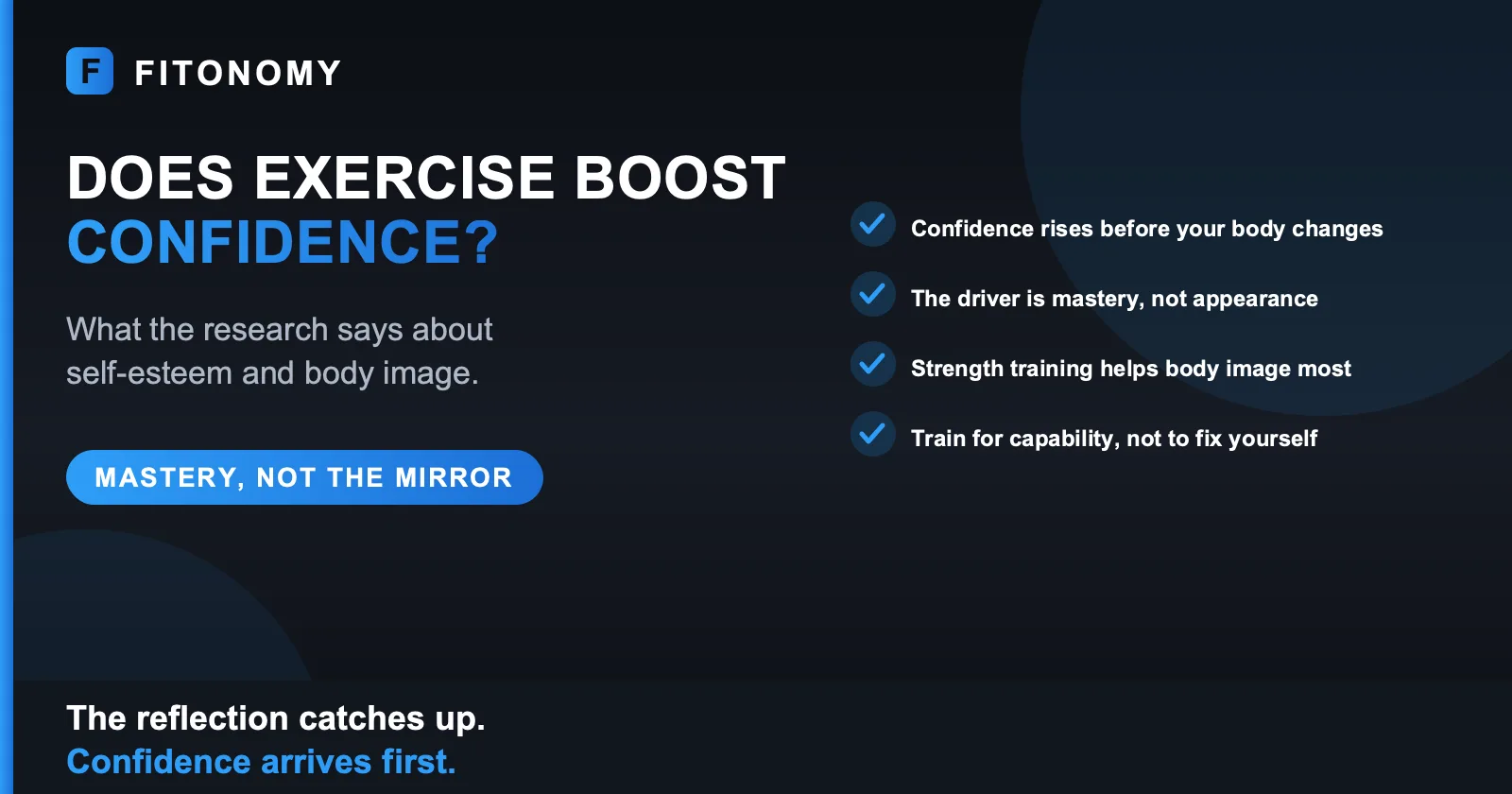
Plenty of people start training to change how they look, hoping a better body will finally make them feel good about themselves. Then something interesting happens. They often feel more confident within weeks, long before their appearance has changed much at all. That is not a coincidence, and it points to how exercise actually builds confidence, which is not the way most people assume.
The research is clear that exercise improves confidence, self-esteem, and body image. But the main engine is not your reflection. It is the sense of mastery that comes from doing something difficult and getting better at it. Understanding that changes how you should train if confidence is what you are after. Here is what the science shows.
Does exercise actually improve self-esteem?
Yes, reliably if modestly. A 2005 meta-analysis by Spence and colleagues found that exercise produced a small but significant improvement in global self-esteem, with the strongest effects on how people felt about their physical selves. A Cochrane systematic review by Ekeland and colleagues found a moderate positive effect on self-esteem in young people (a standardized effect around 0.49). These are not huge numbers, but they are consistent, and self-esteem is a stubborn trait to move, so a reliable nudge upward from a free activity is meaningful.
Takeaway: Exercise reliably improves self-esteem, with a small-to-moderate effect across studies (around 0.49 in young people). Self-esteem is hard to shift, so a consistent upward push from something free and available is genuinely valuable.
The real driver: mastery, not the mirror
Here is the key insight. The confidence boost comes mostly from self-efficacy, the belief that you can do things, which grows every time you accomplish something hard. Researchers describe this in the Exercise and Self-Esteem Model: physical activity raises your self-efficacy, which improves specific self-perceptions like feeling fit, strong, and capable, which in turn lift your physical self-worth and finally your global self-esteem. In plain terms, finishing a workout you did not think you could, or lifting a weight that was impossible a month ago, is direct evidence to yourself that you are capable. That belief spills over into the rest of your life.
This is why the confidence often shows up before the physique does. You do not need to look different to feel the effect. You need to prove to yourself that you can set a hard goal and meet it, and exercise gives you that proof on a regular schedule. It is the same reason building the habit itself feels empowering (see how to stay consistent with exercise).
Takeaway: Confidence from exercise comes mainly from mastery and self-efficacy, the repeated experience of doing something hard and succeeding, not from appearance. That is why you feel more capable within weeks, before your body has visibly changed.
What about body image?
Exercise improves that too, and again, partly independent of actual physical change. A 2009 meta-analysis by Campbell and Hausenblas pooled 57 interventions and found that exercise significantly improved body image compared to not exercising. Notably, people often report feeling better about their bodies even when measurements barely move, because the relationship shifts from judging your body on looks to appreciating what it can do.
Resistance training seems especially good here. A 2017 systematic review found that in 8 of 11 studies, resistance training significantly improved body image, including body satisfaction and reduced anxiety about being seen exercising, and in midlife women it improved body image more than walking did. Getting stronger reframes your body as something functional and capable, which is a more durable source of body confidence than chasing an appearance ideal.
Takeaway: Exercise improves body image, and resistance training is particularly effective. Much of the benefit comes from valuing what your body can do rather than how it looks, which is why it works even before your appearance changes.
What exercise actually improves
- Self-efficacy. What it is: Belief you can do hard things. Evidence: Rises with training, the root of the effect.
- Physical self-worth. What it is: Feeling fit, strong, capable. Evidence: The mediator between activity and self-esteem.
- Body image. What it is: How you feel about your body. Evidence: Improved across 57 interventions (Campbell 2009).
- Global self-esteem. What it is: Overall sense of your own worth. Evidence: Small-to-moderate improvement (Spence, Ekeland).
Which type of exercise builds the most confidence?
The best kind is the one that gives you clear, trackable progress, because seeing yourself improve is the mechanism. Strength training is a standout for this reason: the numbers go up in a way you can measure, adding weight or reps is unmistakable proof of progress, and it reliably improves body image and self-efficacy (our strength training after 30 guide is a good entry point, and lifting will not make women bulky, it builds capability and confidence). But any exercise with visible progress works, from running a longer distance to mastering a new movement. The common thread is measurable improvement you can point to.
Takeaway: Choose exercise with clear, trackable progress, since seeing improvement is what builds confidence. Strength training is excellent because progress is so measurable, but any activity where you can watch yourself get better will do it.
The honest caveat
Two cautions keep this real. First, the effects are modest, not a personality transplant. Exercise is a reliable contributor to confidence, not a cure for deep self-esteem issues, which may need other support. Second, and importantly, if you exercise purely to fix your appearance and chase an ideal, it can backfire and worsen body image and your relationship with your body. The research consistently shows the healthiest path is training for what your body can do and how it makes you feel, not to punish it into a shape. Do it to get stronger and more capable, and the confidence follows. Do it out of self-criticism, and it often does not.
Takeaway: The effects are real but modest, and motivation matters. Training for capability and how you feel builds confidence, while training out of appearance-focused self-criticism can backfire. Aim at what your body can do, not at fixing it.
The Fitonomy angle: make your progress visible
The science points to one practical lever: confidence grows from seeing yourself improve, so the more visible your progress, the more it builds. That is a tracking and structure problem. Fitonomy keeps a record of your workouts and strength numbers so your progress is visible instead of invisible, sets you structured plans with achievable steps so you regularly hit goals and bank the wins, and runs a streak so consistency itself becomes a source of pride. When you can look back and see the weights climbing and the sessions stacking up, you have concrete proof of your own capability, which is exactly what the research ties to confidence. You can track your progress and follow a plan in the Fitonomy app and let visible improvement do the work (logging it is half the point, see how to track your workouts).
Takeaway: Confidence is built by seeing yourself improve, so making progress visible is the whole game. Fitonomy's progress tracking, achievable structured plans, and streaks turn your improvement into concrete proof of capability, which is what the science links to confidence.
The bottom line
Exercise does boost confidence and self-esteem, reliably if modestly, and mostly through the sense of mastery rather than how you look. Every workout you finish and every weight you add is evidence to yourself that you can set a hard goal and meet it, and that belief carries into the rest of your life. Body image improves too, often before your body changes much, especially with strength training. So if confidence is your goal, train for capability, pick activities where you can see yourself improve, track that progress, and do it because of what your body can do. The reflection will catch up, but the confidence arrives first.
Frequently asked questions
Does exercise really boost confidence? Yes. Research shows exercise reliably improves self-esteem and self-efficacy, the belief that you can do hard things. The main driver is mastery: finishing a tough workout or lifting more than before is direct proof to yourself that you are capable, and that belief spills into the rest of your life. It often shows up within weeks, before your body visibly changes.
Does exercise improve self-esteem or just body image? Both, and self-esteem improves partly independent of appearance. A meta-analysis found a small but significant boost to global self-esteem, and a Cochrane review found a moderate effect in young people. Body image also improves, across 57 interventions in one meta-analysis, often because you start valuing what your body can do rather than just how it looks.
Why does exercise make you feel better about yourself even before you lose weight? Because the confidence comes from self-efficacy, not appearance. Accomplishing something difficult raises your belief in your own capability, which lifts how you feel about yourself. You do not need to look different to feel more capable, you just need proof that you can set a hard goal and meet it, which every workout provides.
What is the best exercise for building confidence? The one with clear, trackable progress, because seeing yourself improve is the mechanism. Strength training is excellent since progress is so measurable, adding weight or reps is unmistakable, and it strongly improves body image and self-efficacy. But any activity where you can watch yourself get better, like running farther or learning a new movement, builds confidence.
Can exercise ever hurt your body image? It can, if your motivation is appearance-focused self-criticism. Research shows training purely to fix or punish your body into an ideal can worsen body image, while training for capability and how it makes you feel improves it. The healthiest and most confidence-building approach is to focus on what your body can do, not on correcting how it looks.