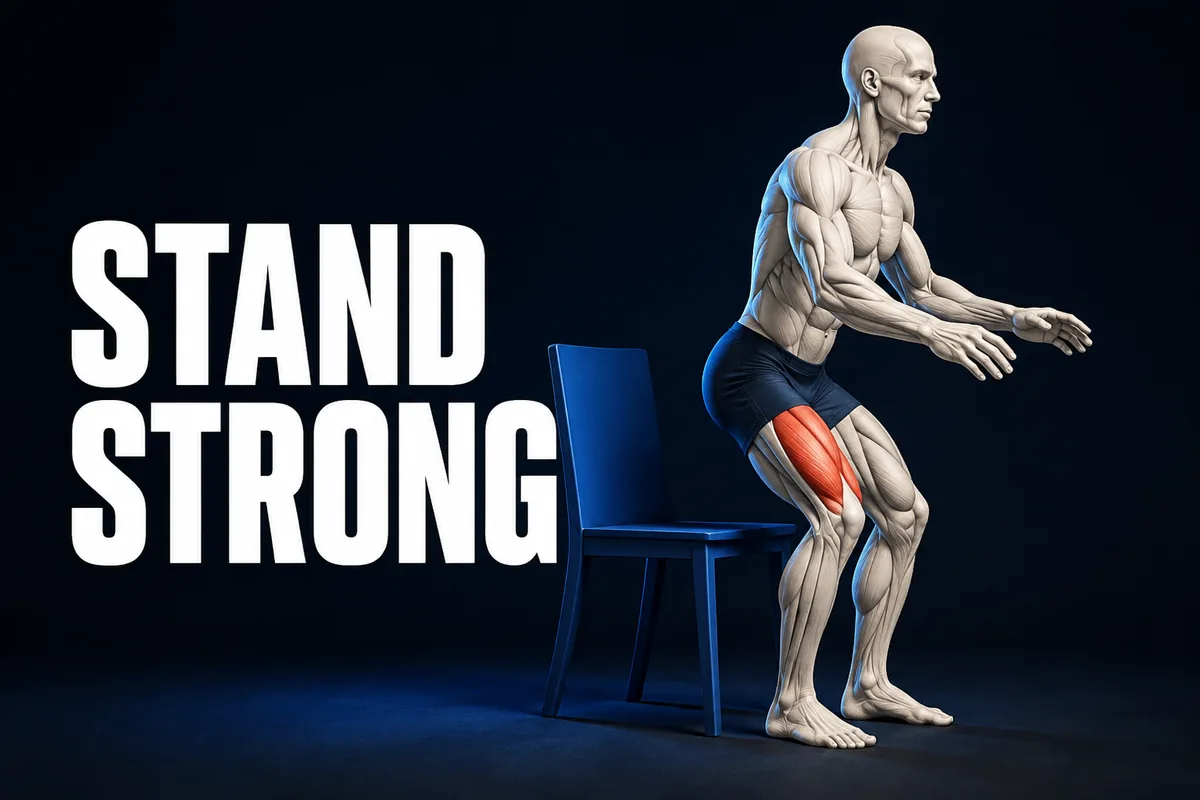
The sit to stand exercise turns getting out of a chair into deliberate strength practice. It gives you a clear start and finish without needing weights. The useful goal is a repeatable, controlled movement, not the fastest possible chair test.
Our quiet apartment circuit combines chair rises with other controlled movements and explains how to keep changes of position gentle.
Start with a stable chair
Choose a firm chair without wheels that cannot slide or tip on your floor. Clear the space around it. You should be able to sit with both feet flat and your knees comfortably bent. A low sofa is a different setup.
The NHS strength guide uses a stable chair and a gradual approach. If standing independently is unsafe, or you need someone to lift you, get individual guidance rather than testing yourself alone.
How to stand and sit with control
- Move toward the front of the seat while keeping a secure seated position. Place your feet about hip width apart and lean your trunk slightly forward.
- Push through your feet and straighten your legs to stand. Look ahead, keep breathing and let the movement stay smooth instead of throwing your body forward.
- To return, bend at the hips and knees and lower yourself steadily onto the chair. Finish sitting with control rather than dropping onto the seat.
The South Tees Hospitals instructions also describe a forward weight shift and a controlled return. Practise the basic movement on both legs. You do not need to copy the separate one leg variations.
How many repetitions should you try?
The NHS gives five repetitions as an example. Start with fewer if that is what you can control comfortably, and rest before another attempt. Stop if you become dizzy, feel pain or lose your balance.
Using your hands for assistance is information about your starting point, not a failed repetition. Keep any support stable. If you cannot find a comfortable, secure setup, ask a qualified professional to help you choose one.
Progress from the same starting point
Record the chair used, whether your hands helped and the number of smooth repetitions. Five repetitions from a high chair are not directly comparable with five from a much lower seat.
When the same setup feels manageable across several sessions, consider one small change, such as an extra repetition. Avoid lowering the seat, removing hand support and adding weight all at once.
This is one exercise, not a complete strength routine. Our wall push up guide offers a separate pressing movement, and our training progression guide explains how to adjust challenge gradually. If an injury, recent operation or health condition affects your movement, get individual advice before progressing.