Confirm the exact task
Use this explanation only if your clinician has personally demonstrated and cleared this exact effort. The Leeds Community elbow guide places it within clinical care for osteoarthritis. That context does not diagnose your symptoms or authorize starting after an injury or operation. Ask first if your permission is unclear.
Recognize the held position
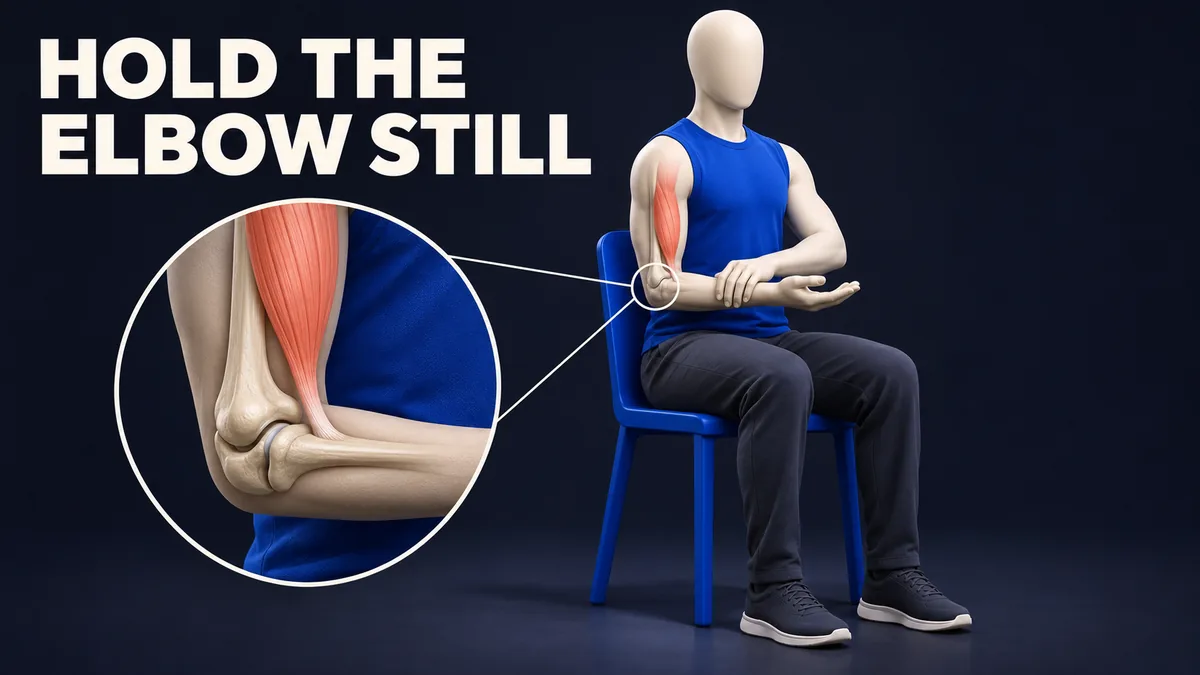
The source describes sitting with the elbow bent and the palm facing upward. The opposite hand contacts the wrist to resist a bending effort. Confirm your own taught support and precise contact. Keep the wrist comfortable; do not pull fingers or choose pressure on a painful spot from the illustration.
Distinguish resistance from assistance
An isometric elbow effort attempts a bend while the elbow angle stays still. The other hand opposes rather than lifts the forearm. An assisted elbow bend instead helps the joint move. These tasks are not interchangeable permissions. Pause and ask for another demonstration if you cannot distinguish the action.
Follow your own effort and amount
Your clinician chooses effort, hold, repetitions, frequency and release. This article does not turn the source’s maximum effort wording or clinical levels into a general prescription. The CUH guide advises seeking help for painful exercise. Stop for pain, tingling, numbness, swelling or lost control and seek individual advice before continuing.
Record control without diagnosing
Note the side, taught contact, personal instructions and whether the elbow stayed still. An active elbow bend actually changes its angle. Do not add weights, stretch farther or borrow another task’s dose. A stationary effort does not prove a range gain or recovery. Fitonomy Mobility does not provide clinical clearance.