Confirm your own instructions
This reminder is for adults already taught and individually cleared for this exact task. The CUH leaflet describes isometric work as muscle effort without wrist movement. It is clinical guidance for wrist injury or weakness, not a routine to choose by diagnosing your own symptoms. Confirm suitability first after injury, surgery or a new change.
Support and choose the taught contact
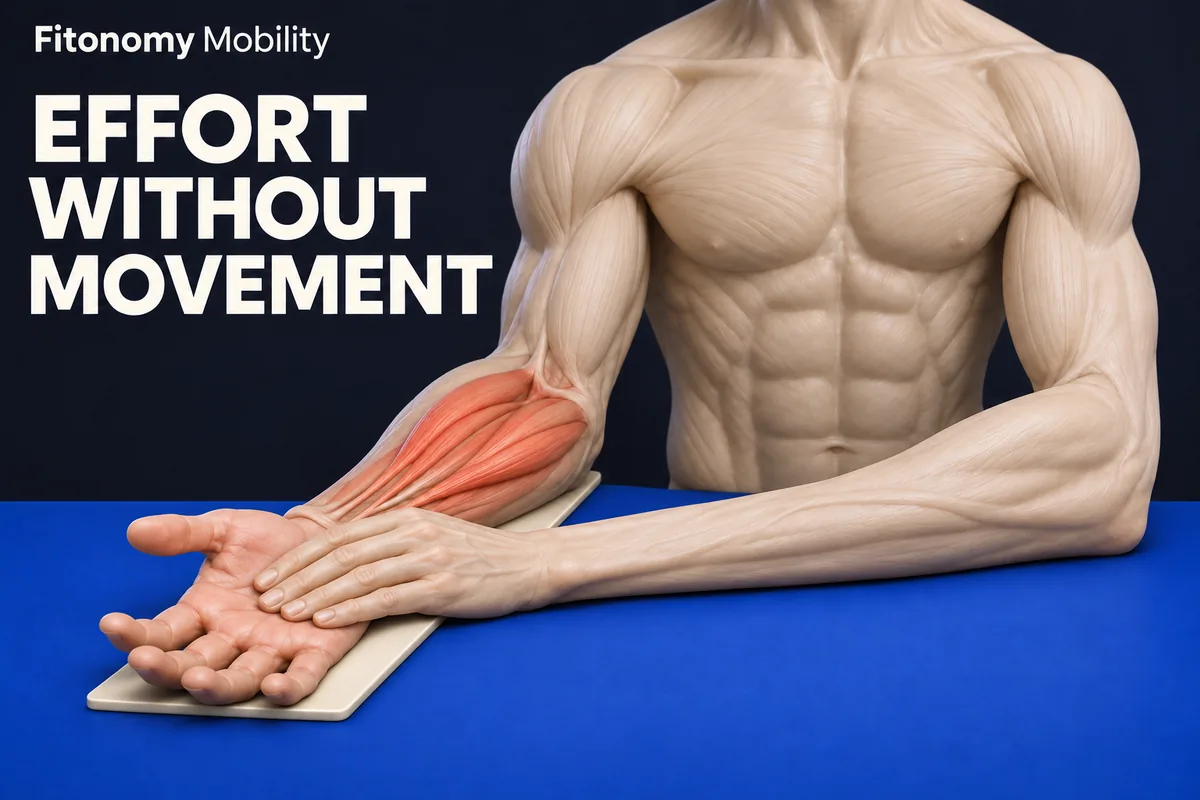
Rest the forearm on a table with the palm up. Use the wrist and finger position your clinician demonstrated. CUH distinguishes thumb side contact for the flexor carpi radialis and little finger side contact for the flexor carpi ulnaris. Ask which contact applies to you. Do not select a tendon or press directly on a sore spot from this illustration.
Make an effort without a bend
Use the other hand at the specified contact to oppose an attempt to bend the wrist toward the palm. The wrist stays still. Keep the forearm supported without turning it or leaning your body into the hand. Use only the effort, hold, repetitions and frequency you were given. The leaflet leaves dosage spaces for individual instructions; this guide does not fill them.
Release and check
Ease the pressure before resetting. Stop if pain, tingling, numbness or swelling occurs and seek individual advice rather than pushing through. If the wrist moves or you cannot reproduce the taught contact, pause and ask for a demonstration. A stronger push is not the aim of this explanation.
Record the task you actually did
Note the taught contact, support, prescribed dose and whether the wrist stayed still. These are control notes, not proof of a larger movement range or recovery. The progress journal helps keep observations clear. Isometric wrist extension uses a different attempted direction, while the assisted flexion stretch actually moves the wrist. Follow the task you were prescribed rather than substituting one for another.