Start with your own instructions
Use this reminder only if your clinician has personally taught and cleared this exact position for you. An injury, operation or movement restriction can change what is appropriate. The AAOS knee guidance advises discussing exercise selection and uncertainty with your clinician. This article does not authorize a new stretch or choose a recovery stage.
Identify what is supported
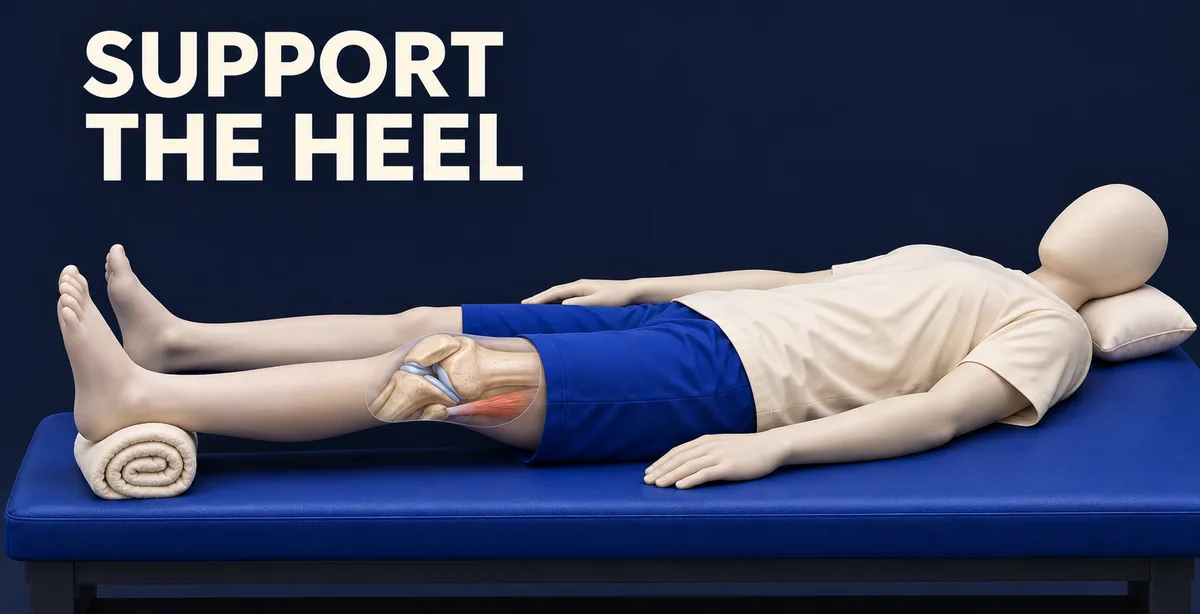
The Royal Devon patient leaflet shows a passive knee stretch with the leg in front and the heel on a block or rolled blanket, leaving no support beneath the knee. Its setting is knee replacement care. Confirm the surface and support your own clinician taught, including a safe way to get into and out of that position.
Keep the task passive
In this taught task the heel stays on its support while the knee is allowed to become comfortably straighter. Do not turn it into an active kick or press the knee down. Do not add a weight, strap or extra height to chase a straighter picture. A support behind the knee changes the setup; ask if the contact is unclear.
Keep time and release individual
Ask your clinician how long, how often and how to release or change position comfortably. Do not borrow the leaflet’s time progression as your own dose. Stop a painful attempt and seek personal advice rather than repeatedly testing it. The cover is an illustration, not an angle target or a guide to force.
Record the task accurately
Note the side, taught support and comfort, without treating a visual change as proof of recovery. The active seated knee extension lifts the lower leg, while a heel slide moves a supported heel to bend and return. Those are separate tasks and permissions. Fitonomy Mobility does not supply clinical clearance, and article languages do not establish app language support.