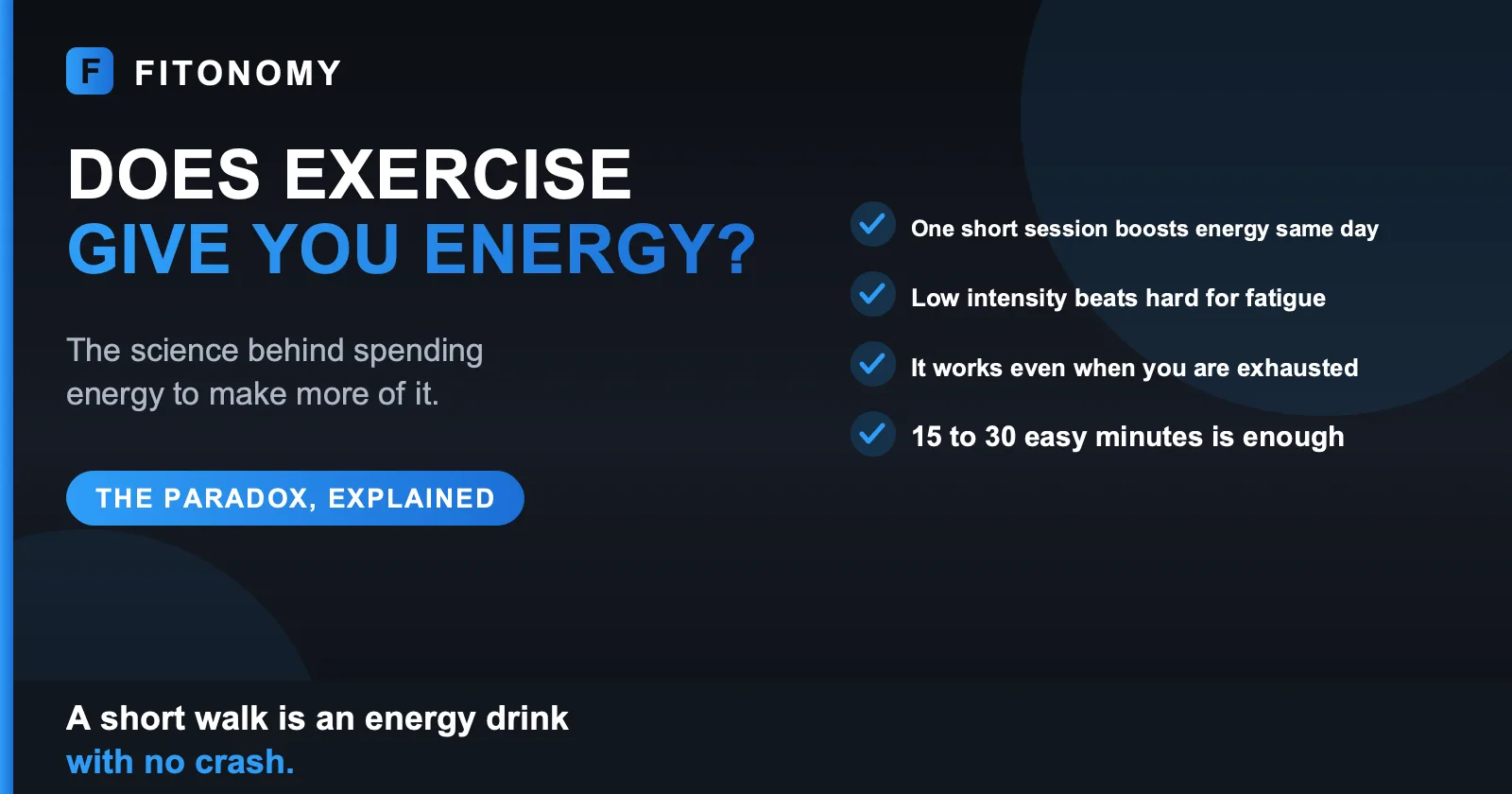
It is one of the great paradoxes of health advice. You are tired, so the last thing you want to do is exercise, because surely that will make you more tired. And yet the most consistent recommendation for low energy is to move. Spend energy to make energy. It sounds like nonsense, or like something only fit people who already have energy get to enjoy.
Except the research is remarkably clear, and it says the paradox is real. A short, easy bout of exercise reliably boosts your energy, often the same day, and it works even for people who are exhausted, sedentary, or unwell. Better still, you do not need to push hard. Gentle movement works best for fighting fatigue. Here is the science behind why spending energy creates it, and exactly how much you need.
Does exercise actually give you energy?
Yes, and this is one of the better-supported findings in exercise psychology. A 2013 meta-analysis by Loy and colleagues looked at 16 experiments on single bouts of exercise and found that one workout increased feelings of energy in 91 percent of the measured effects, with a moderate standardized effect of 0.47. Not after weeks of training. From a single session.
The pattern holds over time too. A large 2022 meta-analysis pooled 81 randomized trials covering more than 7,000 people and found that regular exercise increased feelings of energy (effect size 0.42) and vitality (0.54), while reducing fatigue (0.37). So both the immediate hit and the long-term baseline go up. Movement makes you feel more energized now and more energized in general.
Takeaway: Exercise reliably boosts energy, and not just long term. A single short session raised energy in 91 percent of measured effects in the research. You feel it the same day, and your baseline energy rises over weeks.
How can spending energy create energy?
Because the tiredness that keeps you on the couch is often not a fuel problem, it is a brain and circulation problem. Exercise increases blood flow and oxygen delivery, and it triggers the release of brain chemicals like dopamine and norepinephrine that regulate alertness and drive. Over time it also builds more mitochondria, the tiny power plants in your cells, so you literally produce energy more efficiently.
The most telling clue comes from a 2008 randomized trial by O'Connor and colleagues at the University of Georgia. Sedentary adults who felt persistently tired did six weeks of exercise and increased their energy by about 20 percent while cutting their fatigue by an impressive 65 percent. The revealing part: those benefits were not linked to how much fitter they got. In other words, exercise was acting on the nervous system and mood directly, not just by improving cardiovascular fitness. The energy boost is not a reward you have to earn by becoming fit first. It shows up almost immediately.
Takeaway: Fatigue is often a brain and circulation state, not an empty fuel tank. Exercise raises blood flow, dopamine, and alertness right away, which is why the energy boost appears before any fitness gains do.
How much do you actually need? (Less than you think)
Here is the best news: harder is not better for energy, and for fatigue it is often worse. In that University of Georgia study, low-intensity exercise beat moderate-intensity for reducing fatigue. And the acute research found that light-to-moderate sessions of just 15 to 40 minutes were enough to lift energy. A brisk walk qualifies. You do not need to crush yourself, and crushing yourself can actually leave you more drained.
This flips the usual excuse on its head. You do not need an hour or a high-intensity class to feel more awake, you need a short, easy dose of movement. A 15-minute walk, an easy home workout, some light cycling. The bar is low on purpose, and staying low is what makes it repeatable (see walking as an underrated option and how to make it a routine in staying consistent with exercise).
Takeaway: Low intensity wins for energy, and short counts. Roughly 15 to 40 minutes of light-to-moderate movement, even a brisk walk, is enough. Going all-out is unnecessary and can leave you more tired, not less.
Does it still work if you are already exhausted?
This is the crucial question, because that is exactly when you need it and least want it. The answer is yes, and the evidence comes from some demanding places. The University of Georgia trial was done specifically on people who complained of constant fatigue, and it still worked. Even more strikingly, a large 2012 Cochrane review of 56 studies and over 4,000 people found that aerobic exercise significantly reduced fatigue in cancer patients, both during and after treatment. If gentle movement can cut fatigue in people going through chemotherapy, the ordinary tiredness of a desk job and poor sleep is very much within reach.
Pair it with the basics and it compounds: exercise improves sleep quality, and better sleep means more energy, a virtuous loop we cover in our sleep guide. It also lifts mood, which is tangled up with energy (see exercise for anxiety and depression).
Takeaway: Yes, it works when you are wiped out, that is the whole point. It reduced fatigue even in sedentary chronically tired people and in cancer patients. The days you least feel like moving are the days a short walk pays off most.
Exercise and energy: what the research shows
- A single short session (15 to 40 min). Effect on energy: Reliable same-day boost. Effect on fatigue: Reduced after ~20+ min easy movement.
- Regular low-intensity exercise. Effect on energy: Raises baseline energy. Effect on fatigue: Best option for cutting fatigue.
- Regular moderate-intensity. Effect on energy: Raises energy and vitality. Effect on fatigue: Helps, but low intensity often better.
- Too much or too intense. Effect on energy: Can backfire. Effect on fatigue: Can increase fatigue, risk of overtraining.
The catch: honesty about the limits
Two caveats keep this accurate. First, some of the measured benefit likely includes an expectancy effect. A 2006 meta-analysis by Puetz and colleagues found a solid overall boost to energy and reduced fatigue (effect around 0.37), but noted the effect shrank in the most tightly placebo-controlled studies, so belief plays some role. That does not make it useless, it makes it partly a mind-body effect, which still counts when you feel better. Second, more is not better. Overdoing intensity or volume, especially without recovery, causes fatigue rather than curing it, which is why rest days matter. The sweet spot is gentle and regular, not hard and heroic.
Takeaway: The effect is real but not magic, and part of it is mind-body expectancy. And you can overdo it: too much intensity without recovery drains energy instead of building it. Keep it gentle, keep it regular.
How to use exercise as an energy tool
Treat a short walk or easy session as your first response to the afternoon slump, ahead of another coffee or the couch. Keep the intensity genuinely light on tired days, the goal is to feel better, not to train hard. Aim for 15 to 30 minutes, get outside if you can for the extra lift, and do it earlier rather than right before bed so it does not disturb sleep. Above all, act before the tiredness talks you out of it. The hardest part is the first two minutes, and the energy arrives once you are moving. Lower the barrier as much as possible so the tired version of you will still say yes.
Takeaway: When energy dips, move first and briefly. Keep it light, aim for 15 to 30 minutes, go earlier in the day, and start before you overthink it. The boost comes once you begin, not before.
The Fitonomy angle: make the easy session easy
The research delivers a genuinely encouraging message: the energy-boosting dose is small and gentle, so the only real obstacle is starting when you feel too tired to bother. That means the whole job is removing friction. Fitonomy gives you short guided workouts you can do at home with no equipment and no gym trip to talk yourself out of, so a quick, low-intensity session is always a couple of taps away on a low-energy day. That is exactly the dose the studies reward: brief, easy, repeatable. You can open a short session in the Fitonomy app and let a few minutes of movement do what another coffee cannot.
Takeaway: The energy dose is small, so success is all about lowering the barrier to starting. Fitonomy's short no-equipment home workouts make the easy, energizing session simple to start when you are tired, which is when it helps most.
The bottom line
The paradox is true: spending a little energy on movement reliably gives you more back. A single short, easy session lifts energy the same day, regular gentle exercise raises your baseline vitality, and it works even when you are exhausted or unwell. You do not need intensity, you need to start, and low and brief is the winning dose. So the next time tiredness pins you to the couch, try the counterintuitive move. A 15-minute walk is one of the most reliable energy drinks there is, and the only one with no crash.
Frequently asked questions
Does exercise actually give you energy? Yes. A meta-analysis of 16 experiments found a single bout of exercise increased feelings of energy in 91 percent of measured effects (standardized effect 0.47), and a 2022 review of 81 trials found regular exercise raised energy and vitality while lowering fatigue. The boost is reliable and often shows up the same day.
Why does exercise give you energy instead of tiring you out? Because fatigue is often a brain and circulation state, not an empty fuel tank. Exercise increases blood flow and oxygen and releases dopamine and norepinephrine, which raise alertness. In one trial the energy boost was not even linked to fitness gains, showing exercise acts on the nervous system and mood directly and quickly.
How much exercise do you need to feel more energized? Not much, and gentle is better. Research found light-to-moderate sessions of just 15 to 40 minutes lifted energy, and low-intensity exercise beat moderate-intensity for reducing fatigue. A brisk 15 to 30 minute walk is enough. Going all-out is unnecessary and can leave you more tired.
Does exercise help if you are already exhausted? Yes, that is when it helps most. A University of Georgia trial on chronically tired sedentary adults raised energy 20 percent and cut fatigue 65 percent, and a Cochrane review found aerobic exercise reduced fatigue even in cancer patients during treatment. Ordinary tiredness responds well to a short, easy session.
What is the best exercise for boosting energy? Light, aerobic, and short. A brisk walk, easy cycling, or a gentle home workout of 15 to 30 minutes works well, ideally earlier in the day and outdoors if possible. Keep the intensity low on tired days, since the goal is to feel better, not to train hard, and avoid overdoing it, which can worsen fatigue.