Use an individually taught movement
This is a reminder for adults who have already been taught and cleared to do assisted shoulder abduction. It is not a starting plan after surgery or injury. Cambridge University Hospitals shows this movement within clinical shoulder guidance, while East Lancashire Hospitals says its exercise videos should be used when instructed by a trained professional. Ask your clinician if you do not know whether this version suits you.
Set up the support you were shown
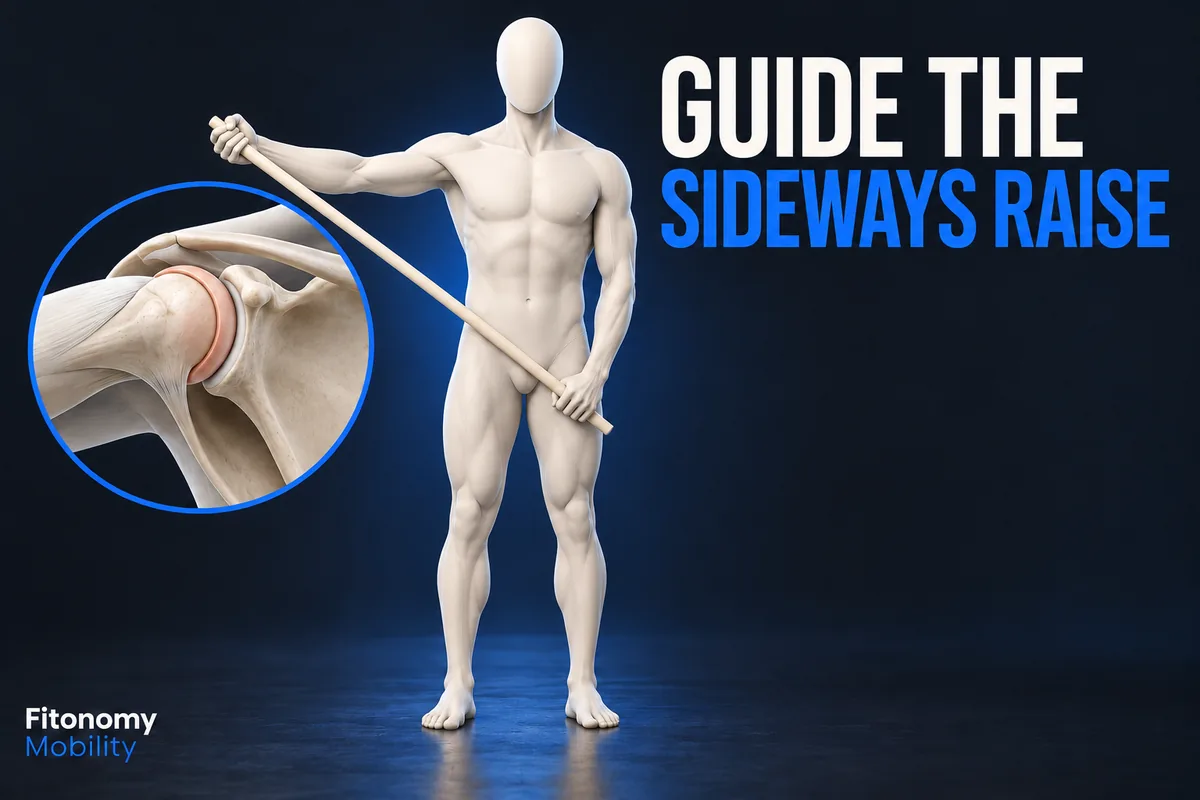
Use a light, straight stick with secure hand contact. In the standing version, the target arm holds one end and the other hand guides the stick from the opposite side. Follow your taught grip, elbow position and support arrangement. Keep your trunk upright and shoulders quiet, without leaning to create extra height. If standing or holding the stick is not secure, ask for an appropriate supported alternative rather than improvising.
Guide the arm out to the side
Let the other hand assist as the target upper arm travels sideways away from the trunk. Move slowly within the range your clinician gave you and keep breathing normally. Do not force an endpoint or use the picture as a height target. This differs from the forward raise with a stick, where the arm travels in front, and from external rotation with a stick, where the forearm turns outward with the elbow near the side.
Return with control and stop when needed
Use the assisting hand to guide the return rather than letting the target arm drop. Stop for pain, pinching, tingling, numbness, dizziness, instability or loss of control, and seek advice before continuing. Follow your personal instructions for repetitions, holds and frequency; there is no universal dose here. Do not add weights or ask another person to push you farther.
Record the version you actually practised
Note the side, the taught setup and whether the movement remained controlled and comfortable. A sideways arm slide while lying down uses a supporting surface and is a different task, not an automatic replacement. Place this reminder within your beginner mobility guide, and bring uncertainty about grip, range or symptoms to your clinician rather than using a log to prescribe progression.