Confirm your own instructions
This explanation is for adults already taught and cleared for this exact movement. The Oxford NHS leaflet describes it within care after neck dissection surgery and says a physiotherapist chooses the exercises and when to start. It is not general permission after surgery or for a painful shoulder. Keep your personal range, support, amount and restrictions; ask for another demonstration if these are unclear.
Recognize the supported start
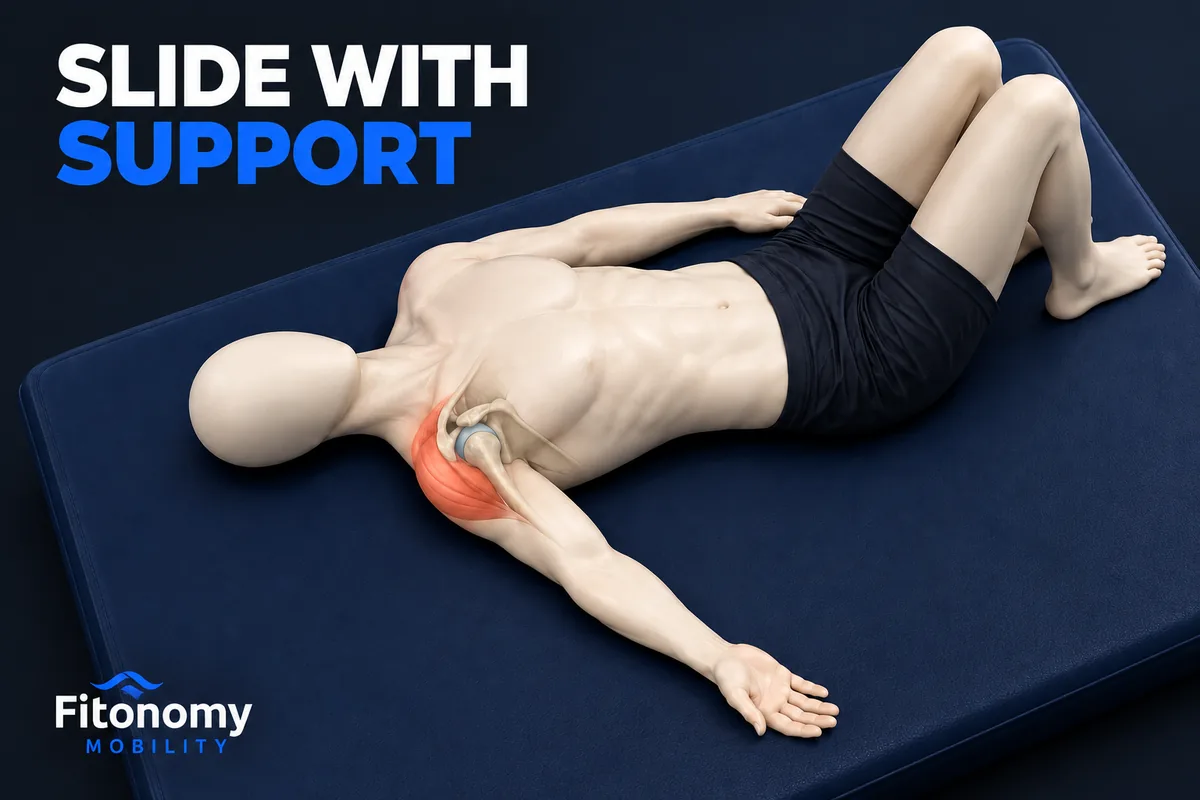
The source starts lying on the back with the arm beside the body and the palm facing the ceiling. Use the stable surface and head support taught to you, with room for the whole arm away from an edge. Keep the arm resting comfortably rather than forcing the elbow straight. If getting into the position or supporting the arm is difficult, stop and ask for an appropriate alternative.
Understand the sideways path
In this task the arm moves out to the side along the bed. The source describes continuing toward above the head, but that is not an endpoint everyone should reach. Follow only your permitted path and range, breathing normally. Keep the arm supported without pressing it down or twisting the trunk to gain distance. Follow your taught return slowly. Do not pull with the other hand or make the entire surface slippery.
Keep other tasks separate
A supine shoulder blade reach starts with the arm upright and moves the blade a little. A forward stick raise adds guidance from the other hand, while a wall slide uses upright support. These have different directions and assistance. Permission for one does not clear another. Do not add a weight, band or copied repetition schedule to this slide.
Record limits and comfort
Note the arm, surface, permitted path and any personal amount. A wider slide is not a mobility score or proof of recovery. Stop for pain, pinching, numbness, tingling, dizziness, instability or lost control and seek personal advice. Do not repeat to test symptoms. The beginner mobility guide offers context. Fitonomy Mobility is a fitness product, not clinical clearance; article translations do not establish its app languages.