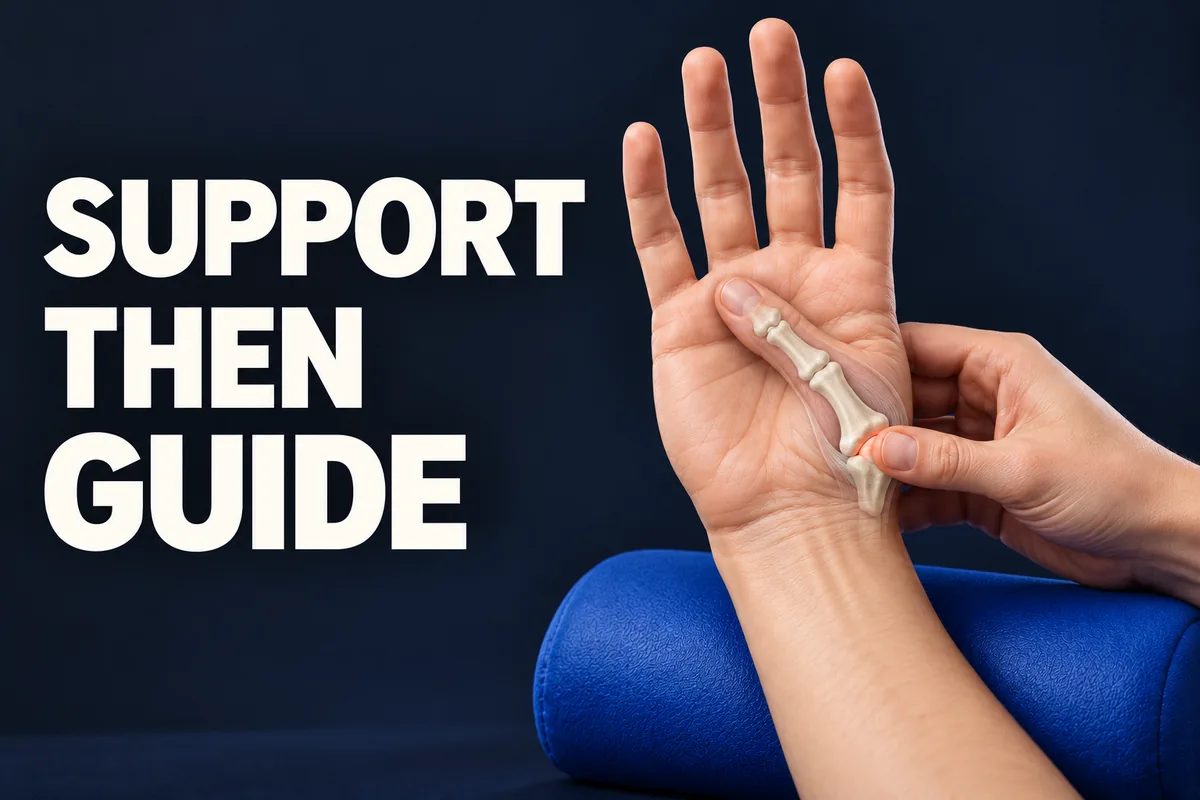
Start with personal instruction
Use this reference only if your clinician or hand therapist has personally taught and cleared this exact task. The RNOH hand leaflet says to perform only advised exercises and respect immobilization. A splint, recent operation or injury may change permission. Finding the movement online does not authorize a new stretch.
Name the across palm path
RNOH describes moving the thumb across the palm toward the base of the little finger, with the thumb joint supported. This differs from opening the thumb away to make cup space. Reaching the little finger base is not a target you must force. Have your therapist confirm the direction and stopping point for your hand.
Use the support you were shown
Support the forearm and hand as instructed. Let the other hand assist around the taught thumb joint contact, without pulling the tip or twisting the wrist. Move slowly through your permitted path, then ease the assistance away and return gently. If the contact or direction is unclear, ask for another demonstration. Your own range, hold and repetitions take priority over a picture or leaflet schedule.
Separate active thumb tasks
The active opposition guide touches fingertips using the thumb itself. Assisted opening moves in another direction, while the supported middle joint bend isolates a different task. The Bexley guide lists active and passive movements separately. Do not add hand pressure to active tasks or combine clinical schedules.
Record context and respect symptoms
Note the side, support and instructions without guessing a normal angle or treating contact distance as progress. Stop for pain, tingling, numbness, new swelling or lost control and seek individual advice. Use the beginner guide for broader context, not clinical clearance. No pain relief or lasting range gain is promised. Article translations do not establish Fitonomy Mobility app languages.