Require individual instruction
Only use assisted thumb opening when your clinician or hand therapist has taught it as suitable for you. The Cambridge passive thumb leaflet is a hand therapy resource. Injury, surgery, splints or movement restrictions can change permission. This page does not authorize a new stretch or treat stiffness.
Understand the opening direction
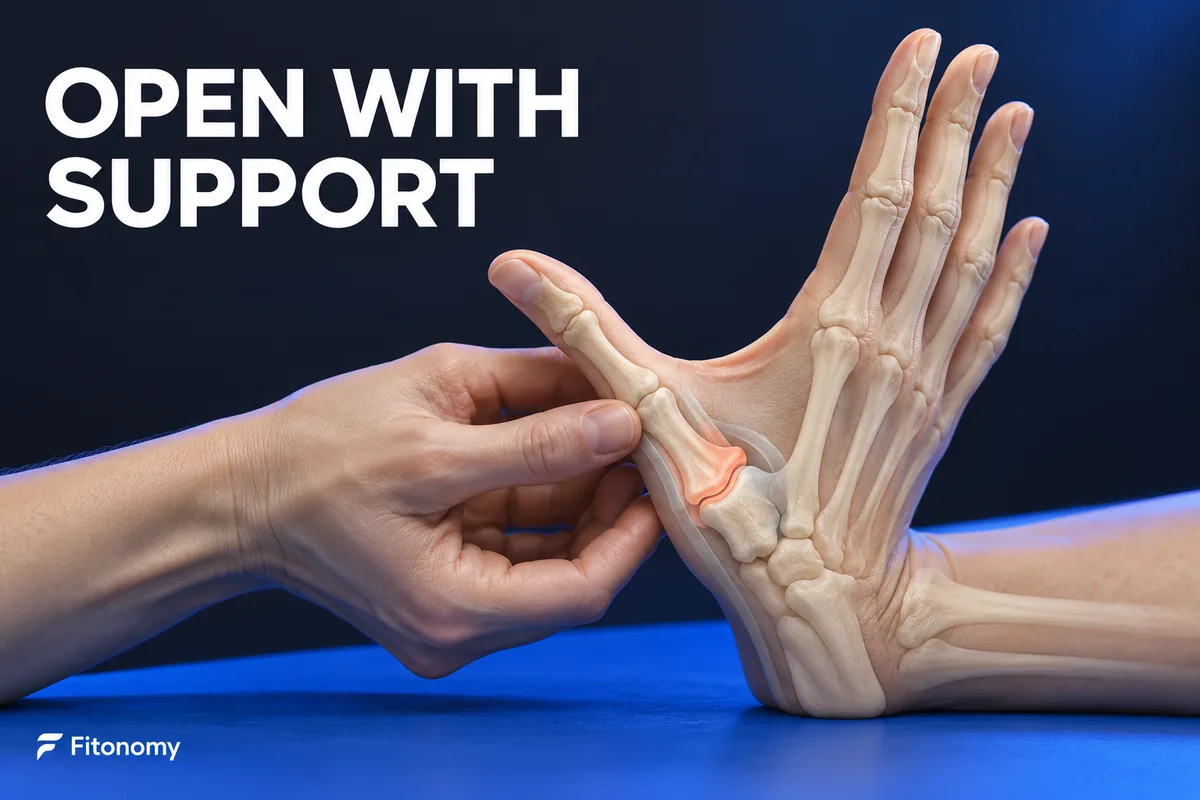
Cambridge describes opening the thumb out in front as though making space for a cup, using the other hand. With the main hand supported on its little finger edge, the thumb opens out of the palm plane. This differs from thumb opposition, which meets fingertips, and from moving the wrist.
Clarify the contact you were taught
Ask your clinician to show where the other hand supports the thumb, the permitted direction and comfortable stopping point. Support the forearm and keep the wrist quiet as demonstrated. Do not pull the thumb tip, chase the leaflet’s L shape or force the largest gap. The Dorset leaflet shows different setups. Do not combine positions or borrow another hold; your clinician decides range, hold, repetitions and frequency. Release gently as taught.
Keep active tasks separate
In active thumb opening, the thumb moves itself without opposite hand pressure. Isolated thumb tip bending targets another joint. Permission for one task does not authorize another. Do not add assisted force to those movements.
Record context and respect symptoms
Note the side, taught support and comfort, without diagnosing an angle or claiming progress. Stop for pain, numbness, tingling, new swelling or loss of control and seek individual advice. Read the beginner guide for context or explore Fitonomy Mobility. Translated articles do not mean the app supports every article language or assesses this clinical stretch.
Opening makes space away from the palm. If separately taught and cleared, identify the assisted path across the palm without reusing this opening direction or its prescribed schedule.