Confirm your personal instructions
Use this explanation only if your clinician or hand therapist has personally taught and cleared the task. The Cambridge leaflet concerns injured thumbs. Surgery, tendon repair, a splint or movement restrictions can change permission. This article does not authorize an exercise, diagnose stiffness or prescribe treatment. Ask for a demonstration if the support or direction is unclear.
Recognize the edge setup
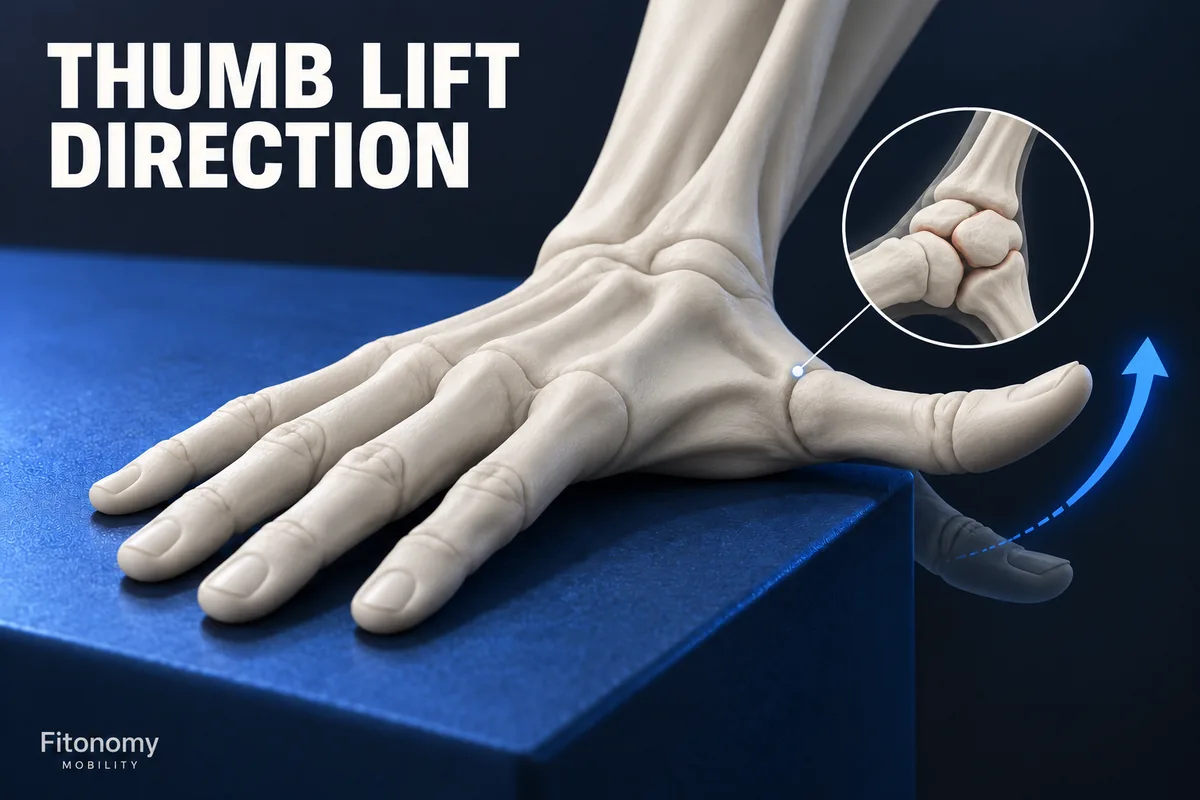
Cambridge describes the hand on a flat surface, with the thumb lowered toward the floor. Its illustration shows palm down support beside an edge so the thumb has space below the surface. Keep the wrist comfortably aligned as personally demonstrated. Do not push a stiff hand flat or lean body weight through it. Use only your taught support.
Understand the active upward path
The thumb moves itself from that lowered position to slightly above the surface level. This is called retropulsion in the leaflet. Do not lift the whole palm, pull with the other hand or add resistance. Your therapist determines the permitted range, return, hold and repetitions. The source's hold is not a universal target, and a higher thumb is not proof of progress.
Separate nearby thumb tasks
The flat thumb slide travels along the palm plane. Palmar opening uses side support, and opposition meets fingertips. The Kent guidance distinguishes those directions and requires professional advice. Permission for one task does not grant permission for another. Keep this lift separate from thumb tip bending or a pinch.
Record context and respect symptoms
Note the side, personally taught support and comfort without scoring an angle or claiming a treatment result. Stop for pain, numbness, tingling, new swelling or lost control and seek individual advice. Use the beginner guide for context or explore Fitonomy Mobility. Article translations do not mean the app supports every article language or assesses this clinical movement.