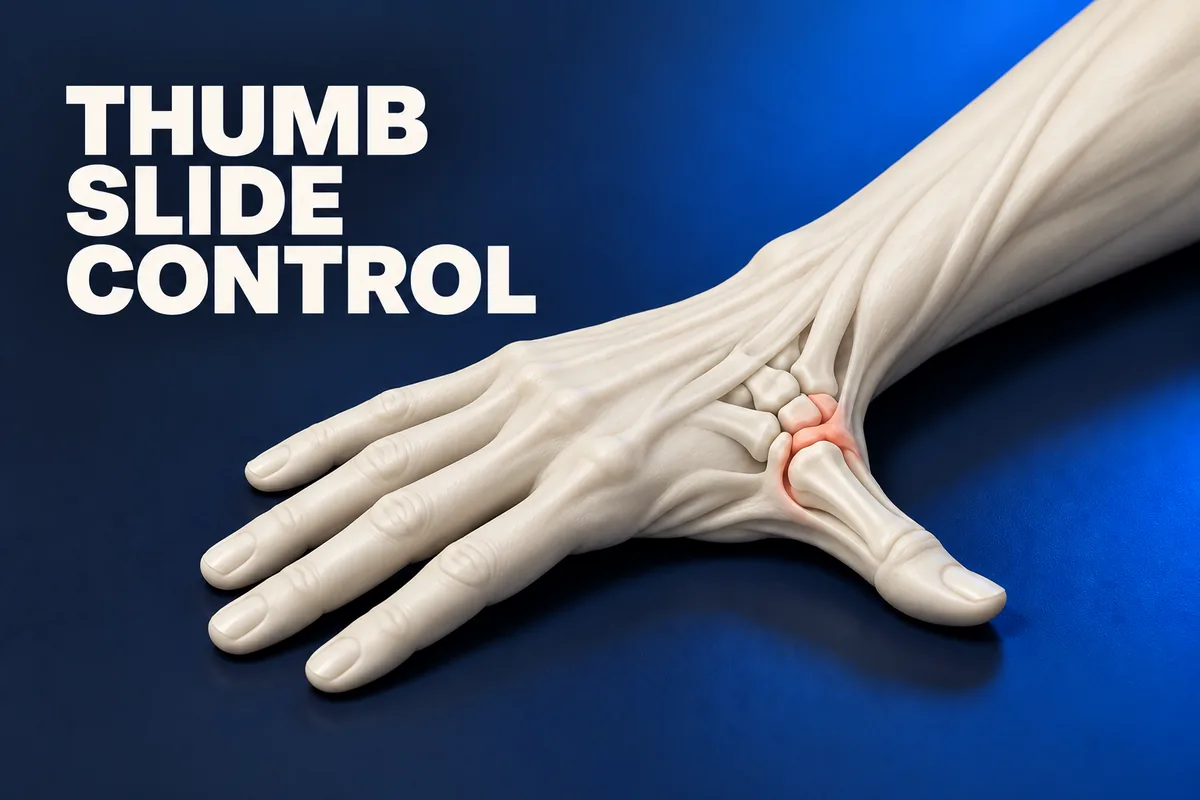
Check individual suitability first
The Kent Community Health leaflet says its instructions require advice from a healthcare professional. Obtain that advice before using this movement as an exercise. This article explains the setup, not a rehabilitation prescription or medical clearance. Follow personal restrictions after injury, surgery or a splint.
Support without pressing
Sit beside a stable table and support the forearm. Rest the hand palm down with relaxed fingers and a comfortably aligned wrist. Do not lean body weight through it or force a stiff palm flat. If this supported position is not comfortable, stop and ask for an appropriate alternative.
Slide within the palm plane
Move the thumb gently away from the index finger along the table, using the thumb’s own movement. The Cambridge guide distinguishes this direction as parallel to the palm plane. Keep a small comfortable path, with no required gap or angle. Do not pull with the other hand, add resistance or lift the thumb off the surface.
Return and watch the wrist
Bring the thumb toward its starting position slowly without pinching the index finger. Pause with the hand relaxed. If the wrist bends, forearm rolls or whole hand slides, reduce the path and reset. Stop for pain, locking, new swelling, numbness or loss of control. Persistent symptoms need individual advice. Clinical repetition schedules are not a universal target here.
Keep the directions distinct
Palmar opening uses side support and moves out of the palm plane. Opposition meets fingertips. This slide stays along the supported palm plane. Note side, support and whether the wrist stayed quiet; a wider gap is not proof of lasting improvement. Use the beginner mobility guide for choosing a permitted task or explore Fitonomy Mobility. Article translations do not imply every app interface language.